
Trailer Sway
Oscillating trailer yaw relative to the tow vehicle around their articulated coupling.
- Amplitude can grow over repeated cycles
- Tire force and hitch geometry affect damping
- Speed changes the available recovery time
Trailer sway is a side-to-side yaw motion around the hitch. A small disturbance from wind, a truck pass, road crown, steering, or a tire can become an oscillation when trailer mass distribution and speed provide too little self-correcting stability.
Sway control matters because the first correction is prevention: suitable tongue load, forward-low cargo, matched tires, correct hitch height, restrained load, and conservative speed. Friction bars, cam systems, integrated hitches, and electronic trailer or tow-vehicle controls can damp motion or apply selective braking, but they have finite authority. They cannot make a rear-heavy trailer stable. After any sway event, slowing safely and correcting load or equipment is more important than turning a control tighter.
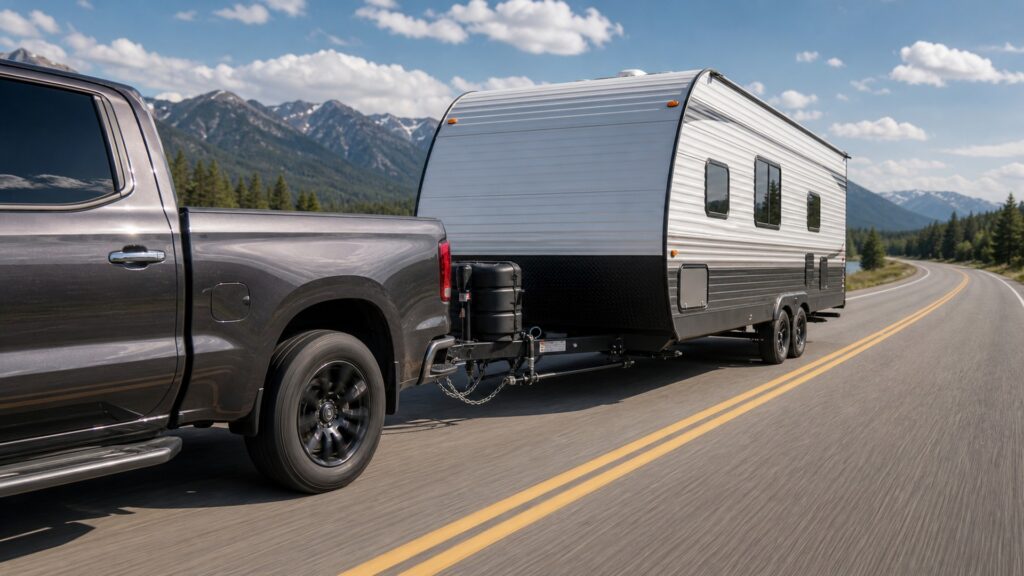
Separate the causes that make yaw grow from devices that resist motion after it begins.
Tip: Move cargo in measured increments and reweigh tongue load. A friction adjustment that seems to hide instability can leave the combination vulnerable when speed, wind, rain, or a downhill grade changes available control.
These terms describe how an articulated trailer begins, sustains, and resists yaw.
Oscillating trailer yaw relative to the tow vehicle around their articulated coupling.
Downward hitch load created by trailer mass positioned relative to its axles.
An operating region where a particular loaded combination can become increasingly sensitive to yaw disturbances.
A mechanical device resisting relative hitch yaw through adjustable sliding friction.
Electronic detection of oscillation followed by selective trailer or tow-vehicle braking and sometimes engine-torque reduction.
Movement of trailer contents that changes center of mass, tongue load, roll moment, or restraint forces during travel.
Tip: Sway-control settings are product-specific and never substitute for correct loading.
When substantial mass sits behind the trailer axle, the hitch carries less stabilizing load and lateral tire forces can feed yaw. High cargo adds roll coupling; liquid or animals can move dynamically.
The trailer's load map is its first sway-control system.
As speed rises, disturbances develop more quickly and steering corrections become more consequential. Crosswind, downhill momentum, road ruts, and passing trucks can initiate motion that a marginal combination cannot damp.
A setup calm at neighborhood speed is not proven at highway energy.
Friction bars oppose articulation; dual-cam or integrated designs use geometry and spring-bar forces to encourage centering. Ratings, lubrication restrictions, adjustment, turning clearance, weather, backing, and installation differ by product.
Added damping is useful only after the underlying trailer is stable.
Trailer-mounted systems or tow-vehicle stability control can apply brakes selectively when an oscillation signature appears. Response depends on functioning brakes, wiring, tire grip, sensor calibration, load, and speed.
Software can spend brake and tire capacity, not manufacture stability.
Abrupt countersteering or heavy tow-vehicle braking can add yaw. Manufacturer guidance commonly emphasizes steady steering, easing acceleration, and carefully applying manual trailer brakes where equipped, followed by a safe stop.
The goal is to remove energy, not win a steering contest.
Loading and speed determine whether yaw tends to decay; mechanical or electronic controls add damping within that baseline.
Travel cargo produces appropriate measured tongue weight, remains restrained low and forward, and every tire, axle, hitch, suspension, brake, and alignment condition supports predictable tracking.
Approved sway equipment is adjusted for the exact load, full articulation is clear, the driver knows the response, and any intervention triggers a stop and inspection.
No friction setting or electronic algorithm corrects rearward mass, shifting cargo, overload, wrong hitch height, damaged tires, excessive speed, strong wind, weak brakes, steering overcorrection, or an incompatible tow vehicle.
Repeated sway, unexplained instability, overheated devices, brake intervention, bent brackets, tire damage, or inability to measure tongue load requires delay and correction rather than another setting change.
Sway myths promise one accessory can overpower a poorly loaded articulated system.
Greater tow-vehicle mass can help, but trailer center of mass, tongue load, speed, tires, wind, alignment, hitch play, and steering still govern yaw. A large truck cannot stabilize fundamentally rear-heavy cargo.
Friction adds damping but also generates heat and has limited authority. It does not raise tire, hitch, trailer, or speed ratings, and higher speed increases yaw energy and reduces recovery time.
Trailers respond to wind, bumps, and steering with small transient motion. Concern rises when oscillations repeat or grow. Slow safely, inspect the cause, and avoid normalizing instability because a device eventually suppresses it.
Gentle manual trailer braking may help damp emerging yaw when approved, but it does not repair load distribution, tires, alignment, hitch geometry, or speed. Stop and correct the initiating condition before continuing.
Tip: Judge whether disturbances decay at conservative speed before asking a device to manage the remaining motion.
These answers address warning signs, tongue load, device types, electronic intervention, driver response, and what must happen before the trip resumes.
Repeated tail movement, steering corrections, sensitivity to trucks or wind, light steering, unstable lane tracking, or growing oscillation deserve attention. Reduce speed smoothly, stop safely, and inspect loading, tires, hitch, suspension, and brakes.
Use the trailer and vehicle makers' specified range and measure the actual loaded trailer. Generic percentages are only starting context; axle placement, trailer design, payload, hitch limits, and cargo movement determine the approved target.
No. Friction devices resist articulation mechanically; electronic systems detect motion and apply braking. Installation, authority, heat, maintenance, compatibility, and response differ, and either one still requires stable loading and working tires and brakes.
Follow the vehicle, trailer, and controller instructions. Abrupt braking or steering can worsen instability; steady steering, easing power, and approved gentle manual trailer braking are common guidance until a safe stop is possible.
Only after stopping safely and correcting the cause. Recheck cargo restraint and position, tongue load, hitch settings, tires, wheel attachment, brakes, wind, road speed, and equipment damage before deciding the combination is roadworthy.
Trailer sway control matters because yaw can amplify when load placement, speed, tires, wind, and steering provide too little natural damping.
Build stability with measured tongue load and restrained cargo first, then use approved mechanical or electronic control as added margin; any sway event is a reason to slow, stop, inspect, and correct—not turn a device tighter and continue.
Related explainers connect sway to hitch selection, the measured towing combination, and trailer safety systems.
Separate front-axle load redistribution from actual sway damping when choosing hitch hardware.
Return to measured loads, cargo restraint, tires, brakes, hitch geometry, and departure checks.
Inspect tires, chains, breakaway, lights, wheel attachment, and emergency equipment after instability.
Choose a retailer
Prices checked regularly. We may earn a commission at no cost to you.