
Optical Haze
Diffuse scattering from glass surfaces, interlayers, films, residue, abrasion, or moisture that reduces contrast and increases glare.
- Night lighting exposes scatter
- Cleaning response identifies residue
- Internal damage may persist
Choose windshield components when the failed output is the forward view or sealed opening: glass is cracked, optically distorted, hazed, or leaking; wipers skip or miss; washers lack delivery; defogging cannot clear the interior; or a camera's sightline is blocked or misaligned. Those faults live at the glazing surface and its attachments.
Choose engine filters when evidence identifies a specific air, oil, or fuel stream: measured restriction, pressure loss, contamination, water separation, damaged media, bypass behavior, or a clean-side sealing failure affects engine protection or supply. Rain, dust, cold, and storage can expose both categories during one trip, but washer flow does not diagnose fuel flow and intake restriction does not explain a missed wiper band.
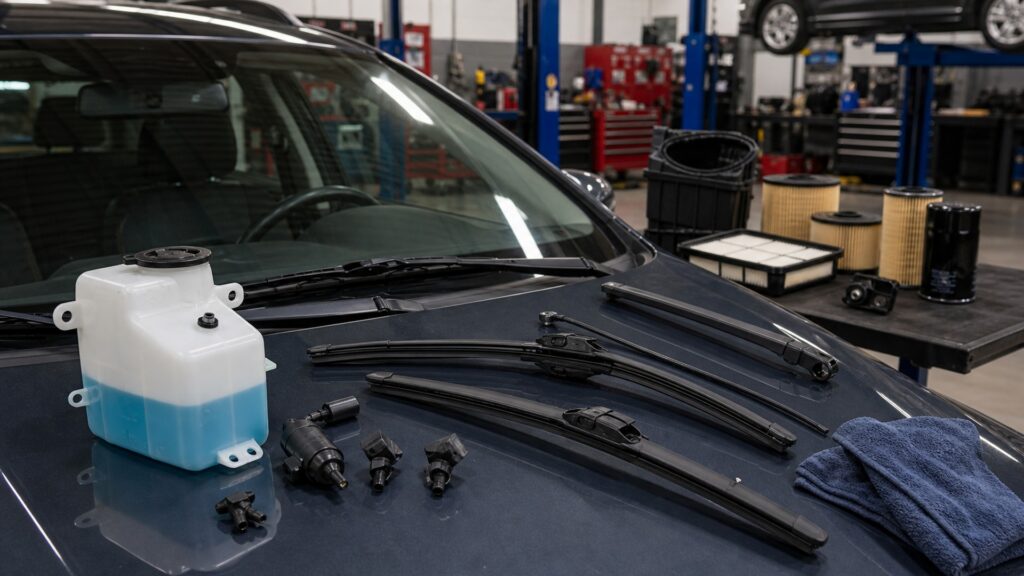
Windshield evidence changes light, water, sweep, or sensor vision; filter evidence changes the pressure, flow, or cleanliness of air, oil, or fuel.
Tip: Do not run wipers dry or operate an empty washer pump merely to extend the test; those actions can add damage without clarifying the original fault.
These terms separate a visibility surface from a contaminant-control element inside an engine stream.
Diffuse scattering from glass surfaces, interlayers, films, residue, abrasion, or moisture that reduces contrast and increases glare.
Intermittent loss of blade-edge contact that leaves repeating unwiped sections as the arm traverses the glass.
Fluid pressure produced through the washer pump, hoses, valves, and nozzles to establish usable spray on the glazing.
Pressure loss across an intake element at a defined airflow and measurement point.
A calibrated alternate oil path that opens when filter differential pressure exceeds a designed threshold.
The interface preventing unfiltered air or liquid from bypassing media into protected downstream passages.
Tip: Name the medium before naming the part: light, rainwater, washer fluid, cabin air, intake air, lubricant, and fuel follow different routes.
Cracks, haze, fog, leaks, skipped wipe zones, poor spray, and blocked camera views can be observed without engine load. Inspect their surface location, pattern, and response to clearing controls.
A driver-position observation often identifies windshield work before the hood is opened.
Intake vacuum, oil differential pressure, or fuel supply changes as pumps, pistons, viscosity, and engine load move the working medium. Test the exact circuit rather than a generic filter category.
An overdue element is maintenance evidence, not proof of the weather complaint.
A dusty season can raise intake loading; rain exposes leaks and weak wiping; freezing temperatures affect washer fluid, blade flexibility, battery supply, oil viscosity, and defogging. Separate each quantity under the same conditions.
Shared timing does not create a shared mechanism.
Defogging depends on HVAC airflow, temperature, humidity, outlets, and glass surface condition. Engine intake filtration protects combustion airflow. A cabin filter may influence HVAC, but it is not an engine filter.
Clarify which air path is weak before purchasing a part.
Windshield service ends with clarity, leak, sweep, spray, defog, sensor, and calibration checks. Filter service ends with correct fit, sealing, pressure, restriction, fluid level, leakage, and engine operation.
Starting the engine cannot prove the windshield, and clear glass cannot prove filtration.
The repair category follows the physical medium and measurement: optical clarity and water control at the windshield versus pressure, flow, and contamination inside an engine circuit.
Crack pattern, optical haze or distortion, bond leakage, molding or cowl fit, wiper sweep and contact, washer delivery, defogging, heater function, rain sensing, camera view, or calibration evidence is abnormal.
The symptom changes with rain, frost, fog, glare, wiping, washing, glass temperature, or a defined sensor view while engine pressure and flow remain unrelated.
Measured restriction, differential pressure, contamination, water collection, media condition, bypass behavior, fluid compatibility, housing integrity, or clean-side sealing identifies the air, oil, or fuel circuit.
Do not use weather timing, mileage, a generic airflow word, or one warning light as a parts verdict. HVAC, electrical, sensor, pump, fluid, wiring, engine, and body-seal faults may imitate either category.
The phrase poor airflow can send a defogging complaint toward an engine air filter, while a rainy no-start can make visibility hardware seem involved in an engine fault.
Engine intake media does not route cabin air across the glass. Defogging depends on HVAC blower output, mode doors, temperature, humidity, outlets, cabin filtration where equipped, and moisture sources. Test that separate airflow path.
Washer systems require compatible fluid for materials, cleaning, temperature, and safety. Plain water can freeze or grow contamination; household chemicals can damage paint, coatings, rubber, sensors, or pumps. Follow vehicle and product guidance.
Water can enter through roof drains, seams, doors, cowls, HVAC inlets, or other openings. Controlled leak tracing should locate the path before adhesive or trim is disturbed around a correctly bonded windshield.
A forward camera looks through a defined glazing zone. Clean and inspect that surface, condensation, frit window, bracket, camera seating, power, data, and calibration. Engine-filter age does not change the optical path.
Tip: Identify the destination of the air or fluid and measure it along that route before choosing a replacement.
These answers distinguish defogging air from intake air, rain leaks from filter faults, and windshield warnings from engine-flow evidence.
It can reduce HVAC airflow on some vehicles, but a cabin filter is not an engine filter. Confirm blower performance, outlet mode, temperature, humidity, evaporator condition, moisture sources, and the exact service interval before replacement.
Moisture can expose ignition, connector, intake, sensor, or fuel issues, while water ingestion can be serious. Preserve codes and inspect the engine path independently; poor wiper performance merely occurs during the same weather.
Ordinary washer faults use separate circuits, though shared voltage, network, or body-control problems can create multiple messages. Read all modules and verify battery supply before claiming an engine filter or washer component caused the other.
Stop safely when forward visibility is inadequate, a crack is rapidly spreading in the critical view, genuine oil pressure is unsafe, fuel leaks, or engine operation risks damage. Do not extend testing through a safety boundary.
Repair restores optical clarity, wet sweep, washer coverage, leak control, defogging, and relevant sensor availability under the original weather condition while engine flow, pressure, and contamination evidence remains independently acceptable.
Use windshield components when light transmission, glass integrity, water sealing, wiper contact, washer delivery, defogging, or camera sightline fails. Use engine filters when measured pressure, flow, contamination, bypass, or clean-side sealing fails in air, oil, or fuel.
Weather can expose both without connecting them. Identify the physical medium, follow its route, and require distinct post-repair proof for the driver's view and the engine stream.
Related explainers trace the windshield visibility paths, the engine filter streams, and diagnostic evidence needed when weather exposes two unrelated faults.
Follow glazing optics, bonding, wiping, washing, defogging, and camera sightlines through the forward opening.
Follow intake air, oil, and fuel through media, seals, pressure drops, and bypass controls.
Use codes and live data as test directions while preserving weather, voltage, and event timing.
Choose a retailer
Prices checked regularly. We may earn a commission at no cost to you.