
Winter Tire
A tire engineered with tread and compound priorities for sustained cold, snow, slush, and sometimes ice.
- Rubber remains more compliant at low temperature
- High edge density works in packed snow
- Warm-weather wear and response can suffer
Winter tires become the better tool when cold, snow, slush, or ice is a recurring operating condition rather than a rare surprise. Their low-temperature compounds, fine biting edges, and snow-managing tread are designed to keep working after many all-season designs have lost flexibility and traction margin.
The decision is not made by one magic thermometer reading. Overnight lows, road treatment, elevation, bridge icing, storm timing, trip necessity, driveway grade, vehicle weight, and the harm from a longer stop all matter. All-season tires remain the practical year-round choice in mild climates, but their name does not promise equal performance across severe winter conditions. Use exact product markings and testing, then plan a four-tire seasonal changeover before the first hazardous week.
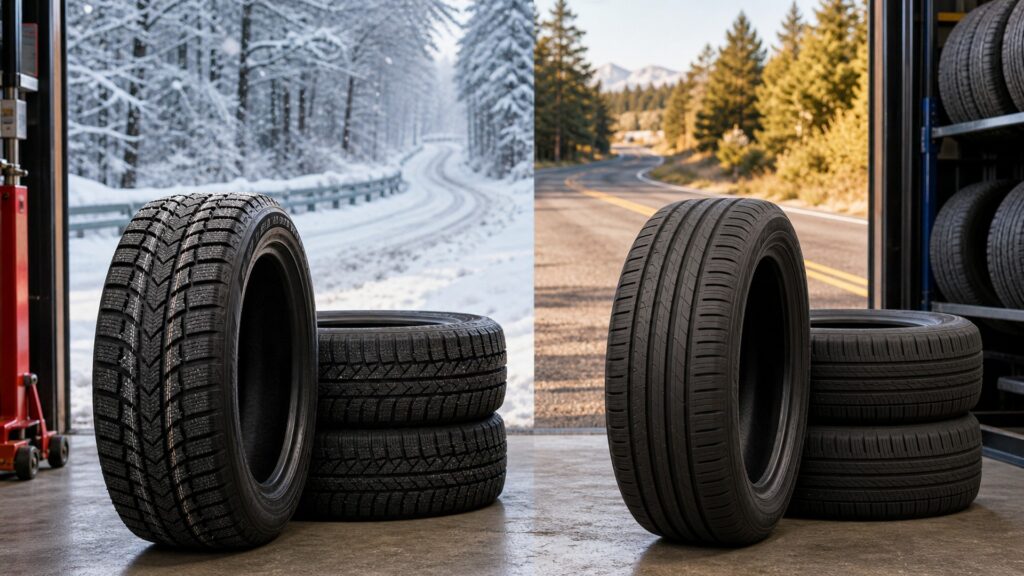
A winter set is justified when the route repeatedly asks for cold flexibility and snow or ice control, especially when delaying a trip is not always possible.
Tip: Review the coldest portion of each essential trip—not the average afternoon temperature. A shaded descent or predawn bridge can determine the needed tire even when the city forecast looks merely cool.
These terms turn a vague winter label into a specific material, certification, and operating decision.
A tire engineered with tread and compound priorities for sustained cold, snow, slush, and sometimes ice.
A road tire balancing warm, wet, cool, wear, noise, and limited winter use across one annual fitment.
The three-peak mountain snowflake symbol indicating performance in a standardized acceleration test on medium-packed snow.
A tread-rubber formulation intended to retain useful deformation and friction as temperature falls.
The variable autumn or spring period when temperatures cross between winter and warm-weather operating ranges.
The distance and controllability reserved between normal operation and a collision under the actual surface condition.
Tip: A winter mark identifies a defined capability; it does not eliminate the need to compare ice, wet, dry, wear, and load evidence for the exact tire.
As temperature falls, tread formulations stiffen by different amounts. A winter compound is tuned to remain compliant enough to generate friction on cold pavement, while many all-season compounds preserve more warm stability and tread life at the expense of low-temperature response.
Winter performance begins as a material problem even on a dry-looking road.
Winter patterns use dense sipes and shapes that accept, retain, and release snow because snow-on-snow adhesion can exceed rubber sliding on packed snow. Block supports restrain excess movement so the added edges do not make steering hopelessly vague.
A good winter footprint manages material; it does not simply cut through it.
The 3PMSF test addresses acceleration on packed snow, not every ice or wet maneuver. Ice friction changes with temperature and surface film; compound, microtexture, studs where lawful, and exact test results matter more than aggressive shoulder blocks.
All-wheel drive can multiply launch force, but all four tires still limit braking and turning.
Installing winter tires only on the driven axle creates large front-rear friction differences. During braking or cornering, the lower-grip axle can lose control first, producing understeer or oversteer that surprises the driver and control systems.
Winter traction is a vehicle-stability decision, not merely a drive-wheel decision.
A second set needs storage away from ozone, sunlight, moisture, and damaging loads; changeover requires correct wheels, sensors, fasteners, torque, pressure, and position. Remove winter tires before sustained warmth erodes their soft compound and dry response.
Seasonal tires deliver value only when the logistics keep both sets ready.
The case strengthens with frequent cold starts, untreated snow or ice, elevation, essential travel, and high consequences for one missed stop.
The route regularly sees sustained cold, packed snow, slush, ice, steep grades, shaded surfaces, or storm travel that cannot always be postponed.
The owner can fit four approved tires, preserve load and speed requirements, store the alternate set correctly, and schedule timely seasonal installation and removal.
The climate is mild, freezing conditions are rare and avoidable, roads are treated promptly, and the exact all-season tire has credible performance for the limited exposure.
Neither choice defeats unsafe speed, worn tread, wrong pressure, untreated glare ice, mixed fitments, or a trip that should be delayed because conditions exceed driver and vehicle capability.
Winter-tire myths usually confuse getting the vehicle moving with retaining steering and stopping margin through the whole trip.
All-wheel drive can distribute propulsion, helping the vehicle start, but braking and cornering still depend on tire-road friction at four contact patches. It cannot restore cold-compound flexibility or create biting edges on snow and ice.
The mark reflects a standardized acceleration result on medium-packed snow. It does not certify ice braking, wet stopping, cornering, or every temperature, so exact comparative testing and conservative winter driving remain necessary.
A two-tire installation can create a large grip imbalance. The opposite axle may slide first during braking or a turn, so tire and vehicle organizations generally call for four winter tires to preserve predictable behavior.
Soft cold-focused compounds can wear rapidly, respond less precisely, and stop less effectively in warm conditions. Seasonal removal protects both warm-weather performance and the expensive winter tread needed for the following cold season.
Tip: Evaluate the coldest essential route, the exact tire's tested envelope, and the stability of all four corners rather than relying on drivetrain or a seasonal label.
These answers address the practical thresholds, rain behavior, storage, replacement, and trip decisions behind a two-set strategy.
Manufacturers often discuss a sustained cool-weather transition rather than one exact instant. Use the exact tire guidance, overnight and route temperatures, forecast variability, appointment availability, and the first plausible snow or ice event to schedule changeover.
Not necessarily in cold rain, where their compliant compound may help, but warm wet pavement can expose softer blocks and longer response. Compare exact wet tests and maintain drainage depth, pressure, alignment, and appropriate seasonal timing.
Clean and dry the tires, mark positions, and store them in a cool, dark, dry area away from ozone-producing equipment and chemicals. Follow maker guidance for mounted versus unmounted stacking, pressure, covers, and support.
Only when vehicle and tire-maker guidance permits it, legal requirements are met, the driver is informed of the lower limit, and load capability remains correct. Never treat a seasonal rating change as permission to exceed any marked speed.
Replace for damage, age, or remaining depth inadequate for the expected snow and slush—not only when a legal wear bar appears. Measure multiple grooves, inspect uneven wear, and consider whether the tire retains its winter features.
Use winter tires instead of all-season tires when sustained cold and recurring snow or ice make low-temperature compound, dense edges, and a stable four-tire winter footprint valuable on essential routes.
Base the choice on exposure and stopping consequence, validate the exact model, then manage timely changeover, storage, pressure, depth, and warm-weather removal so the seasonal advantage remains real.
The related explainers deepen the material, tread, and pressure mechanisms that determine whether a winter set retains its intended advantage.
Learn how polymer formulation, fillers, hysteresis, heat, and aging set the temperature window in which tread rubber works.
See how sipes, voids, block support, water paths, and wear turn tread geometry into snow, slush, and wet-road behavior.
Keep the cold inflation baseline correct as ambient temperature changes and casing deflection controls heat and footprint shape.
Choose a retailer
Prices checked regularly. We may earn a commission at no cost to you.