
Cold Inflation
Tire pressure measured before meaningful driving and before external heat has raised the tire temperature.
- It provides the repeatable setup baseline
- Placard values are generally cold values
- Shade and ambient conditions still matter
Tire pressure is the setting that lets an air-supported casing carry the vehicle with its intended shape. Too little cold inflation increases deflection and heat while distorting the footprint; too much can change impact compliance and contact distribution. Either direction can alter steering, braking, wear, and durability.
The correct starting point is the vehicle placard for the approved original fitment, not the maximum molded on the tire. Pressure must be checked cold with a trustworthy gauge because driving and sunlight warm the air. TPMS is a loss warning, not a precision setup tool: a tire can be meaningfully below its recommendation before the lamp appears. Recurring loss deserves leak diagnosis rather than repeated refilling.
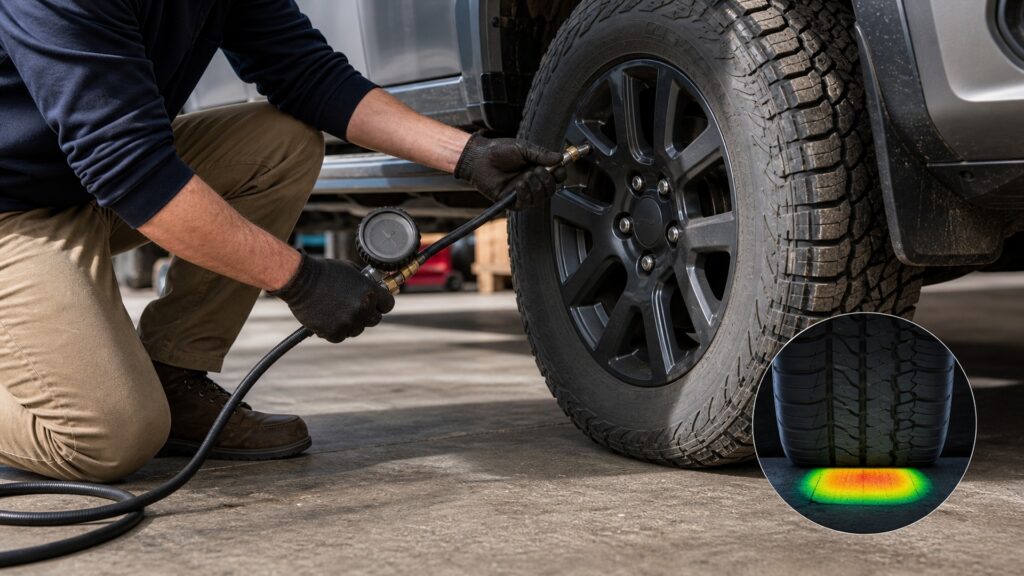
A reliable cold reading connects the placard target to real load support, predictable footprint shape, and a trend that can expose leaks.
Tip: Record all four cold pressures and ambient temperature for several weeks. A tire that repeatedly separates from the others is giving better diagnostic evidence than a one-time dashboard warning.
These terms separate the recommended setup, physical mechanism, warning system, and fault conditions.
Tire pressure measured before meaningful driving and before external heat has raised the tire temperature.
The cyclic bending and shape change of sidewall and tread structure as the loaded tire rotates.
The vehicle manufacturer's recommended cold pressure for specified original tire fitment and loading assumptions.
The programmed loss condition at which the tire-pressure monitoring system must or chooses to warn.
The higher reading produced after operation, sunlight, braking heat, or ambient warming increases tire temperature.
Progressive pressure loss through a puncture, valve, bead, wheel, or other sealing defect.
Tip: Pressure becomes actionable only when the gauge reading, temperature state, vehicle fitment, and placard recommendation refer to the same moment.
Vehicle weight flattens the tire until internal pressure acting over the footprint balances the load. Less pressure requires more deformation; more pressure changes the area and stiffness. The casing contains that pressure but does not make the setup independent of air.
Pressure sets the geometry through which the tire carries force.
An underinflated tire flexes more as it enters and leaves the footprint. That hysteresis generates heat, raises rolling loss, slows response, and can fatigue cords or bonds. Heavy load, speed, and hot weather magnify the same mechanism.
Restoring air does not erase structural damage created while the tire ran low.
Inflating above the recommended value may reduce some deflection, but can alter contact distribution, ride harshness, braking behavior, wear, and pothole impact response. Maximum sidewall pressure is a limit under defined conditions, not a performance target.
A firmer steering sensation can coexist with less useful compliance or grip.
Pressure commonly changes with ambient and operating temperature because the contained gas warms or cools. Seasonal drops can reveal a marginal setup; sunlight can split readings side to side. Establish pressure cold rather than bleeding a normally warmed tire.
A number without its temperature history is incomplete evidence.
A gauge and log can distinguish a broad weather-related change from a local leak. Soap testing and professional inspection can locate valve, bead, puncture, or wheel problems; repeated refill cycles cannot establish whether the tire remained structurally safe.
Pressure maintenance becomes safety work when it leads to cause, not just another top-off.
It establishes load support and handling for the approved fitment before driving heat changes the reading.
Casing deflection, heat, footprint shape, steering response, braking, wear, and pressure-based load capacity remain within the intended operating envelope.
Comparable cold readings create a trend that exposes leaks, seasonal change, side-to-side anomalies, and a tire that needs inspection before another high-speed trip.
Air cannot restore cords, innerliner, bead, sidewall, or tread separation damage caused by an impact, puncture, overload, overheating, age, or extended run-low operation.
The placard value does not automatically apply to every alternate size, competition use, off-road airing-down practice, heavy conversion, or tire category without documented application guidance.
Pressure myths often confuse a warning threshold or tire limit with the vehicle's intended cold operating setting.
Maximum pressure is a tire limit tied to marked conditions, not the vehicle's routine recommendation. Use the certification or tire placard for the approved fitment and consult documented guidance when load or tire configuration legitimately changes.
TPMS warns after a programmed loss condition and may not flag gradual, equal, or smaller deviations immediately. A gauge detects the actual cold setup, while visual inspection can reveal damage that pressure monitoring cannot classify.
Normal driving raises tire temperature and pressure. Bleeding that warm tire to the cold recommendation can leave it underinflated after cooling; adjust at a cold baseline unless vehicle or tire guidance specifies an emergency procedure.
Reinflation restores shape but cannot reveal or reverse internal cord, liner, or bond damage from excessive deflection and heat. A tire with run-low history needs removal and qualified inspection before its serviceability is decided.
Tip: Keep recommendation, measurement state, and fault diagnosis distinct; then the number describes the tire instead of merely calming the dashboard lamp.
These answers cover measurement timing, gauge choice, nitrogen, seasonal change, leaks, and the relation between pressure and heavy loading.
Check before driving or after the vehicle has sat long enough for the tires to approach ambient temperature, away from strong sun. If an emergency requires a warm reading, follow maker guidance and recheck cold later.
Use a quality gauge with an appropriate range, readable increments, and periodic comparison against a trusted reference. Consistency helps track trends, but a consistently wrong gauge can mis-set every tire, so replace damaged or questionable tools.
No. Nitrogen-filled tires still lose gas and respond to temperature, and valves, beads, punctures, or wheels can leak. Its use does not change the need for cold checks, placard-based setup, damage inspection, or timely repair.
Cooling lowers pressure, so tires already near the warning threshold can cross it overnight. Measure all tires cold, set them to the correct recommendation, and investigate one tire that loses disproportionately rather than waiting for warmer weather.
Some vehicles specify alternate pressures for defined loading or towing conditions. Follow the vehicle and tire documentation and remain within wheel and tire limits; do not invent an increase without measuring load or understanding the approved fitment.
Tire pressure matters because it sets casing deflection, footprint shape, heat, response, wear, and pressure-based load support before the vehicle begins moving.
Start with the vehicle's cold placard recommendation, measure accurately, interpret temperature changes correctly, and diagnose recurring loss; a TPMS lamp and a sidewall maximum cannot perform those jobs.
The related explainers connect the gauge reading to the tire's load capacity, tread behavior, and the complete hub-to-road system.
Translate cold pressure through the correct load table and compare the result with measured axle distribution and vehicle limits.
See how pressure changes footprint shape and the way grooves, blocks, shoulders, and sipes meet the road.
Trace force and heat through casing, bead, rim, hub, fasteners, and contact patch.
Choose a retailer
Prices checked regularly. We may earn a commission at no cost to you.