
Airflow Rate
Volume of air delivered per unit time under stated pressure and test conditions.
- Flow falls as pressure rises
- Units may not be comparable
- Hose restriction reduces delivery
Portable air compressors matter because tire pressure is a controllable part of vehicle mobility. After deliberate off-road deflation, a slow leak repair, or an ordinary pressure loss, a compressor can restore the vehicle to an appropriate road pressure without depending on a nearby service station.
The useful capability is not the highest PSI printed on the box. Large tires need sustained airflow, while the compressor, hose, connector, power circuit, and gauge heat and lose efficiency during the job. Accurate pressure, adequate duty cycle, stable electrical supply, and cooling pauses determine whether all tires finish consistently. Inflation also cannot cure structural tire damage, an unseated bead beyond equipment capability, or an incorrect target pressure.
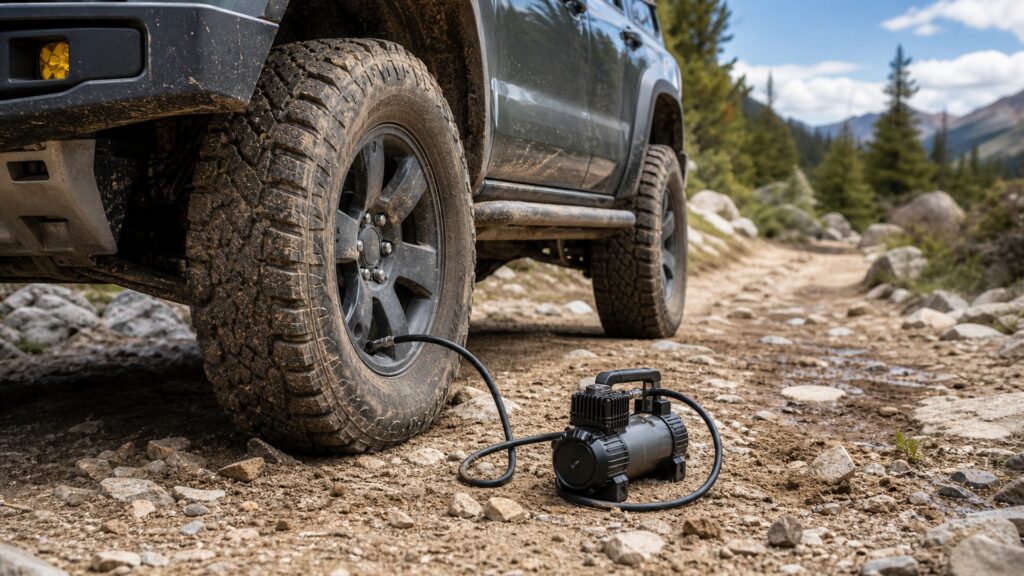
Start with the vehicle's correct pressure, tire size, number of tires, expected pressure change, available current, and acceptable time; then verify gauge and thermal performance through a full cycle.
Tip: Time a four-tire inflation from the lowest planned trail pressure to the road target under realistic ambient conditions, recording gauge agreement, connector temperature, compressor shutdowns, and final cold-pressure correction.
These terms distinguish usable flow and repeatable operation from headline pressure.
Volume of air delivered per unit time under stated pressure and test conditions.
Highest pressure the compressor may reach under limited conditions, not its inflation speed.
Allowed operating time relative to required cooling time at specified conditions.
Vehicle-specified target measured before driving heat raises tire pressure.
Protection that interrupts compressor operation when temperature exceeds a set threshold.
Reduction in voltage at the compressor caused by conductor, connector, fuse, and ground resistance.
Tip: Inflation safety depends on the vehicle, tire, wheel, load, speed, and compressor instructions; damaged tires, uncertain beads, or unusual inflation assemblies require qualified service and appropriate restraint.
Raising pressure requires adding a mass of air to the tire volume. Larger and multiple tires demand sustained flow at increasing back pressure; a tiny compressor may eventually reach target PSI but overheat or take impractical time.
Maximum pressure describes a boundary, while useful airflow describes the actual job.
High-current compressors may need battery clamps or permanent protected wiring rather than a low-rated accessory socket. Long thin leads, corroded plugs, poor grounds, weak batteries, and idling restrictions create voltage loss and heat.
A compressor can be mechanically capable yet electrically starved by its installation.
Compression heats air, cylinder, head, hose, and fittings while the motor and conductors generate additional heat. Ambient temperature, pressure ratio, enclosure airflow, and repeated tires determine when protection trips or materials become burn hazards.
A generous duty cycle is valuable because the recovery task often requires four similar inflations, not one demonstration tire.
Built-in gauges can differ from a trusted reference and may read dynamically while air flows. Tire temperature raises pressure after driving, so a warm trail-side reading is not directly equivalent to the placard's cold target.
Pressure accuracy matters more than displaying extra decimal places.
Lower pressure may improve compliance and footprint on some terrain, but it also increases sidewall flex, heat, bead and rim risk, and pressure loss sensitivity. A compressor restores the pressure needed for speed, load, and pavement afterward.
Carrying inflation capability does not make every low-pressure choice safe for every tire, load, or wheel.
Usable airflow, accurate measurement, adequate electrical supply, heat control, and realistic full-set timing matter more than maximum PSI.
It restores all vehicle tires from a planned trail setting to the correct road target within its duty cycle and the driver's available time.
Compatible fittings, protected power, an independent gauge, repair supplies, and cooling procedures make the system repeatable rather than merely portable.
Air cannot make cuts, exposed cords, bulges, damaged beads, cracked wheels, failed valves, unsafe repairs, or overloaded tires serviceable.
A compressor may not have the volume, equipment, or safety controls needed to seat a completely displaced bead or inflate large commercial assemblies.
These myths confuse pressure capability with airflow, accuracy, and complete four-tire performance.
Most passenger and light-truck tires operate far below extreme advertised pressure. Inflation speed depends on airflow at useful pressure, tire volume, hose restriction, voltage, temperature, and duty cycle—not the no-flow pressure ceiling.
Sockets, plugs, wiring, and fuses have current limits. A high-output compressor may require direct protected battery connection or permanent wiring. Using an undersized socket can blow fuses, overheat contacts, or starve the motor.
Display resolution is not calibration accuracy. Flow pulsation, hose pressure, temperature, sensor drift, and placement affect readings. Compare the gauge with a trusted reference and measure after airflow stops for final adjustment.
Compressor availability only supports reinflation. Tire construction, load, speed, terrain, wheel width, bead retention, heat, steering input, and sidewall exposure determine a safe lower limit; poor choices can damage tires before reinflation.
Tip: Evaluate the compressor under the exact repeated job and electrical connection it will face away from pavement.
These answers cover compressor sizing, engine operation, hot readings, bead seating, and post-use inspection.
Choose from tire volume, number of tires, pressure change, airflow at working pressure, full-set inflation time, duty cycle, available current, hose reach, fitting compatibility, environmental protection, and storage—not maximum PSI alone.
Follow the compressor and vehicle instructions. Running may support voltage but introduces exhaust, moving components, heat, noise, and battery-management considerations. Never operate in an enclosed area or route cables near belts and fans.
Inflate toward a safe operating level using vehicle and tire guidance, recognizing heat elevates the reading. After the vehicle sits and tires become cold, recheck against the placard or applicable load-specific target and correct precisely.
Some high-flow equipment and approved procedures may handle limited cases, but displaced beads can require large air volume, wheel inspection, cleaning, lubrication, and safety restraint. Avoid flammable seating methods and seek qualified help when uncertain.
Check sidewalls, tread, beads, valves, wheel damage, pressure consistency, hose and fitting heat, power connectors, fuse condition, abnormal compressor noise, leaks, and thermal shutdown history; then clean and cool equipment before storage.
Portable air compressors matter because they restore tire pressure after deliberate off-road deflation, a suitable repair, or ordinary loss, preserving the ability to return to higher speed and load safely.
Choose usable airflow and duty cycle for every tire, provide protected electrical supply, measure with an accurate gauge, manage heat, inspect damage, and verify the final manufacturer-specified pressure again when the tires are cold.
These explainers show how pressure management lowers some traction problems and why a compressor belongs inside a broader route-specific recovery plan.
Place the compressor alongside a gauge, repair supplies, spare strategy, shovel, traction devices, rated connections, communication, and inspection in a complete recovery kit.
See how pressure adjustment and reinflation can reduce resistance before or after recovery-board use without introducing a strap load path.
Budget compressor mass, current demand, storage access, heat, and deployment time inside the complete overlanding system.
Choose a retailer
Prices checked regularly. We may earn a commission at no cost to you.