
Hydraulic Containment
The sealed ability of master cylinder, lines, hoses, valves, and calipers to hold commanded pressure.
- Leaks reduce delivered clamp force
- Air makes pedal travel compressible
- Hoses must resist expansion
Brake components form a safety chain between the driver's foot and tire contact patches. Pedal force becomes hydraulic pressure, calipers create clamp load, friction material turns motion into heat, and tires finally transmit the decelerating force to the road. Each link needs reserve beyond one gentle stop.
Safety factors matter because wear, heat, water-contaminated fluid, loose fasteners, seized slides, mismatched friction, leaks, sensor faults, and poor bedding can reduce that reserve before a dramatic failure appears. A safe repair uses the exact vehicle procedure, specifications, compatible parts, clean handling, measured inspection, and controlled road verification. A brake label or new-looking surface cannot substitute for those checks.
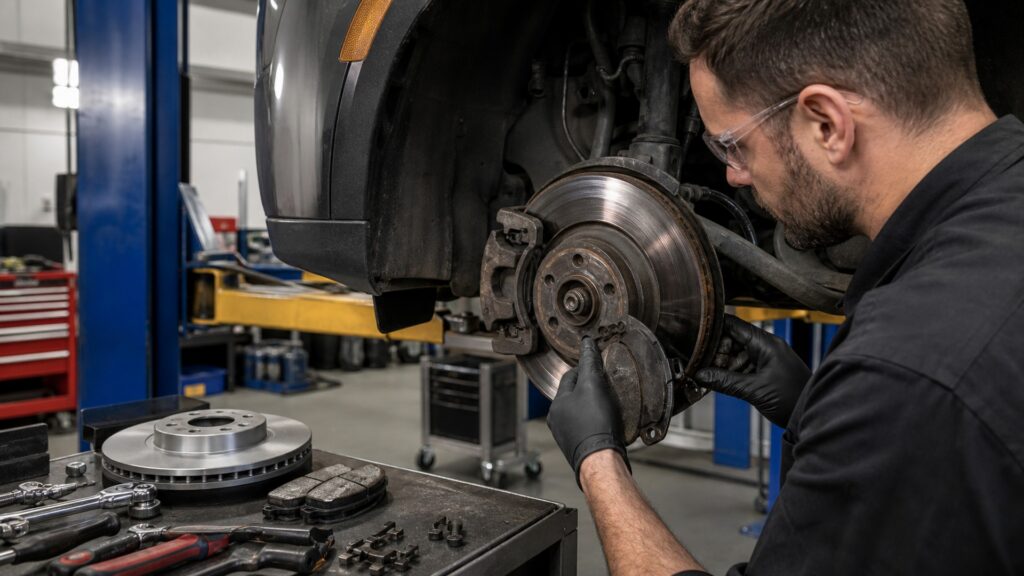
Brake safety is layered: pressure must remain contained, friction must stay stable as temperature rises, hardware must remain located, and left-right response must stay predictable.
Tip: Do not road-test a questionable pedal. Establish a firm pedal and leak-free system before the vehicle moves under its own power.
These terms identify the reserves that protect a brake system when load, temperature, or component condition changes.
The sealed ability of master cylinder, lines, hoses, valves, and calipers to hold commanded pressure.
Usable pad, shoe, rotor, or drum capability remaining above the service and thermal limits.
A temporary loss of braking effectiveness when heat changes friction behavior, fluid condition, or component geometry.
The maker's discard dimension below which a rotor or drum no longer has approved material reserve.
The intended front-rear and left-right relationship among brake forces during deceleration.
The remaining usable pedal travel and firmness after the system applies the brakes normally.
Tip: A single acceptable thickness reading is not a complete safety verdict; pressure integrity, hardware condition, heat history, and axle balance remain separate gates.
Master-cylinder displacement pressurizes specified brake fluid, but leaks, trapped air, swollen hoses, damaged flare seats, or internal seal bypass can reduce or delay caliper force. A clean reservoir level alone cannot prove containment.
A firm static pedal is the first evidence that the pressure path survived service.
Backing plates, bonding, friction surfaces, rotors, drums, and mounting faces transfer large shear and clamp forces. Cracks, oil, grease, glazing, delamination, or below-limit dimensions remove dependable margin.
Usable thickness includes structural and thermal capacity, not merely remaining mileage.
Caliper brackets, slide pins, wheel fasteners, hose fittings, and retainers keep the friction pair aligned while loads reverse. Wrong torque, reused one-time hardware, corrosion, or cross-threading can turn a routine stop into component movement.
A brake job is safe only when every load-carrying attachment is accounted for.
Vehicle mass and speed determine the kinetic energy the brakes must absorb. Descents or towing can accumulate heat faster than rotors, drums, and airflow reject it, while moisture lowers brake fluid's boiling resistance.
More demanding duty requires more thermal reserve, not stronger pedal pressure from the driver.
Wheel-speed sensors and stability logic can modulate available pressure when tires approach slip. They depend on sound hydraulics, correct tire sizes, valid signals, and mechanically equal corners; warning lamps identify faults but not every imbalance.
Electronic modulation can preserve control only from the braking capacity the hardware still provides.
A durable stop needs pressure containment, sound friction surfaces, secure attachments, temperature capacity, valid controls, and adequate tires at the same time.
Measured dimensions clear exact specifications, fluid and joints remain leak-free, the pedal is firm, hardware is torqued, warnings clear, and a controlled test confirms straight repeatable stops.
The repair record identifies parts, fluid, measurements, procedures, torque values, diagnostic results, bedding instructions, and any limits the driver must observe.
A sinking pedal, active leak, cracked friction surface, below-limit rotor or drum, damaged hose, loose attachment, unresolved ABS fault, or uncertain fitment requires correction before road use.
No workshop test guarantees traction, stopping distance, fade resistance, or component life under every load, tire, road, weather, towing, and driver condition.
Brake shortcuts often isolate one visible wear item and overlook the layers that keep deceleration controllable.
Pedal firmness supports hydraulic confidence, but seized slides, contaminated friction, cracked rotors, weak hoses, incorrect balance, sensor faults, and poor tires can remain. Release requires inspection and dynamic verification as well as pedal feel.
Pads cannot correct thin or heat-damaged rotors, sticking calipers, degraded fluid, poor tires, hydraulic faults, or an unsuitable friction match. The replacement must bed correctly and operate within the whole system's limits.
ABS helps preserve steerability by limiting wheel lock on many surfaces, but stopping distance depends on road texture, tires, speed, load, control calibration, and driver input. It cannot create friction or repair hardware.
Fluid level can fall with pad wear or leakage, while moisture and contamination change boiling and corrosion behavior without obvious loss. Use the vehicle maker's fluid specification, inspection method, and service interval.
Tip: Treat any safety-critical uncertainty as a reason to measure, consult exact service information, or involve a qualified technician before the vehicle returns to traffic.
These answers focus on release criteria, paired service, fluid, bedding, and what to do when confidence is incomplete.
Friction parts are commonly serviced by axle to preserve comparable material and response, but the exact procedure depends on design and condition. Inspect both sides, follow manufacturer instructions, and never mix incompatible friction formulations.
A fault can directly reduce deceleration or directional control, often under heat and emergency load. The work also involves stored pressure, heavy supported vehicles, hazardous dust, hot surfaces, and fasteners carrying repeated force.
Confirm fitment, fluid level, leak-free joints, firm pedal, wheel rotation, fastener torque, warning-lamp operation, diagnostic status, and specified bedding. Begin any road check at low speed in a controlled area.
No. Rust and wear patterns can make the lip misleading. Use the specified micrometer locations, check thickness variation and runout where required, and compare the smallest valid measurement with the exact discard specification.
Stop before improvising. Obtain exact service information by VIN and configuration or use a qualified brake professional. Safety margins should come from documented limits and verified work, not from resemblance to another model.
Brake-component safety factors matter because each stop consumes hydraulic, friction, structural, thermal, electronic, and tire capacity at once.
Release the vehicle only after exact fitment, measurements, fluid control, hardware torque, diagnostics, pedal reserve, and controlled dynamic behavior all agree. A failed gate is a repair finding, not paperwork to waive.
Related brake explainers trace the operating mechanism, fitment controls, and maintenance measurements that establish whether the complete stopping chain retains usable reserve.
Follow pedal input through hydraulics, clamp force, friction, heat, and tire force before judging any isolated component.
Match exact dimensions, hydraulic interfaces, sensors, friction material, and hardware before installation.
Use wear measurements, condition checks, fluid evidence, and documented intervals to preserve reserve over time.
Choose a retailer
Prices checked regularly. We may earn a commission at no cost to you.