
Wake State
The ignition, accessory, delayed-accessory, or interface condition in which the receiver and attached devices are expected to operate.
- Cranking can interrupt voltage
- Shutdown timing affects draw
- Accessories may wake separately
A head-unit feature has practical value only when its complete operating contract is satisfied. Bluetooth needs the right profile, permissions, source, and audio route; a camera input needs compatible video, power, and a trigger; preouts need correct channel assignment and a downstream amplifier; steering controls need a supported interface and mapping.
Operating function matters because a product page usually names the endpoint, not every dependency between the driver and that result. Converting each feature into a source, command, transformation, output, vehicle state, and limit makes compatibility easier to judge and failures easier to isolate. It also prevents a working radio station from being treated as proof that calls, cameras, prompts, or external amplifiers are ready.
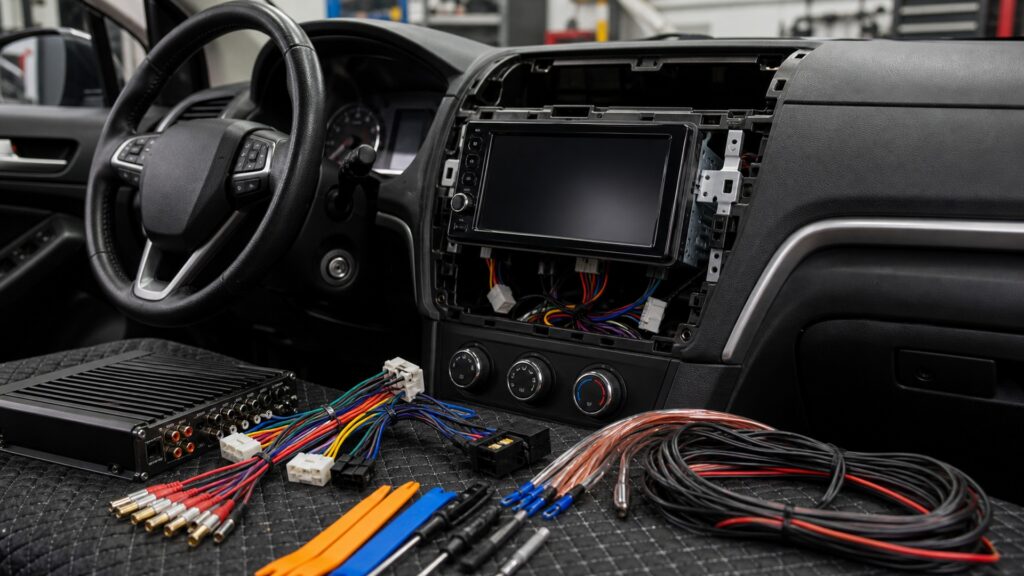
Test receiver wake state, tuner antenna path, phone projection session, control input mapping, preout channel assignment, and reverse-camera trigger as separate contracts rather than treating one working feature as proof of the others.
Tip: Replace 'supported' with a six-part question: supported source, connection, command, output, vehicle state, and downstream device.
These terms form a practical contract for deciding whether a receiver capability is merely listed or fully usable in the installed vehicle.
The ignition, accessory, delayed-accessory, or interface condition in which the receiver and attached devices are expected to operate.
The active relationship between a tuner, phone, USB device, or stored medium and the receiver function using it.
The assignment connecting a button, knob, touchscreen event, steering command, or voice request to a receiver action.
The routing that sends a source or processed channel to internal speaker outputs, preouts, prompts, screens, or connected accessories.
A separate device, signal, permission, adapter, antenna, microphone, trigger, or vehicle module required for the named feature.
Verification of a feature in every relevant vehicle and receiver condition, including start, drive, reverse, call, playback, shutdown, and restart where applicable.
Tip: Write the required state and observed output beside every feature; if either is missing, the operating claim remains incomplete.
Constant power, ground, accessory logic, network wake, amplifier turn-on, and shutdown timing decide when the receiver and attached equipment are available. A function that works on bench power may reboot during starting or remain awake after the vehicle should sleep.
Power-state behavior is a prerequisite shared by features, not evidence that their signal paths pass.
The tuner relies on an antenna path; stored media relies on supported file systems and codecs; Bluetooth uses particular profiles; phone projection adds cable or wireless negotiation, permissions, apps, and compatible controls. Similar menu icons hide different dependency chains.
Source acquisition owns the content entering the receiver; downstream tuning cannot repair a failed session.
Touch targets, knobs, steering buttons, microphone commands, and phone interfaces send different control events. An integration module may translate some of them, while receiver settings determine mapping, feedback, source context, and whether an action is allowed while moving.
A responsive screen is not proof that remote controls or voice input reach the same function.
Internal speaker outputs and low-level preouts are not interchangeable. Channel assignment, mute state, crossover, balance, zone, source volume, amplifier gain, remote turn-on, and connected impedance determine whether the selected program reaches the intended speakers cleanly.
The receiver's output function ends at a verified connector; acoustic performance continues through the wider system.
Hands-free calling needs a working microphone path and call routing. A reversing image needs camera power, compatible video, and a reverse trigger. Steering controls, chimes, factory amplifiers, vehicle data, and settings depend on documented interface coverage and programming.
Accessory acceptance occurs in the real vehicle state, not from the presence of a connector or menu option.
The method exposes missing dependencies and misrouted signals; it does not make unsupported hardware, software, or vehicle architecture work together.
Feature names are converted into specific sources, commands, outputs, states, and attached devices that can be tested separately.
A successful radio, phone call, camera, or steering command is credited only to its own path instead of masking unrelated failures.
Phone models, operating systems, codecs, interfaces, factory amplifiers, cameras, antennas, and vehicle data can impose non-negotiable support limits.
Software updates may change behavior, so current compatibility information and a complete retest matter more than a historical demonstration video.
These misconceptions treat a familiar feature label or one successful path as proof of complete receiver operation.
Bluetooth includes different profiles and permissions for calls, contacts, media, and control. Receiver firmware, phone software, active source, microphone routing, and reconnection behavior can differ, so pairing alone does not prove the required operating function.
The receiver and camera must agree on video format, connector or adapter, power, grounding, trigger logic, and supported viewing behavior. A physically connected camera can produce no image, unstable video, or the wrong operating state.
Additional outputs can provide routing flexibility, but result quality depends on signal voltage, noise, channel assignment, crossovers, downstream gain, amplifier loads, speakers, and acoustics. Unused or incorrectly configured preouts add no operating benefit.
Vehicle commands, factory wiring, interface module, firmware, receiver input, programming, and button mapping all affect retention. A supported combination may retain only specified functions, so each intended short press, long press, and source context requires testing.
Tip: Test the named input, control, output, state, and dependency instead of accepting a menu icon as functional evidence.
These answers apply the operating-contract model to radio, phone, camera, audio-output, and retained vehicle functions.
The tuner uses its own antenna and receiver circuitry, while phone projection requires a supported device, software, permissions, wired or wireless negotiation, and compatible settings. A successful radio path establishes nothing about that separate source session.
For each required feature, identify the exact source device, connection, interface, command method, output, vehicle state, and compatibility note. Reject vague support claims that do not cover the actual phone, vehicle trim, accessory, or downstream equipment.
Use a known source, confirm receiver routing and crossover state, verify remote turn-on, and measure or monitor the assigned preout before the amplifier. Then test clean downstream output with the supported load and gain relationship.
Power source, grounding, reverse trigger, video format, interface programming, receiver settings, firmware, and camera supply stability all influence the view. Reproduce the correct vehicle state and test each dependency rather than adjusting image settings first.
Retest after installation, battery or wiring service, interface programming, receiver firmware changes, major phone updates, factory resets, camera work, or amplifier changes. Use a checklist covering startup, sources, calls, controls, outputs, reverse, alerts, and shutdown.
Car stereo head-unit operating function matters because every feature depends on a specific source, connection, command, output, vehicle state, and attached device.
Turn marketing labels into operating contracts, then test each route independently. One working feature proves only its own path; complete acceptance requires sources, controls, audio outputs, microphones, cameras, retained vehicle functions, startup, and shutdown to behave as documented.
These explainers show the receiver's internal paths, the vehicle conditions required to connect them, and the boundary between head-unit responsibilities and the complete audio system.
Follow the receiver sequence from wake state through source acquisition, commands, processing, outputs, and accessory coordination.
Check whether the exact vehicle, receiver, interfaces, harnesses, accessories, sightlines, and retained functions can support the required contracts.
Separate the receiver's upstream responsibilities from amplification, speakers, enclosures, wiring, and cabin acoustics in the complete system.
Choose a retailer
Prices checked regularly. We may earn a commission at no cost to you.