
Branch-Circuit Protection
A fuse or breaker placed to interrupt excessive current before protected wiring overheats.
- Rating follows the conductor and equipment
- Location near the source limits unprotected wire
- Substitution can defeat protection
A replacement head unit touches more than music. Its power feed can carry fault current, its chassis occupies a crash environment, its screen competes for attention, and its integration hardware may reproduce warnings, camera views, or amplifier commands. Safety therefore depends on how the receiver is connected and used, not merely on whether it turns on.
The useful question is whether each affected path fails safely. Correct circuit protection limits wiring damage; secure mounting keeps mass controlled; retained cues remain recognizable; controls do not demand unnecessary glances; and shutdown behavior does not drain the vehicle battery. Treating these factors as one acceptance plan prevents entertainment improvements from quietly weakening another vehicle function.
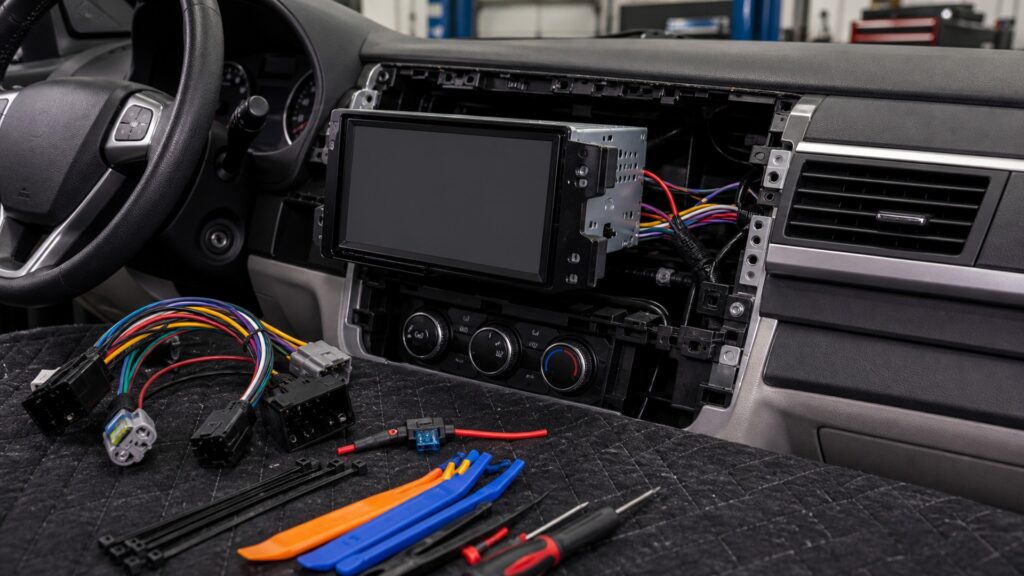
Electrical energy, physical retention, vehicle cues, driver attention, and cabin sound create separate hazards that need different controls.
Tip: A powered screen is only evidence of operation; inspect the path that limits harm when a wire, mount, interface, or user action goes wrong.
These terms distinguish energy control, mechanical restraint, retained information, and driver workload.
A fuse or breaker placed to interrupt excessive current before protected wiring overheats.
The planned low-resistance path carrying receiver and accessory current back to the electrical source.
A chime, warning tone, camera view, or status message that may pass through factory audio or display integration.
Brackets, fasteners, trim support, and cable restraint keeping the receiver assembly controlled under vibration or sudden loading.
The combined looking and hand action required to complete a receiver task.
A condition in which entertainment sound makes another useful sound harder to detect.
Tip: Name the hazard first, then verify the control designed for that specific failure mode.
A receiver circuit should be sized and protected as a complete path. The power source, fuse location, conductor capacity, connectors, ground return, and downstream remote outputs all matter. An oversized fuse can let a smaller wire overheat before protection opens.
Electrical safety comes from coordinated limits, not from the receiver powering up.
Some vehicles route warning chimes, amplifier audio, camera images, parking information, or configuration menus through the original receiver. An interface may retain only documented functions, so each affected cue must be reproduced in its real vehicle state.
Retention is proven function by function; a working volume knob cannot certify warnings.
The radio chassis, screen, brackets, trim, adapters, and bundled harnesses occupy a vibrating cabin. Correct fasteners carry the assembly, rear clearance prevents crushed wiring, and cable routes stay outside deployment zones and pedal or steering mechanisms.
A flush appearance does not prove that the assembly is securely retained behind the panel.
Source selection, destination entry, pairing, equalization, and app setup can require prolonged viewing or several touches. Complete configuration while stationary, preserve intended lockouts, and favor controls that give predictable feedback without requiring repeated visual confirmation.
The safer interface is the one that minimizes competing work during the driving task.
Entertainment output can conceal sirens, horns, mechanical changes, or vehicle prompts, especially as road noise rises. Receiver gain, source normalization, navigation mixing, chime routing, and amplifier settings should produce stable, recognizable behavior without abrupt surprises.
Audibility is contextual, so no single volume number can certify a safe listening condition.
Engineering and installation controls constrain foreseeable faults; the driver still manages attention, listening level, and changing road conditions.
Protected wiring, stable mounting, documented retention, predictable power states, and verified controls remove avoidable equipment hazards.
A structured state test exposes missing cues or unexpected behavior before ordinary use.
Vehicle architecture, user hearing, cabin noise, local rules, and the traffic situation prevent universal settings or placement claims.
An intact head unit cannot compensate for distracted interaction or unsafe driving choices.
These myths confuse successful entertainment playback with electrical, mechanical, or human-factors safety.
An equipment fuse may protect internal electronics, while the supply conductor still needs protection appropriate to its source, size, and route. Added amplifiers or accessories require their own coordinated circuits rather than dependence on one dashboard fuse.
Some warnings are produced or routed through original audio hardware. Retention depends on the vehicle option, interface capability, programming, amplifier path, and speaker routing, so each warning must be triggered and heard during acceptance.
Dashboard location does not remove visual and manual demand. Deep menus, small targets, delayed feedback, or unsupported phone tasks can still divert attention, which is why complex setup belongs in a parked vehicle.
Increasing level can add distortion, fatigue, and masking without improving important detail. Correct gain structure, suitable speakers, controlled cabin noise, and moderate operation address different parts of the problem; traffic awareness still governs use.
Tip: Credit each passing test only to the hazard control it actually exercises.
These answers focus on protection, retained functions, secure installation, driver workload, and shutdown behavior.
Follow the vehicle and product instructions for the exact feed. Protection generally belongs close enough to the electrical source to limit unprotected conductor length, and its rating must suit the wire, connectors, and connected equipment.
List every original chime or prompt, then trigger each applicable condition with the vehicle stationary and secured. Confirm route, level, timing, and speaker output after programming, and repeat after resets or interface firmware changes.
The chassis and display have mass, while loose brackets, forced trim, unsupported adapters, or trapped wiring can move under vibration or sudden loading. Correct application hardware and restored panel retention keep the assembly controlled and serviceable.
No. Voice interaction can reduce some looking and touching, but listening, formulating commands, correcting errors, and interpreting responses still use attention. Keep nonessential tasks brief and postpone complicated interactions until the vehicle is parked.
Some faults appear only during delayed-accessory shutdown or network sleep. Confirm that the receiver and external amplifier turn off as designed, settings persist correctly, and off-state draw follows the vehicle and interface requirements.
Head-unit safety factors matter because electrical energy, retained warnings, physical retention, driver interaction, and listening conditions fail in different ways.
Protect each circuit, secure every component, preserve documented vehicle cues, minimize visual-manual work, and verify startup through sleep. A successful song is not a safety certificate for the other paths.
These explainers connect the risk controls to internal receiver operation, vehicle-specific fitment, and testable feature contracts.
Trace power, source, control, output, and accessory paths before assigning a safety symptom.
Check chassis support, rear clearance, harness routing, and interface compatibility in the exact vehicle.
Convert every retained or entertainment feature into a source, state, output, and dependency test.
Choose a retailer
Prices checked regularly. We may earn a commission at no cost to you.