
Supply Flow
The water volume available at usable inlet pressure before the pump, measured under realistic site demand.
- Long hoses reduce delivery
- Shared taps create variation
- Filters add pressure loss
Car wash equipment fitment is the compatibility of an entire operating chain, not merely whether two connectors thread together. The water source must feed the pump; hoses, gun, lance, nozzle, and foam cannon must share ratings and interfaces; electrical supply must support the motor; and wetted materials must tolerate the chosen chemistry.
The wash target also sets compatibility. A foam cannon needs the right connection, flow, pressure, and orifice; detergent paths need chemical-resistant seals and correct dilution; electric equipment needs the specified protected circuit; brushes, towels, and nozzles must suit paint, wheels, glass, coatings, sensors, trim, and clearance. Fixed systems add drainage, reclaim quality, bay geometry, and vehicle detection. One mismatched interface can make the entire setup unsafe or ineffective.
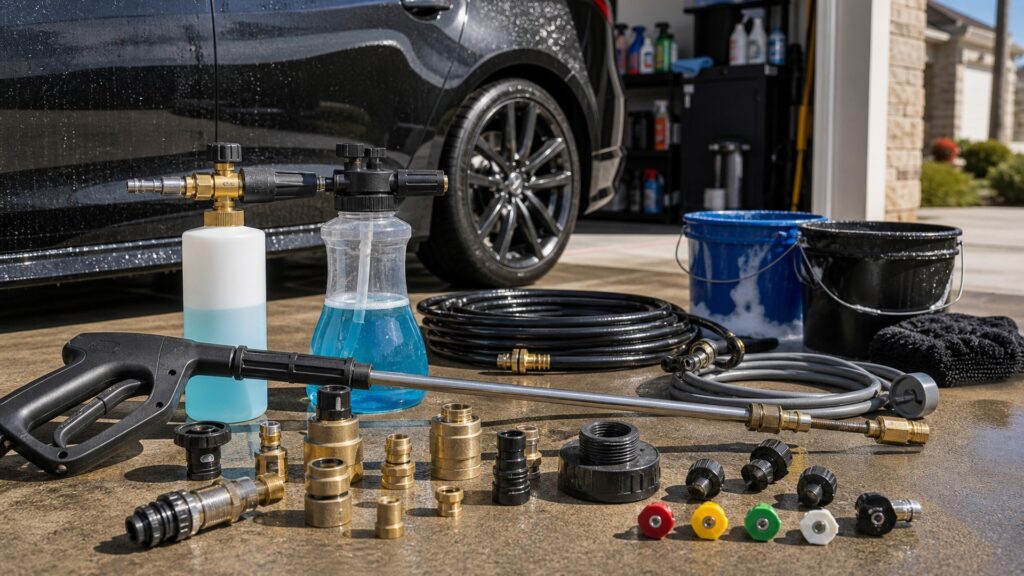
A valid setup confirms every connection and rating from tap to nozzle, then checks chemistry, reach, drainage, and material sensitivity at the vehicle.
Tip: Depressurize and disconnect power before comparing adapters; identifying a coupler while the hose is charged turns a fitment check into an injection and whip hazard.
These terms define the interfaces that determine whether a pump, hose, gun, nozzle, foam device, and wash site can operate together.
The water volume available at usable inlet pressure before the pump, measured under realistic site demand.
The maximum continuous pressure a component is designed to carry under its stated conditions rather than a brief proof value.
A defined plug, socket, diameter, and locking geometry intended to join compatible fluid components without threaded assembly.
A calibrated flow designation relating orifice area to pump output and pressure, not simply the spray fan angle.
The internal restriction that helps create pressure differential for detergent draw and air mixing within a foam device.
Ground-fault circuit interruption designed to disconnect electrical supply when current leakage indicates a shock hazard.
Tip: Treat adapter stacks as warning signs. Extra transitions add leak points, leverage, trapped pressure, and opportunities to exceed the weakest component's rating.
A machine rated for a given flow requires supply hose diameter, tap delivery, filtration, temperature, and suction conditions within its manual. Bubbles, surging, noise, or pressure cycling can begin upstream.
A larger outlet nozzle cannot repair an empty pump inlet.
Every downstream component sees working pressure and pressure pulses. Ratings, thread forms, seal materials, bore, locking engagement, bend limits, and temperature must match the machine and chemical exposure.
A high-rated pump does not upgrade a low-rated hose.
Nozzle size influences backpressure and flow, while fan angle distributes the resulting jet. The correct combination lets the pump operate within its envelope and gives the vehicle an appropriately gentle impact pattern.
Choosing by color alone can mismatch another brand's coding or machine flow.
Some injectors work only at low pressure; foam devices need adequate flow; acids, alkalines, solvents, and concentrated soaps can attack metals, elastomers, coatings, wheel finishes, or paint when misapplied.
A connector that fits does not establish chemical compatibility.
Cord length, GFCI, hose routing, ventilation, bay height, boom or wand reach, mirror and antenna clearance, runoff collection, and reclaimed-water treatment must suit the real work area and vehicle fleet.
Equipment fitment includes where the operator stands and where dirty water goes.
Supply, pump, pressure circuit, connectors, nozzle, detergent path, electricity, surface materials, workspace, and wastewater handling must agree before operation.
Available inlet flow and temperature, pump model and curve, working pressure, hose diameter and length, gun and lance rating, thread or quick-connect geometry, nozzle size and fan, injector direction, and foam-device requirements.
The correct circuit protection, cord guidance, detergent and seal compatibility, vehicle surfaces, ground clearance, trim and sensor sensitivity, operator reach, runoff route, reclaim stage, and winter storage are also documented.
It needs forced threads, loose adapters, missing locks, unknown ratings, undersized nozzle, starved inlet, unsupported hot water, damaged hose, bypassed GFCI, unapproved chemicals, or a jet too aggressive for the vehicle surface.
Do not rely on a generic universal claim. Verify the exact machine, accessory, chemical, site, and vehicle instructions, especially when mixing brands or adapting commercial and consumer equipment.
Pressure-washer accessories often appear standardized, yet small differences in threads, plugs, orifices, temperature, and ratings can create leaks or move the pump away from its designed operating point.
A latch can engage despite wrong bore, seal, plug length, pressure, temperature, or chemical rating. Confirm the exact standard and full specifications; partial engagement can release violently under pressure or leak into electrical areas.
An undersized orifice can raise backpressure, cycle the unloader, overload the pump, and concentrate surface impact. Use the size specified for pump flow, then choose a vehicle-safe fan and distance.
Concentration, viscosity, pH, solvents, surfactants, seal materials, injector design, dilution ratio, and downstream surfaces differ. Use chemicals approved for the equipment and vehicle, and flush the path as directed. reliably
Length, diameter, fittings, reel passages, kinks, elevation, and flow create pressure loss. An approved larger-bore hose may preserve delivery, but machine and accessory limits still govern; do not compensate with unsafe nozzle changes.
Tip: Verify interfaces as a chain and let the lowest rating and most delicate surface set the limit.
These answers cover cross-brand accessories, nozzle sizing, foam cannons, water supply, GFCI, hoses, chemicals, and fixed-site plumbing.
No. M22 descriptions can differ in internal diameter, sealing details, thread use, and machine application, while other systems use proprietary bayonets or quick connects. Check the exact manufacturer compatibility chart and ratings.
Possible causes include inadequate flow or pressure, wrong internal orifice, clogged mesh, air adjustment, dilution, product viscosity, cold chemistry, leaks, or an incompatible connection. Diagnose the device before shrinking the nozzle blindly.
Follow the equipment manual. A timed container test at the actual tap and hose can estimate volume, while observing inlet pressure, shared demand, filter condition, temperature, and air helps confirm whether supply stays adequate.
Only when the manufacturer permits it and specifies conductor size, length, outdoor rating, grounding, connection protection, and GFCI requirements. Undersized or wet connections can overheat, trip, or create shock risk.
Depressurize, install and lock correctly, tug-test where instructed, restore water and power, check low-risk leaks, observe pump cycling, verify spray pattern at safe distance, and confirm no component exceeds rating or damages the test surface.
Car wash equipment fitment matters because supply flow, pump output, hose and gun ratings, connectors, nozzle orifice, detergent hardware, electrical protection, chemicals, vehicle materials, workspace, and drainage form one operating chain.
Match every interface and let the weakest component and most sensitive surface set the limit. Reject forced adapters, unknown ratings, unsupported chemistry, and outlet changes used to conceal an inlet or pump problem.
Related explainers connect hydraulic operation, delivered cleaning performance, and maintenance checks to the exact interfaces that must agree.
Trace water through the pump, pressure circuit, nozzle, detergent stage, surface contact, rinse, and drainage.
Evaluate delivered pressure, flow, jet shape, chemical dwell, lubrication, rinse quality, and panel outcome.
Control injection, hose, electrical, chemical, exhaust, slip, runoff, and vehicle-damage hazards before adapting equipment.
Choose a retailer
Prices checked regularly. We may earn a commission at no cost to you.