
Operating Pressure
The fluid pressure available during actual spraying with the installed nozzle, supply, hose, and regulator conditions.
- Rated maximum may differ
- Leaks lower delivered pressure
- Distance changes surface effect
Car wash equipment matters through functions, not labels. A pump supplies hydraulic energy, a nozzle shapes that energy, a detergent stage loosens compatible soil, contact media dislodges remaining film, rinse flow transports residue, and towels or blowers remove water. If one stage is mismatched, extra power elsewhere may increase damage without improving cleanliness.
Operating function also explains why specifications cannot be read alone. Pressure without flow may cut at a small point yet rinse poorly; foam volume can look impressive while delivering weak chemistry; recycled water can conserve supply but needs treatment for its assigned stage. Evaluate the entire path and its bottleneck.
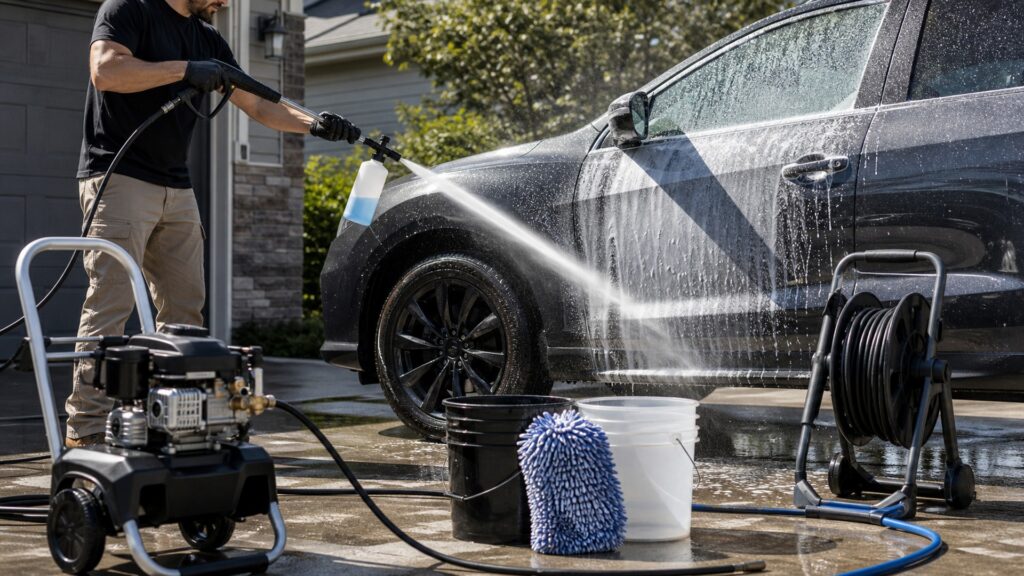
A useful evaluation asks what each component changes, which variable controls that change, and how failure at one stage appears at the next.
Tip: Change one operating variable at a time on a test area; otherwise apparent improvement cannot be assigned to pressure, chemistry, contact, or rinsing.
These terms describe the functions that connect machine ratings to surface outcome. Diagnosis compares operating pressure, delivered flow, nozzle fan, detergent dwell, boundary-film release, rinse transport, and final-water quality.
The fluid pressure available during actual spraying with the installed nozzle, supply, hose, and regulator conditions.
The water volume reaching the outlet under operating conditions and available to wet, carry, cool, and rinse.
The fan angle, droplet distribution, or jet pattern formed by the nozzle and its distance from the target.
The thin traffic-derived layer of oils, particles, salts, and residues that remains after loose soil is rinsed.
Movement of loosened soil and spent chemistry away from the surface with sufficient clean water and drainage.
The mineral, particle, and chemical condition of water used near the last rinse or left to evaporate.
Tip: Record conditions at the nozzle and vehicle, not only values printed on a pump housing or chemical bottle.
Pressure concentrates force at the surface; flow supplies water mass for wetting, cooling, dilution, and transport. Cleaning changes when either variable changes, so a single maximum-pressure number cannot predict rinse speed or damage risk.
Impact and transport are related functions, not interchangeable ratings.
A wide fan distributes output; a narrow jet concentrates it. Increasing standoff lets the pattern spread and lose intensity. Worn, blocked, or wrong-size orifices change both pump loading and the force reaching trim, paint, seals, and tires.
The nozzle is the final hydraulic control, not a decorative accessory.
Detergent must be compatible, correctly diluted, kept wet for its labeled dwell, and rinsed before drying. Remaining road film may need clean mitts or soft brushes whose lubrication and loading are actively controlled.
Foam is a delivery state; released soil is the outcome.
Rinse flow must export loosened soil and spent surfactant from seams, emblems, mirrors, and lower panels. Drying then removes mineral-bearing water before evaporation concentrates deposits, using clean towels, filtered air, or managed final rinse.
A glossy wet panel can still carry chemistry and grit.
Settling, filtration, separation, disinfection, and dissolved-solids control serve different contaminants. Reclaimed water may suit early washing but not a spot-sensitive final rinse unless treatment and monitoring deliver the required quality.
Water origin matters less than verified fitness for its assigned function.
A strong pump cannot compensate for starved inlet flow, incorrect chemistry, contaminated media, incomplete rinsing, mineral-rich final water, or uncontrolled wastewater.
Pressure stays stable, the spray fan is even, chemistry remains wet for the specified dwell, contact media releases soil, and rinse water carries residue away without cycling or redeposition.
The final surface is clean under inspection lighting, free of detergent streaks and avoidable spotting, while runoff follows the planned collection path and equipment stays within duty limits.
Pulsing, cavitation noise, streaked spray, dry foam, dragging mitts, persistent film, suds in crevices, rapid spotting, hot connectors, or dirty reclaim indicate a specific stage needs correction.
Raising pressure is not a universal remedy; it can damage weak finishes, decals, seals, sensors, tires, and trim while leaving chemistry, flow, media, or water-quality problems unchanged.
Operating-function myths often elevate one visible number or effect into the whole cleaning mechanism.
More pressure can increase local impact but does not guarantee sufficient flow, chemistry, access, or rinse transport. It may damage vulnerable surfaces and force water into openings while the actual bottleneck remains unchanged.
Foam can improve coverage and dwell visibility, but thickness alone does not reveal active concentration, soil compatibility, water hardness, wetting, or release. Judge the labeled process and the soil removed after safe rinsing.
Spray and chemistry can remove loose and soluble contamination, yet oily boundary film may remain. Controlled lubricated contact can be necessary when compatible chemistry, dwell, pressure, and flow no longer improve the test panel.
Properly treated reclaimed water can serve selected early stages and reduce potable demand. Suitability depends on particles, oils, microbes, salts, odor, treatment performance, equipment compatibility, and the finish requirements of that stage.
Tip: Diagnose the failing stage and its control variable before adding force, product, or contact.
These answers address pressure and flow, nozzle choice, detergent delivery, contact washing, final-rinse water, and how to find the process bottleneck.
They perform different jobs. Pressure helps detach contamination; flow wets, cools, dilutes, and transports it. The better balance depends on soil, surface, nozzle, distance, supply, and runoff capacity rather than one universal priority.
Possible causes include inadequate supply, a clogged inlet filter or nozzle, air entry, leakage, an incompatible orifice, or unloader behavior. Stop, depressurize, and diagnose according to the manufacturer instead of continuing to cycle.
Use clean, lubricated contact media after loose abrasive soil is removed and compatible chemistry has loosened remaining film. Work in controlled passes, inspect loading, rinse or replace the media, and avoid unnecessary pressure.
Softening exchanges hardness minerals but can leave dissolved sodium and other solids. Spot risk depends on total dissolved material, droplets, heat, dwell, rinsing, and drying, so verify final-water quality and remove water promptly.
Observe the process in sequence: inlet stability, pump behavior, spray pattern, wetting, chemical dwell, film release, contact-media loading, rinse transport, residue, drying, and runoff. Correct the first failing stage before changing later ones.
Car wash equipment operating function matters because soil removal is a chain of distinct physical and chemical jobs, each with its own controlling variables and failure signs.
Balance inlet supply, pressure, flow, spray geometry, chemistry, contact, rinse transport, water quality, and drainage. The cleanest safe result comes from correcting the bottleneck, not maximizing every setting.
Related explainers trace the full equipment path, show why hardware fitment changes output, and isolate safety controls that must remain independent of cleaning speed.
Follow water and chemistry through the pump, hose, nozzle, surface, rinse, drying, and wastewater path.
Check supply, connector, nozzle, electrical, chemical, surface, and site compatibility before judging machine output.
Review injection, electrical, chemical, slip, surface, and combustion hazards before changing operating settings.
Choose a retailer
Prices checked regularly. We may earn a commission at no cost to you.