
Charging Power
The instantaneous rate of energy transfer, commonly expressed in kilowatts.
- It can rise and fall
- It is not battery capacity
- The lowest limit prevails
Charging speed matters because vehicles need energy by a deadline, not an impressive peak number. The useful rate determines whether an overnight stop restores a commute, a lunch break adds a meaningful distance buffer, or a highway session reaches the next reliable station without consuming unnecessary time.
The displayed peak is only one moment in a negotiated process. Source capacity, EVSE limits, connector temperature, the vehicle's AC converter or DC acceptance, battery temperature, state of charge, shared power, and protective tapering can all reduce delivery. Good planning therefore compares energy gained across the available dwell window with the next trip's requirement.
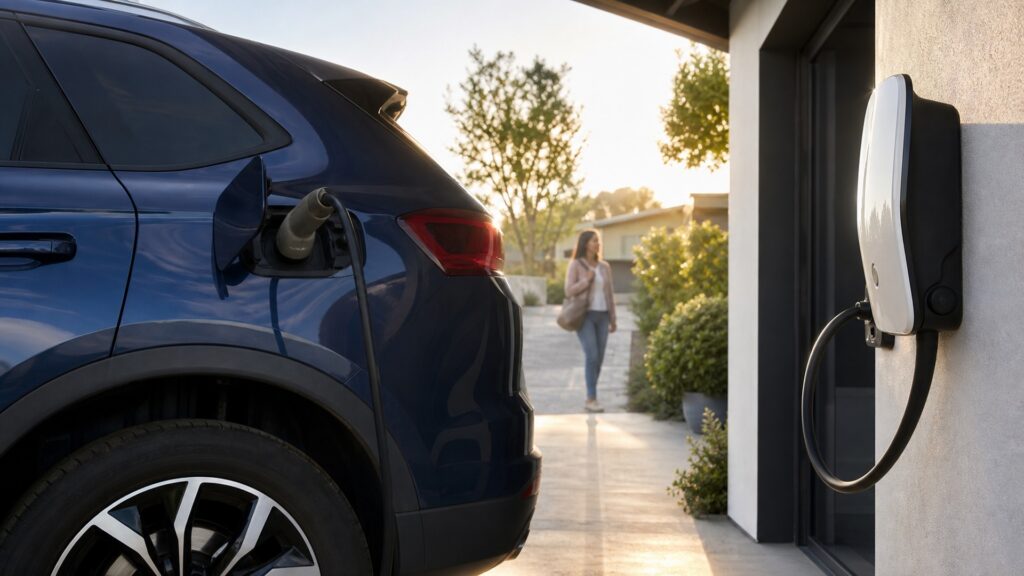
Charging speed becomes meaningful only after watts are integrated over time and compared with the energy the next trip will consume.
Tip: Compare sessions by kilowatt-hours added during the same practical stop, not solely by the highest kilowatt figure shown for a few minutes.
These terms explain why one advertised number cannot predict a complete session.
The instantaneous rate of energy transfer, commonly expressed in kilowatts.
The quantity transferred over time, commonly measured in kilowatt-hours.
The period a vehicle can remain connected before its next required departure.
The changing power acceptance across battery state, temperature, and control limits.
Heating or cooling used to bring battery cells and charging hardware toward an acceptable operating window.
The charge level and time chosen to support the next trip with an appropriate reserve.
Tip: Record starting charge, battery condition, arrival time, energy added, and departure target when diagnosing slow charging; an isolated peak conceals the shape of the session.
A charger can deliver high power briefly yet add less energy than a modest source used for many hours. Readiness depends on the area under the charging-power curve: the changing rate multiplied across the actual connection time, minus conversion and conditioning losses.
A useful speed statement always includes time, because instantaneous power alone cannot describe recovered driving capability.
Grid service, branch circuit, EVSE, cable, connector, communications, vehicle inlet, onboard AC charger, battery controls, and cell conditions form one negotiated chain. Raising a station rating has no effect when another component already sets a lower ceiling.
Charging speed belongs to the complete matched system, not independently to the station or car.
Battery management limits current when cells are too cold, too warm, near empty under some conditions, or approaching full charge. Route-based preconditioning can improve arrival temperature on supported vehicles, while high state of charge commonly produces a deliberate taper.
A slower rate can be evidence of normal protection rather than a charger fault, so context must accompany the number.
Faster charging is valuable when a short dwell otherwise blocks departure, a vehicle serves several shifts, or route options are sparse. At home, excess power may add no benefit after the car already finishes hours before departure, while increasing electrical-service or demand-management requirements.
The valuable rate is the lowest one that reliably meets the schedule, with faster capability serving as flexibility rather than a constant objective.
Compare similar starting charge, temperature, station, vehicle, and shared-load conditions. A persistent early ceiling suggests supply or equipment limits; a late decline may be expected taper; repeated interruptions, abnormal heat, or fault messages require qualified evaluation.
Trend evidence turns the vague complaint of slow charging into a specific point in the power path and charge curve.
Higher power can create flexibility, but the full session and the actual deadline determine whether it improves mobility.
Short stops, commercial utilization, long-distance travel, and large daily energy deficits can make sustained higher power operationally important.
Adequate speed creates route reserve and absorbs late arrivals, unexpected mileage, or shorter-than-planned parking windows.
A brief maximum does not reveal energy delivered, taper behavior, station sharing, thermal limits, conversion losses, or connection overhead.
Home charging that already completes before departure gains little mobility from a larger circuit unless future use or backup margin changes the deadline.
These myths mistake a rating for the energy and readiness produced across a complete session.
Time improves only until the vehicle, connector, battery, or shared station becomes the lower limit. A larger nameplate cannot force acceptance above those controls, and connection overhead may dominate very short stops.
Power often ramps, plateaus, and tapers as temperature and state of charge change. The final portion can be deliberately slower, so extending a road-trip stop toward full may add little useful energy per minute.
Low power can result from vehicle settings, cold or hot cells, high state of charge, shared capacity, cable temperature, circuit limits, or protective communications. Repeated comparable evidence is needed before assigning fault.
If ordinary overnight charging already restores the daily deficit, more power may not change departure readiness. It can still add resilience, but may require costlier service capacity, load management, or utility coordination.
Tip: Use starting conditions, the entire power curve, and the departure requirement when interpreting speed.
These answers connect charging-rate observations to daily planning without reducing the topic to a single specification.
Compare kilowatt-hours added over the same practical time, starting charge, battery temperature, vehicle, and station conditions. Note any shared-load changes, preconditioning, taper point, session interruption, and energy reported by both station and vehicle.
Many vehicles reduce accepted power as cell voltage approaches upper limits and balancing or thermal protection becomes more important. The exact transition varies, so 80 percent is a planning convention rather than a universal threshold.
It can. Cold cells may accept less power until warmed, and cabin or battery heating consumes energy during the session. Vehicle-supported preconditioning and arrival strategy can improve results without overriding protective battery controls.
Estimate the typical daily kilowatt-hour deficit, divide by realistic plugged-in hours, include losses and difficult-weather margin, then confirm the vehicle and electrical installation support that rate. Completion before departure is the decisive test.
Seek qualified help for repeated faults, abnormal connector heat, damaged pins, burning odor, unexpected interruptions, or a persistent low ceiling under comparable acceptable conditions. Preserve session records, warning messages, station identity, temperature, and state of charge.
EV charging speed matters because energy must arrive within a real parking window and before a real trip; peak kilowatts are only one point on that timeline.
Evaluate the full limiting chain and charge curve, then choose enough sustained power to meet the departure target with margin rather than chasing a rating the vehicle cannot use.
These explainers place session speed inside the broader charging system and the parking routines that determine its value.
Trace electricity, signaling, conversion, battery controls, and safety interlocks through a complete EV charging session.
Examine why Level 2 often changes overnight energy recovery while remaining limited by circuit and vehicle acceptance.
Apply charging speed to parking duration, electrical capacity, rate schedules, and a repeatable departure routine.
Choose a retailer
Prices checked regularly. We may earn a commission at no cost to you.