
Swept Glass
The windshield area regularly cleared by a wiper, affecting rain, dirt, and snow visibility through the lens.
- Coverage varies across the glass
- Blade condition influences clarity
- A legal zone may be narrower
Dash-camera fitment is the relationship between a lens, the windshield, the vehicle structure, and the electrical states that support recording. A mount can adhere securely yet leave the road partly hidden, sit outside the wiper sweep, reflect the dashboard at night, or place wiring across a restraint path.
Good fit also survives time. The camera must tolerate the chosen thermal location, accept a supported storage card, remain reachable for service, change correctly between driving and parking modes, and avoid unwanted battery drain. Only recorded clips and vehicle-state tests can prove that physical placement and electrical integration work as one installation.
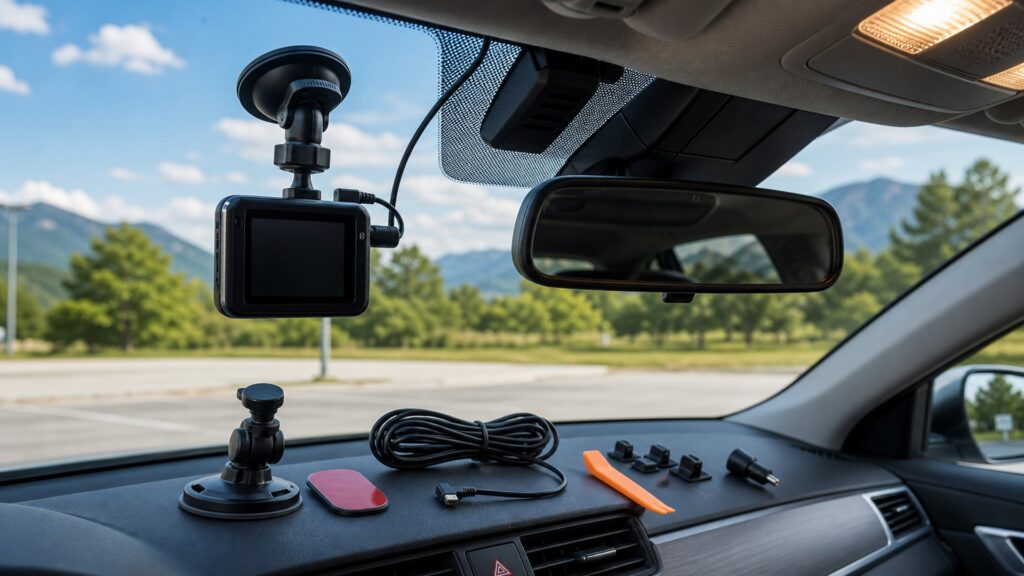
Windshield geometry, restraint zones, hidden cable paths, heat, storage access, and vehicle sleep all influence whether the installed camera remains useful.
Tip: Before hiding a cable, record a sample view from the final mount and verify the route against the exact vehicle's restraint and trim information.
These concepts define fit by what the camera can see, how it is retained, and how the vehicle powers it.
The windshield area regularly cleared by a wiper, affecting rain, dirt, and snow visibility through the lens.
A blocked portion of the camera view caused by mirror hardware, tint bands, sensors, stickers, pillars, wipers, or bodywork.
The space through which an airbag or other restraint component moves during activation.
A protected power arrangement connecting the camera to selected vehicle circuits for defined operating states.
A device or setting that stops parking-mode power at a configured condition to limit battery depletion.
The space and access needed to remove storage, operate controls, detach the camera, and inspect wiring without damaging trim.
Tip: Treat every hidden route as part of fitment; a neat surface view cannot certify what passes behind trim.
Height, lateral position, pitch, lens offset, mirror housings, sensor covers, tint, and windshield curvature set the field actually recorded. Wiper coverage, glare, and dashboard reflections change it across weather and lighting.
Fit is optical before it is cosmetic; the saved frame must contain the intended road context.
Adhesive or suction attachment, clean glass, bracket engagement, camera weight, cable pull, and heat determine whether aim drifts. The assembly should not rattle, swing, detach, obstruct the driver, or interfere with existing mirror and sensor hardware.
A mount passes when its recorded framing stays stable, not merely when it feels firm once.
Front power cables and rear-camera leads often cross pillars, headliners, hatch boots, or moving joints. Routes need suitable slack, abrasion protection, secure retention, and separation from deployment paths without compromising weather seals or trim clips.
Concealment is secondary to restraint clearance and long-term cable support.
A switched outlet may end recording with the ignition; an always-on feed may keep the camera awake; a hardwire device can expose separate constant and accessory states. Fuse choice, ground quality, cutoff settings, timer behavior, and network sleep require verification.
Power fitment is correct only when the camera changes mode without defeating vehicle sleep.
Sun-heated glass can expose cameras, adhesive, batteries or capacitors, and memory media to severe conditions. Fitment should follow rated limits, leave ventilation clear, permit card removal, and avoid trapping the unit behind hardware that prevents inspection.
A hidden installation still needs a practical path for media replacement, updates, and fault diagnosis.
Initial framing is necessary, but vibration, weather, sun, battery state, trim movement, and storage service determine whether the view remains available.
Correct placement and routing provide stable coverage, restraint clearance, predictable power transitions, and accessible maintenance.
Sample clips reveal occlusion, reflections, blur, and aim errors that exterior appearance cannot show.
Local obstruction rules, exact airbag layouts, windshield treatments, vehicle power logic, and cabin temperatures differ widely.
No mount position can guarantee readable detail in every angle, speed, weather, or lighting condition.
These myths treat adhesion, concealment, or a live preview as proof of complete fit.
A high mount can reduce visible hood but may sit behind tint, sensors, mirror hardware, or an unswept area. Legal restrictions, lens offset, wiper coverage, glare, service access, and the actual saved view decide suitability.
Pillars and headliners may contain curtain airbags, clips, drainage, antennas, or sharp edges. An unsupported cable can cross a deployment path or chafe over time, so exact vehicle guidance matters more than visual neatness.
Continuous power does not establish battery protection, correct mode transition, or vehicle sleep compatibility. Camera draw, cutoff logic, outlet behavior, battery condition, temperature, and parking duration all affect whether the arrangement is appropriate.
Preview does not confirm exposure after dark, wiper coverage, stable aim, sustained storage writes, event protection, startup timing, rear-channel continuity, shutdown, or retrieval. Open several saved clips after real driving and parking-state tests.
Tip: Verify saved footage and every affected vehicle state after the trim is restored.
These answers address mounting position, rear-camera wiring, power choice, batteries, and final acceptance.
Choose a location allowed by applicable rules that preserves the driver's view, gives the lens useful swept-glass coverage, avoids sensor and mirror occlusion, supports the mount, permits service, and follows the camera and vehicle instructions.
The cable may cross multiple trim zones and a moving hatch or trunk transition, while the lens faces defroster lines, tint, headrests, cargo, glare, and rear wiper limits. Route and sample footage both require verification.
No. Circuit behavior, loading, protection, fuse type, conductor size, ground, accessory versus constant state, and vehicle electronics all matter. Use documented connection methods and qualified help when the exact electrical architecture is uncertain.
Parking recording consumes energy after driving. Runtime depends on camera mode, battery condition, temperature, drive pattern, cutoff or timer behavior, and other loads. Verify supported protection and do not treat a cutoff as unlimited coverage.
The mount remains stable; the view is useful day and night; wiring respects restraints and movement; trim and seals are restored; driving and parking states switch correctly; vehicle sleep is normal; and recent clips open successfully.
Dash-camera fitment matters because optical coverage, mount stability, hidden wiring, vehicle power states, heat, and service access determine whether recording remains both useful and responsibly integrated.
Prove fit with saved clips and start-to-sleep tests. Adhesion and tidy trim alone cannot verify the view, the route, or the battery behavior.
These explainers show how the fitted camera builds files, which functions require acceptance, and which safety controls deserve their own audit.
Follow the image, encoding, loop-storage, event, and retrieval stages the installed camera must support.
Audit readiness, capture continuity, event preservation, metadata, and file access after installation.
Review view obstruction, mount security, wiring protection, battery limits, and privacy as distinct hazards.
Choose a retailer
Prices checked regularly. We may earn a commission at no cost to you.