
Sightline Obstruction
A device, cable, reflection, or mount blocking visual information the driver needs from the roadway or vehicle.
- Near objects cover large angles
- Legal zones vary
- Both eyes and seating position matter
A dash camera can record excellent video and still be poorly integrated. A windshield mount can block useful vision, a loose camera can detach, a hidden cable can cross an airbag path, or an unfused lead can expose wiring to fault current. Parking operation can also consume battery energy long after the driver leaves.
Safety factors matter because these risks are separate from image quality. The screen and alerts should not invite interaction while moving; heat and power limits should be respected; and stored audio, locations, faces, or conversations require responsible handling. A complete review asks what harm each installation or use choice could create, then tests the corresponding control.
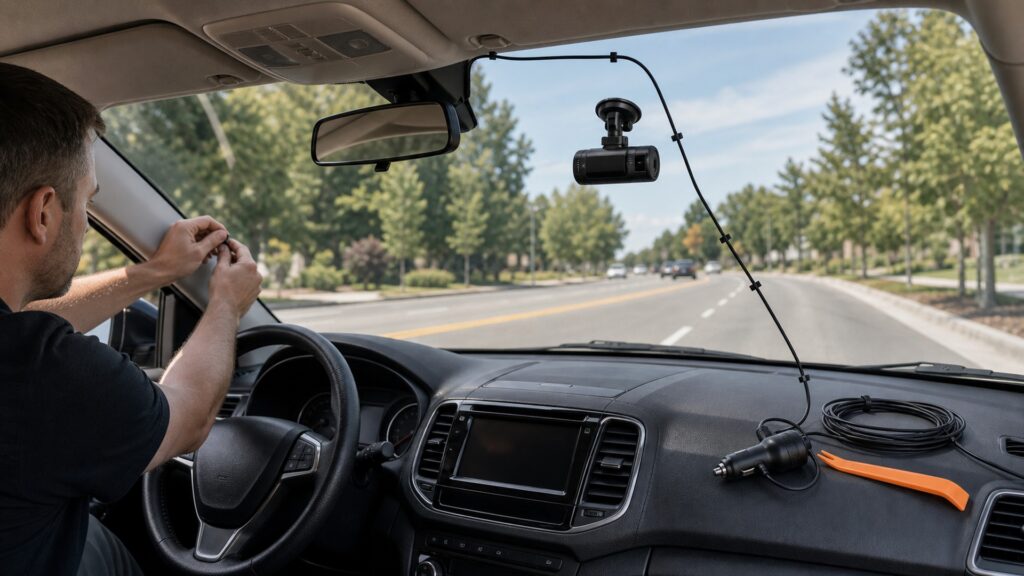
Driver view, physical restraint, protected wiring, battery state, temperature, attention, and recorded data each need their own safeguard.
Tip: Do not let a sharp clip end the review; inspect the device, route, power source, shutdown state, and data workflow that produced it.
These terms identify hazards that recording specifications cannot measure.
A device, cable, reflection, or mount blocking visual information the driver needs from the roadway or vehicle.
The ability of the attachment, bracket, and camera joint to remain secured through vibration, temperature, and expected loading.
Separation of camera wiring and hardware from airbags, pretensioners, and their deployment or service areas.
A fuse or equivalent control near the power origin limiting fault energy in the added conductor.
The finite battery energy available to camera operation while the charging system is inactive.
Deliberate control of audio, video, location, access, copying, sharing, and retention.
Tip: For every risk, name the physical or procedural control and verify it in the condition where it matters.
A compact camera close to the driver's eyes can obscure a meaningful angle, especially around mirrors, pillars, pedestrians, signs, or traffic signals. Cables, status lights, and dashboard reflections can add distraction or visual clutter even when the lens view is good.
The camera's field of view should never be improved by sacrificing the driver's own view.
Glass preparation, adhesive or suction condition, bracket engagement, joint tension, heat, vibration, and cable pull influence attachment. A detached camera or dangling lead can distract the driver or move through occupant space during sudden maneuvers.
Stable footage is useful evidence, but secure mass control is the safety purpose of retention.
Pillars, headliners, seats, and trim may contain airbags, sensors, antennas, wiring, or moving mechanisms. Cables need exact routing, abrasion protection, suitable clips, and serviceable slack without being placed across deployment zones or controls.
A concealed wire is not necessarily a safe wire; its relationship to vehicle systems matters.
Added power wiring should match source, conductor, connector, fuse, ground, and camera requirements. Parking mode adds off-state draw, so cutoff or timer behavior, battery condition, temperature, driving frequency, and vehicle sleep must be treated as one energy plan.
A low-voltage cutoff reduces one risk but cannot guarantee starting under every battery and weather condition.
Configure the camera while parked, understand alerts, and avoid screen review during driving. Decide whether audio or location is necessary, restrict app and cloud access, preserve important originals, and share footage only with appropriate purpose and context.
Safe use includes the people and information inside the recording, not only the hardware on the glass.
Proper placement, retention, routing, power, and data practice remove avoidable hazards while road conditions, law, batteries, and human behavior remain variable.
The driver's view remains clear, the mount stays secured, wiring respects restraints, the circuit is protected, and vehicle sleep behaves normally.
Automatic startup and restrained alerts reduce the need to interact while driving, while deliberate data controls limit unnecessary exposure.
Mounting legality, audio consent, privacy, evidence handling, and permitted disclosure differ by place and circumstance.
Battery capability, adhesion, heat, and attention can change over time, so initial acceptance is not permanent assurance.
These myths equate recording success with safe installation and use.
Mirror position, camera size, lens offset, mount, cable, tint, sensors, and the driver's eye point all matter. A device hidden from one seating angle can still block another view or violate applicable placement rules.
Small mass can still detach, swing, distract, strike trim, or pull a cable during sudden motion. Proper surface preparation, approved mounting parts, locked joints, strain relief, and periodic retention checks remain important.
Cutoff accuracy, battery age, temperature, parasitic loads, parking duration, drive recovery, wiring protection, and vehicle sleep affect risk. The device limits one condition; it does not certify every battery or electrical scenario.
Recordings may contain passengers, conversations, locations, plates, homes, and bystanders. Phone apps, automatic backups, service access, or casual sharing can create copies, so settings, access, retention, and disclosure deserve deliberate control.
Tip: Check the hazard control directly instead of using video quality as a proxy.
These answers focus on obstruction, retention checks, airbag routing, parking battery risk, and handling important footage.
Sit in the normal driving position and assess the full device, mount, cable, reflections, and status lights against road, mirror, signal, pedestrian, and vehicle-display views. Then apply the exact jurisdiction's placement requirements.
Inspect after installation, strong temperature cycles, glass work, trim service, accidental contact, unusual vibration, aim drift, adhesive edge lift, or a cable change. Follow the mounting instructions rather than adding unapproved adhesive or hardware.
Curtain-airbag shape, anchor points, trim clips, sensors, and deployment direction vary by body style, model year, seat, and option. Generic tucking advice cannot establish clearance; use exact service information or qualified installation.
Any off-state load can contribute when battery capability, temperature, parking duration, other loads, or drive recovery is unfavorable. A supported cutoff or timer reduces exposure, but its threshold and behavior must be tested conservatively.
Retrieve it promptly, preserve the original relevant files and surrounding context, document when and how copies were made, restrict access, avoid editing the only copy, and seek appropriate guidance when legal or insurance handling matters.
Dash-camera safety factors matter beyond image quality: the driver's view, mount retention, restraint clearance, circuit protection, parking energy, heat, attention, and recorded data can each create a distinct risk.
Verify every control directly and revisit it after service or environmental change. A good clip does not prove a safe installation.
These explainers show where the camera belongs, how its recording chain behaves, and which end-to-end tests reveal hidden failures.
Apply view, route, power-state, thermal, and service constraints to the exact vehicle installation.
Verify that safe automatic operation still produces continuous, retrievable recordings without unexpected state behavior.
Place recording benefits beside realistic coverage, context, privacy, and evidence limits.
Choose a retailer
Prices checked regularly. We may earn a commission at no cost to you.