
Diagnostic Hypothesis
A testable proposed cause that predicts specific observations when the system is placed under defined conditions.
- It narrows tool choice
- Competing causes require separating tests
- Results should update the next step
Diagnostic equipment matters because a symptom is an observation, not a cause. A no-start, warning lamp, vibration, misfire, leak, overheating event, or poor brake feel can arise from many systems. Instruments turn those possibilities into voltage, current, pressure, temperature, waveform, dimension, flow, and network evidence.
The tool must fit the hypothesis. A scan tool reports what modules see; a meter tests electrical potential and continuity; a scope preserves time; a pressure gauge reveals hydraulic or pneumatic behavior; smoke finds certain leaks; mechanical gauges establish wear or geometry. Each can mislead through wrong range, reference, connection, sampling rate, or test condition. Strong diagnosis compares the measurement with service information and a known-good baseline, then repeats the decisive test after repair.
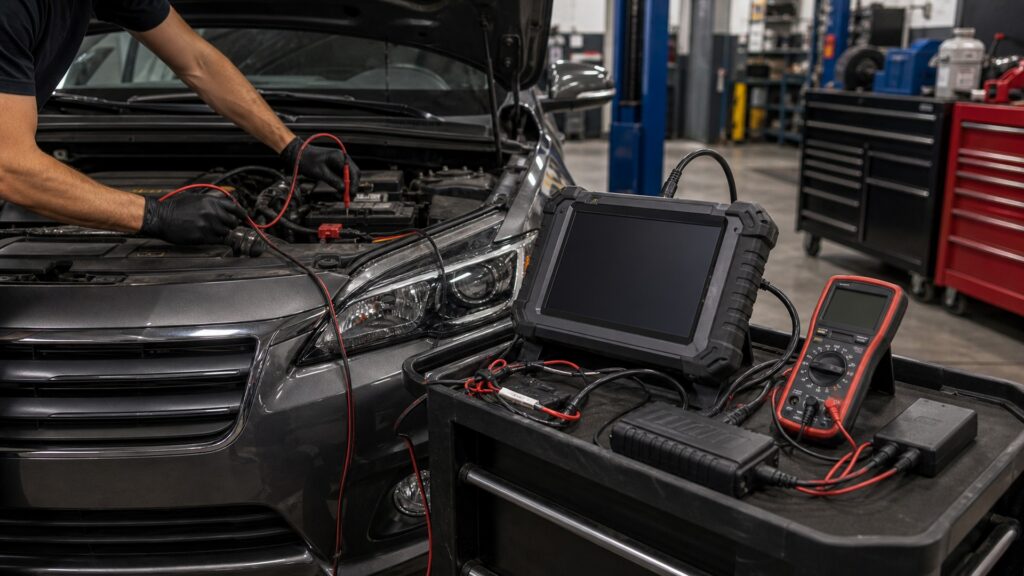
Diagnosis becomes efficient when the expected result, test condition, tool range, connection point, and decision after each possible reading are defined before measurement.
Tip: Before connecting a tool, write: If the reading is high, low, normal, or intermittent, what will that result eliminate? If no answer changes the next step, the measurement is collecting data without diagnosing.
These terms distinguish useful evidence from a number detached from conditions and reference.
A testable proposed cause that predicts specific observations when the system is placed under defined conditions.
An expected measurement tied to an exact vehicle, system state, location, temperature, load, and procedure.
Electrical potential measured across a conductor or connection while current flows through the circuit.
Change in circuit or system behavior caused by connecting the diagnostic instrument itself.
The frequency at which an instrument captures values from a changing signal over time.
Repetition of the fault-revealing test and relevant functional checks after corrective work.
Tip: A measurement must identify what was measured, where, when, under which load, with which range and instrument.
Corroded terminals, damaged strands, weak grounds, or high-resistance contacts can pass a continuity test yet collapse voltage during starter, blower, lamp, heater, or motor operation. Voltage-drop and current tests reveal what the circuit delivers under demand.
An unloaded twelve volts can coexist with a circuit unable to supply useful power.
Sensors, injectors, ignition, communication buses, and motors change too quickly for a basic display. An oscilloscope can correlate command, voltage, current, and mechanical signatures, but probe choice, grounding, bandwidth, trigger, and timebase determine whether the trace is faithful.
A colorful trace without timing and reference can be more persuasive than informative.
Fuel, oil, cooling, boost, vacuum, brake, and hydraulic systems need the right gauge, transducer, adapters, and safe containment. Static pressure may be normal while flow collapses; dynamic pressure can reveal restriction, leakage, pump wear, or control error.
Command data and delivered pressure belong in the same diagnostic story.
A smoke machine can reveal intake or evaporative leaks at controlled pressure, while cooling, refrigerant, combustion, and fluid leaks may need dyes, gas detection, chemical tests, vacuum decay, or visual inspection. Excess test pressure can create damage.
Visibility is useful only when the tracer behaves safely in the system being tested.
Record the initial condition, decisive abnormal measurement, corrective action, and post-repair result under comparable load and temperature. A scan report, waveform, pressure graph, or dimensional reading becomes more valuable when another technician can reproduce it.
A repair is strongest when the same instrument shows why the symptom disappeared.
Each instrument should separate plausible causes with a measurement the vehicle state and service reference make interpretable.
It reproduces the symptom safely, measures a quantity causally related to the fault, uses the correct range and connection, and compares against an exact reference or known-good baseline.
Its result changes the diagnostic branch, is documented with test conditions, and can be repeated after repair to show that the causal abnormality—not merely the code—was corrected.
A costly tool cannot create a valid hypothesis, a trustworthy reference, safe probing, correct interpretation, or an understanding of how one system can make another module report a fault.
No reading should override damage, smoke, fire, unstable lifting, high-voltage boundaries, pressure hazards, refrigerant law, airbag precautions, or a procedure that requires specialist equipment and training.
Diagnostic myths treat instruments as answer machines instead of ways to challenge a specific causal explanation.
Modules report their inputs, logic, and network observations, but cannot directly prove every wire, pressure, mechanical clearance, fluid flow, or combustion event. Independent electrical and mechanical measurements often establish whether the reported state is real.
A few meter milliamps may pass through corrosion or one remaining strand. Test voltage drop while the normal load operates, inspect terminals and strain points, and compare current with expected circuit behavior before clearing the conductor.
Higher bandwidth, accuracy, coverage, or support can expand capability, but wrong setup and interpretation still produce wrong conclusions. The simplest instrument that safely separates the hypotheses is usually the best first measurement.
Intermittent faults, temperature, vibration, load, module strategy, and sampling can make a brief test look normal. Reproduce the relevant condition, compare multiple linked quantities, and capture enough time to include the event.
Tip: Judge a test by the branch it resolves and the condition it reproduces, not by the tool's price or number of displayed channels.
These answers cover tool priorities, meters versus scopes, current clamps, known-good data, smoke testing, and how to avoid turning diagnostics into random measurement.
Choose from the work performed. A quality meter, test leads, service information, pressure gauge, or basic scan tool may offer more value than a complex scope. Learn safe setup and interpretation before expanding channel count.
Use it when timing, waveform shape, brief dropout, communication integrity, or current ramp contains information a slower meter or scan refresh cannot preserve. The operator must understand probes, grounding, bandwidth, triggering, and expected patterns.
A suitable clamp measures current without disconnecting the conductor, preserving the loaded system and capturing changing demand. Jaw placement, conductor direction, range, zeroing, bandwidth, and nearby magnetic fields can still affect accuracy.
Use manufacturer specifications, service procedures, training resources, verified technical databases, and measurements from an equivalent healthy vehicle under matching conditions. Record configuration, temperature, load, units, connection, and software state so comparison remains valid.
No. Smoke suits selected low-pressure air and vapor paths when the equipment and procedure approve it. Liquid leaks, high-pressure systems, internal engine leakage, refrigerant, combustion gases, or faults that close during testing need different methods.
Automotive diagnostic equipment matters because it turns competing explanations into electrical, pressure, temperature, waveform, dimensional, and network evidence tied to a real operating condition.
Choose the quantity that can separate causes, measure it safely against an exact reference, document the setup, and repeat the decisive test after repair; more data without a hypothesis only creates a larger guessing surface.
Related explainers connect instrument-based diagnosis with scanner coverage, standardized OBD-II information, and tool selection by interface and risk.
Decide when enhanced module data, topology, active tests, secure access, and programming justify a professional scan platform.
Use standardized OBD-II codes, freeze frame, monitors, and live data within their regulatory scope.
Match meters, leads, adapters, pressure ranges, probes, and protective ratings to the exact system and question.
Choose a retailer
Prices checked regularly. We may earn a commission at no cost to you.