
Service Interval
The maker's time, distance, operating-hour, or algorithmic prompt for inspecting or replacing a specified filter.
- Intervals assume defined conditions
- Exact engine application matters
- Symptoms can require earlier action
Engine-filter maintenance preserves clean flow before restriction, contamination, or seal failure reaches sensitive engine surfaces. Intake elements load with environmental dust; oil filters retain wear debris and combustion material; fuel filters protect pumps and injectors and may collect water. Each circuit has its own interval, endpoint, and handling rules.
Maintenance matters because waiting too long can raise pressure loss or permit damage, while changing too often can disturb seals, introduce downstream dirt, waste capacity, and conceal the condition trend. The correct plan combines the exact schedule, severe-duty guidance, measured restriction where specified, contamination events, fluid changes, careful housing inspection, documented fitment, and pressure or leak verification after installation.
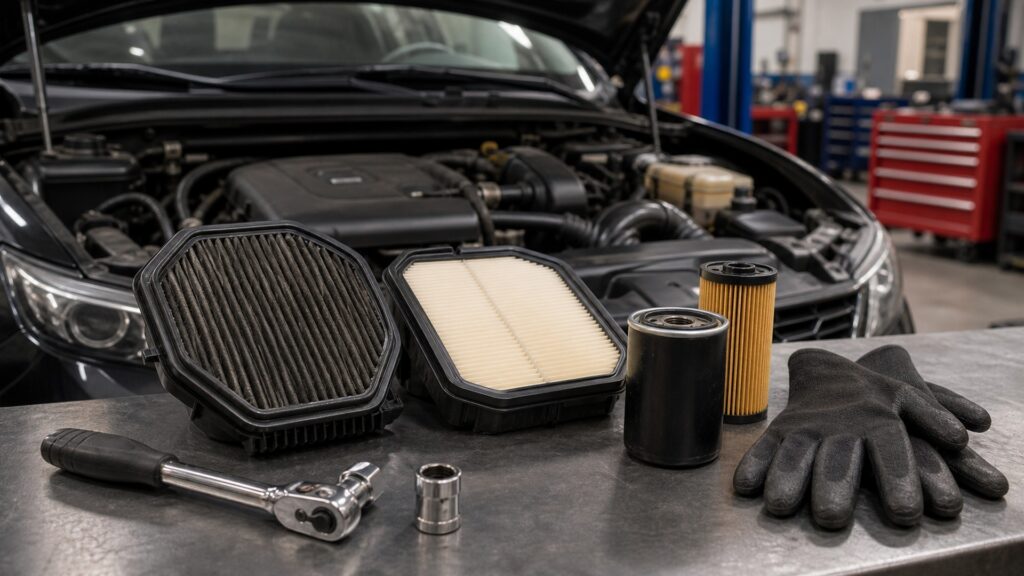
Maintenance is not one universal mileage number; exposure, flow, fluid condition, media capacity, housing condition, and manufacturer guidance decide when intervention protects rather than disrupts.
Tip: Do not open a heavy-duty air cleaner merely to admire the media; unnecessary removal can damage the seal and place dirt on the protected side.
These terms connect calendar prompts with real filter condition and safe maintenance decisions.
The maker's time, distance, operating-hour, or algorithmic prompt for inspecting or replacing a specified filter.
A shorter or modified maintenance plan for dust, idling, towing, short trips, temperature extremes, or other demanding use.
A device recording intake vacuum or pressure loss so air-filter service follows a calibrated endpoint.
A fuel-filter assembly that coalesces and collects water for monitored or scheduled drainage.
An unusual exposure such as water intrusion, wrong fluid, damaged ducting, tank debris, or open-circuit service dirt.
Dated evidence of element identity, operating conditions, findings, fluid, seals, procedures, and verification.
Tip: Keep the removed part until verification ends; its loading, seals, markings, and deformation can explain the old condition or expose a catalog error.
The manual establishes a baseline from expected operation. Dust, road construction, agricultural work, frequent idling, water exposure, poor fuel, or repeated short trips can alter loading and fluid behavior before the standard point.
A maintenance date is a decision prompt, not proof that every filter reached the same condition.
Some dry media becomes more efficient as dust loads while resistance gradually rises. Excess removal, tapping, compressed air, or poor reseating can tear media, deform pleats, or contaminate the outlet.
Useful capacity should be consumed without sacrificing the clean-side boundary.
Oil and filter choices interact with cold flow, pump delivery, contaminants, and the engine's bypass design. A correct filter installed with wrong oil quantity, old gasket, or unsuitable viscosity does not complete maintenance.
Maintenance owns the entire disturbed lubrication path, not only the cartridge.
Fuel service may require depressurization, clean priming, separator drainage, new seals, and disposal of flammable liquid. Longer intervals can load media; careless service can introduce exactly the particles or air the system excludes.
A clean fuel circuit can be damaged during the maintenance intended to protect it.
After service, confirm every housing is closed, fluid quantity is correct, prime and pressure appear normally, warnings remain off, and no leak or intake gap exists. Record conditions and findings for the next interval.
A documented baseline turns the next inspection into a trend instead of a guess.
The best interval preserves contaminant capacity and clean flow without needless handling, wasted material, or a service-created leak.
The exact schedule, severe-duty classification, measured endpoint, contamination event, warning, or damaged condition provides a documented reason to act.
Correct parts, clean handling, new specified seals, fluid requirements, torque, priming, pressure, leakage, and final operating checks are planned before opening the circuit.
Media color, an oil-change habit, a generic shop package, or another vehicle's mileage cannot replace exact application guidance and circuit evidence.
A new filter cannot repair damaged ducts, housings, pumps, sensors, injectors, worn engine parts, contaminated tanks, wrong fluids, or an active pressure fault whose root cause remains present.
Maintenance myths reward either needless frequency or heroic delay while ignoring the contamination risk of opening a protected circuit.
Unnecessary opening can damage media, disturb seals, introduce clean-side debris, or create leaks while discarding usable capacity. Follow the exact interval, severe-duty rules, measured endpoint, and any damage or contamination event.
Dust color and surface appearance do not quantify restriction, capacity, tears, moisture, or perimeter sealing. Use manufacturer guidance and a calibrated indicator where provided, while replacing any visibly damaged, wet, or deformed element.
Cartridge and spin-on designs differ in seals, caps, torque, drain features, priming, bypass, orientation, and oil-level checks. Follow the exact engine instructions rather than transferring a familiar sequence across housings.
Fuel may remain pressurized and flammable, while clean high-pressure equipment is contamination-sensitive. Depressurize, contain liquid, control ignition sources, cap openings, install exact seals, prime correctly, and inspect carefully for leakage.
Tip: Use documented endpoints and careful technique so the act of maintenance does not become the filter system's worst exposure.
These answers address interval selection, severe duty, reusable elements, unknown history, and what a maintenance record should preserve.
Use the vehicle maker's definition, which may include dust, towing, idling, short trips, low speed, temperature extremes, commercial use, or poor fuel. Do not assume the label from driving style alone.
Inspect and follow exact guidance. Wet air media can distort or restrict; water in fuel requires controlled draining and source correction; contaminated oil may require broader service. Identify downstream exposure before simply installing an element.
Inspect application, housing, seals, fluid condition, warnings, pressure or restriction evidence, and service records. A reasonable baseline replacement may be prudent, but unknown history does not excuse wrong parts or careless opening.
Only within the product and vehicle instructions. Cleaning, drying, oiling where applicable, media integrity, sensor compatibility, sealing, and permitted reuse cycles determine suitability. Incorrect servicing can raise restriction or release contamination.
Record date, mileage or hours, duty classification, measurements, warnings, filter and seal numbers, fluid specifications, observed contamination, housing condition, torque, priming, pressure, leakage, engine response, disposal method, and technician findings.
Engine-filter maintenance matters because air, oil, and fuel elements load differently and because opening any protected circuit can either restore margin or introduce a new fault.
Combine exact intervals with severe-duty evidence, measured endpoints, contamination events, clean installation, and verified pressure or restriction. Preserve the result in a service record that makes future decisions more precise.
Related explainers connect maintenance timing to filter mechanics, hidden fitment interfaces, and the operating curves that define useful capacity and terminal restriction.
Trace how each filter captures contamination while preserving required air, oil, or fuel flow.
Match seals, valves, materials, threads, standpipes, housings, and application data before opening the replacement package.
Interpret efficiency, capacity, loading, differential pressure, collapse strength, and bypass across the service life.
Choose a retailer
Prices checked regularly. We may earn a commission at no cost to you.