
Graded Media
Layered or structured fibers arranged so contaminant capture and loading occur through different depths of the element.
- Open upstream layers hold larger debris
- Finer layers capture smaller particles
- Depth can expand capacity
An engine filter is not simply a screen. Air and liquid filters use fiber networks, pore paths, surface treatments, pleat area, flow direction, and sometimes electrostatic or coalescing effects to intercept contaminants across a distribution of sizes. The element must retain what it captures without shedding or collapsing.
Operating function matters because stronger capture can increase resistance, greater area can add capacity, and system pressure or viscosity can change the load on media and seals. Air filters approach a terminal restriction; oil circuits may use calibrated bypass during excessive differential pressure; fuel filters may separate water and must avoid air leaks. The correct result is protected downstream hardware with sufficient clean flow—not maximum filtration in isolation.
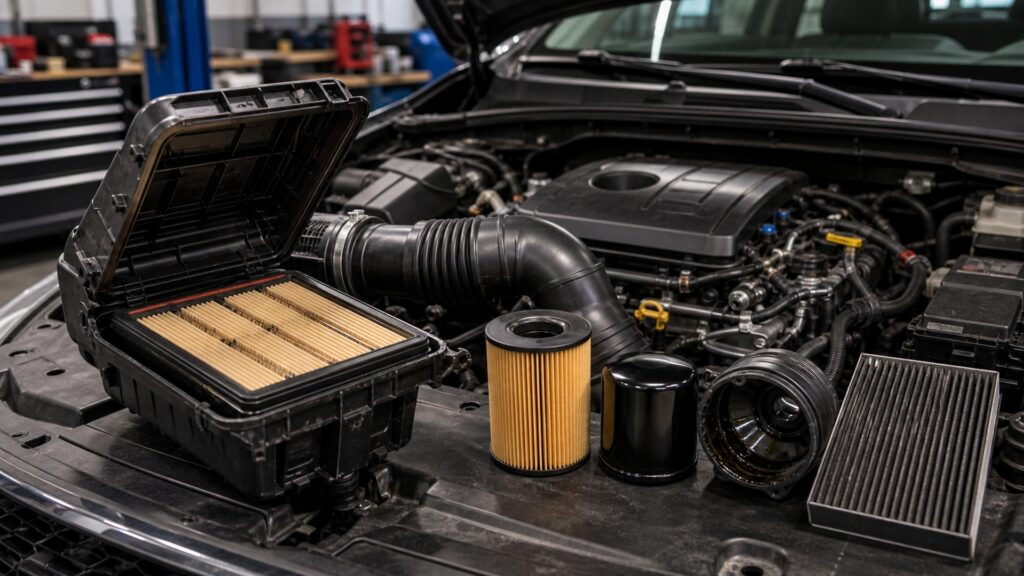
Efficiency, capacity, restriction, structure, sealing, and circuit controls must remain compatible from clean installation to the service endpoint.
Tip: A percentage without particle size, test method, flow, endpoint, and application tells little about how an element will protect a real engine.
These terms explain how media behavior and circuit limits combine during the filter's working life.
Layered or structured fibers arranged so contaminant capture and loading occur through different depths of the element.
Particle capture that occurs when mass prevents a contaminant from following fluid around a fiber.
Contaminant storage within the thickness of filter media rather than only across its upstream face.
The defined maximum resistance or pressure-drop endpoint at which the application calls for filter service.
The ability of folded media and supports to maintain spacing and flow area under pressure, vibration, and moisture.
The collection of fine water droplets into larger drops that can separate from fuel into a sump.
Tip: Compare performance data from the same recognized test method; unrelated micron labels and marketing percentages do not form a reliable ranking.
Contaminants do not pass straight through uniform holes. They encounter tortuous fiber paths where interception, impaction, diffusion, sieving, and surface forces contribute differently with particle size, flow, media, and fluid.
A filter's smallest advertised particle is not the same as controlled efficiency at that size.
Pleats multiply area within a compact housing, while media structure determines where deposits accumulate. More capacity delays terminal restriction under a given dust or debris challenge, but real environments rarely match a constant laboratory feed.
Service life is the distance between correct installation and a defined operating limit.
Every filter consumes some pressure. Higher flow and accumulated contaminant raise that loss; cold viscous oil can create a much larger differential than hot oil. The circuit must retain supply throughout its normal envelope.
Restriction becomes harmful when the circuit can no longer deliver required fluid through the intended path.
Pressure pulses, vibration, heat, water, fuel chemistry, and handling try to deform pleats or separate joints. Collapse or seal leakage can reduce filtration abruptly even when the media material itself remains efficient.
Mechanical integrity turns laboratory media performance into usable engine protection.
Oil-filter bypass preserves supply during excessive differential pressure; anti-drainback features can retain oil in selected orientations; fuel-water separators collect water for controlled draining; restriction indicators can mark air-service endpoints.
These controls complement correct media; they are not interchangeable accessories.
Filtration quality emerges across contaminant size, efficiency, capacity, restriction, structure, sealing, flow, temperature, and the circuit's control thresholds.
A recognized test method, defined contaminant, efficiency curve, capacity endpoint, pressure-drop data, structural ratings, valve specifications, material compatibility, and exact application fit.
In-service verification shows normal pressure or restriction, intact seals and housings, no downstream contamination event, and service timing appropriate to the real duty cycle.
Absolute micron numbers, airflow percentages, extended intervals, washable labels, and visual cleanliness lack meaning without test conditions, engine limits, maintenance procedure, and effect on downstream protection.
No filter function compensates for a cracked housing, open duct, wrong fluid, weak pump, contaminated tank, incorrect bypass, service debris, or operation outside the engine's pressure and temperature envelope.
Operating-function myths oversimplify a filter into either a blockage or an unrestricted screen.
Particle size alone omits efficiency, test method, contaminant distribution, pressure drop, capacity, structure, bypass, and application. A nominal claim may describe partial capture, while engine protection requires documented performance across relevant conditions.
Low restriction can help when the original element constrains demand, but it must coexist with adequate dust efficiency, capacity, sealing, structural integrity, and calibration. Measured engine benefit and downstream cleanliness both matter.
Bypass is intended for limited conditions when preserving lubrication flow is safer than forcing oil through excessive restriction. Correct media handles normal operation; frequent bypass suggests cold viscosity, loading, fitment, or circuit problems.
Media behavior changes as particles occupy pathways. Some filters gain efficiency as they load while restriction also rises. Performance must be understood across the test cycle through its specified terminal endpoint.
Tip: The engineered goal is selective resistance: impede damaging contaminants while sustaining the fluid delivery the engine needs.
These answers cover micron ratings, laboratory tests, restriction, bypass, washable elements, and the meaning of capacity.
Efficiency describes the portion of defined contamination removed under stated conditions; capacity describes how much contamination the element holds before a specified endpoint. High efficiency does not automatically provide long service life or low restriction.
Low temperature raises viscosity, so moving the same volume through media requires greater pressure differential. Correct viscosity, media area, supports, bypass calibration, pump behavior, and warm-up conditions protect flow during startup.
Yes, deposited dust can narrow pathways and improve capture of finer particles, while simultaneously increasing restriction. That is why some heavy-duty systems use a manufacturer-defined restriction endpoint rather than appearance alone.
No. Cleaning method, media damage, oiling amount where applicable, seal condition, drying, housing cleanliness, and manufacturer cycle limits affect performance. An incorrectly serviced reusable element can leak, restrict, shed material, or contaminate sensors.
Use like-for-like standardized tests, exact application data, particle-size efficiency, capacity, initial and terminal pressure drop, burst or collapse strength, valve settings, seal materials, warranty, and independent engine constraints rather than slogans.
Engine-filter operating function matters because capture, capacity, restriction, structure, sealing, and circuit controls change together throughout service life.
Choose an exact application with credible test context, install it without clean-side contamination, and service it at the documented interval or endpoint. Protected downstream hardware and sufficient flow are the joint objective.
Related explainers connect filter physics with correct fitment and the engine functions that depend on clean air, lubricating oil, and conditioned fuel.
Trace the complete air, oil, and fuel paths in practical service order.
Match seals, internal geometry, valve settings, materials, and housing interfaces to the exact engine.
See how filtered air, oil, and fuel support combustion, bearings, cooling, pumps, injectors, and controls.
Choose a retailer
Prices checked regularly. We may earn a commission at no cost to you.