
Coupler Geometry
Defined dimensions and interfaces for the vehicle inlet and charging connector.
- Shape prevents incorrect mating
- Retention carries mechanical loads
- Pins have assigned functions
EV charging standards matter because a plug must do far more than fit. Before energy flows, the vehicle and supply equipment identify connection state, advertise limits, verify safe conditions, and coordinate contactors. Fast charging may add digital communication for voltage, current, isolation, authorization, and fault handling.
Standards give independent designers a shared technical language, but they do not make every charger, vehicle, network, or adapter interchangeable. Regional connector families, optional features, implementation versions, certification, payment systems, cable ratings, and software behavior still vary. Reliable charging therefore depends on standards plus conforming products, correct deployment, qualified adapters, maintenance, and useful failure reporting.
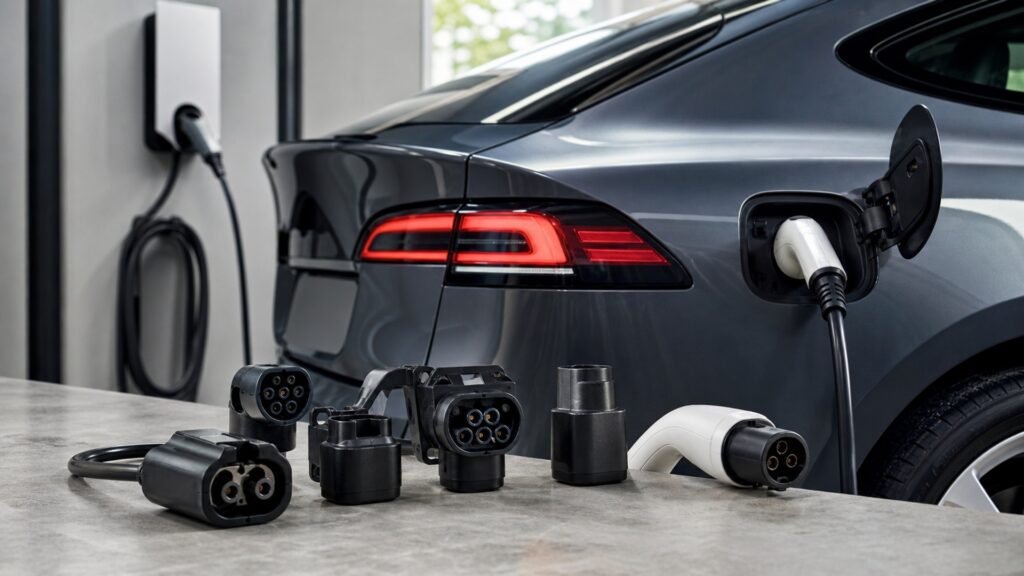
A standard coordinates mechanical, electrical, signaling, and test expectations across products built by different organizations.
Tip: When compatibility is uncertain, verify the exact vehicle, inlet, charger, cable, adapter, network, and software combination; a familiar logo or matching plug is incomplete evidence.
These concepts show how standards convert a physical connection into controlled power transfer.
Defined dimensions and interfaces for the vehicle inlet and charging connector.
A signaling path used to communicate connection state and available current for conductive AC charging.
Sensing that identifies connector presence or latch activity.
Digital data exchanged over conductors associated with charging.
Structured testing of a product against specified requirements and behaviors.
An assembly designed, rated, and authorized to bridge particular interfaces without bypassing safety functions.
Tip: Use the current edition and the product's declared implementation; standards families evolve, and optional functions may not be present on every conforming device.
Conductive charging uses connection detection, current advertisement, insulation or isolation checks where applicable, and commanded contactors so high power is not simply present at an unmated handle. Defined fault states provide a coordinated path to stop transfer.
The visible plug is only the final interface in a timed safety sequence shared by both sides.
A connector can mate while communication, authorization, voltage range, current capability, certificate handling, network service, or software remains incompatible. Standards divide these jobs across documents, and products may implement different optional features or revisions.
Interoperability is an end-to-end behavior, not a photograph of two matching connectors.
With AC charging, the vehicle's onboard charger converts grid AC to battery DC and the supply advertises permissible current. DC fast equipment performs conversion off board and negotiates battery-facing voltage and current, creating different hardware and communication demands.
The same connector family may carry different power modes, so electrical capability must be verified separately from shape.
A safe adapter must preserve grounding, signaling, retention, insulation, temperature behavior, current limits, and the vehicle-maker's supported communication path. Unqualified parts can create new joints and failure modes even when the conductors appear straightforward.
An adapter translates a defined system boundary; it cannot manufacture missing protocol or network support.
Published standards let manufacturers test against stable requirements while revisions address new evidence, power levels, adapters, and communication functions. Deployed vehicles and stations remain on earlier hardware or software, so transition planning and backward compatibility matter.
Standards reduce ambiguity, but disciplined implementation and lifecycle support turn the document into dependable charging.
Common geometry and signaling make multi-vendor charging possible while optional features, versions, networks, and maintenance preserve real differences.
They define interfaces, states, limits, sequencing, and tests that let independently developed vehicles and equipment coordinate safely.
They create diagnosable boundaries, giving engineers and technicians specific behaviors to verify instead of relying on proprietary guesswork.
Conformance does not promise every optional feature, payment method, network service, power level, adapter, or software version will interoperate.
Damaged hardware, poor installation, thermal stress, communication faults, and obsolete deployments can defeat a nominally compatible pairing.
These myths reduce a layered technical agreement to connector appearance.
Mechanical mating confirms only one layer. The vehicle and station must also agree on signaling, voltage, current, safety state, communication, authorization, and supported mode before contactors close and useful power flows.
Standards permit ranges of current, voltage, cable construction, and communication capability. Station hardware, site capacity, vehicle acceptance, battery condition, thermal limits, and power sharing still determine the delivered rate in practice.
Adapters differ in ratings, sensing, retention, insulation, communication support, validation, and vehicle authorization. A passive-looking shape change may omit functions required by the exact pairing or add a heat-sensitive electrical joint.
Modern charging crosses embedded controllers, protocol stacks, certificates, network services, and station management. Standards define expected behavior, but implementation defects, version mismatches, expired credentials, or connectivity problems can still interrupt a session.
Tip: Verify electrical mode, protocol, ratings, implementation, and authorization before assuming compatibility.
These answers clarify standards decisions that connector names alone leave unresolved.
No. Each name sits within a larger system of coupler requirements, signaling, charging modes, communication, testing, and deployment practices. Verify the relevant SAE and vehicle documentation rather than treating the label as complete compatibility.
Optional features, software versions, certificates, timing, cable ratings, station configuration, network authorization, or implementation defects may differ. Capture the exact charger, vehicle, adapter, software, state of charge, and error sequence for diagnosis.
A technical standard specifies requirements or practices; product certification and listing involve separate evaluation to defined safety requirements. Installation, inspection, maintenance, and correct use remain necessary after any laboratory assessment.
Yes. Standards are revised while deployed hardware remains in service. Software updates may add some compatibility, but physical ratings and missing components cannot always change, making backward support and qualified adapters important.
Confirm the vehicle and charging providers expressly support it, verify connector direction and power mode, inspect ratings and condition, update required software, follow handling instructions, and stop immediately for faults, looseness, odor, or abnormal heat.
EV charging standards matter because they coordinate the mechanical, electrical, signaling, communication, and test rules needed for equipment from different makers to exchange power safely.
Use the standard as a compatibility foundation, then verify the exact implementation, revision, power mode, adapter, network, installation, and maintenance state that complete the real session.
These explainers apply interoperability rules to connectors, equipment, and the rate a driver actually receives.
Trace how supply equipment, vehicle electronics, signaling, conversion, and battery controls cooperate during charging.
Compare J3400/NACS and CCS through connector design, AC and DC paths, communication, deployment, and adapters.
See how portable and wall-mounted equipment move responsibility among circuits, receptacles, mounting, weather, and handling.
Choose a retailer
Prices checked regularly. We may earn a commission at no cost to you.