Why Exhaust Upgrades Matter

Exhaust upgrades matter because each cylinder releases a hot pressure pulse that must travel through ports, headers, collectors, catalysts, resonators, mufflers, and tailpipes. Geometry can reduce pumping loss or use wave timing to help cylinder clearing, but diameter alone does not determine performance. Velocity and pulse separation also influence torque.

A useful system fits the engine's mass flow and speed range while retaining catalyst function, oxygen-sensor behavior, clearance, heat shielding, flexible joints, mounts, drainage, and acceptable sound. Turbocharged engines add turbine-outlet pressure and wastegate flow. Measure pressure, mixture, temperature, noise, and repeatable torque before treating louder operation or a larger tube as evidence of improvement.

By: Review Streets Research Lab
Updated: August 31, 2026
Explainer · 8-12 min read
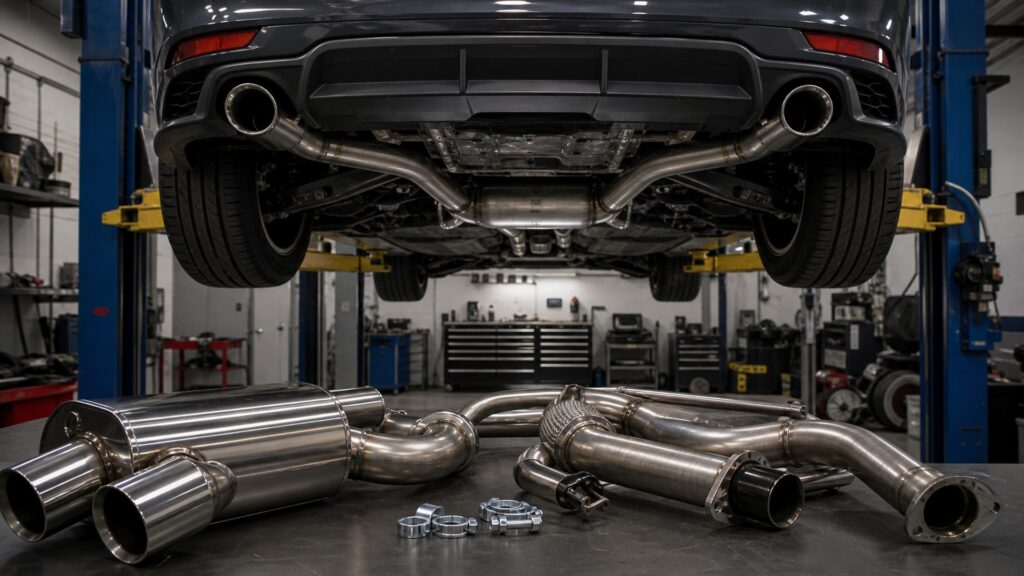
exhaust upgrades explainer hero image for Review Streets
What You'll Learn

Trace the Operating Chain behind Exhaust Upgrades

For Exhaust Upgrades, follow physical inputs, control decisions, limiting conditions, and verification evidence to determine whether the claimed result is useful.

  • How Headers Can Assist Cylinder Clearing
  • Why Diameter Has an Operating Window
  • How Aftertreatment and Feedback Remain Part of the System
  • Why Mufflers, Resonators, Flex Joints, and Hangers Matter
  • Where Exhaust Changes Influence Control Strategy
  • Where exhaust upgrades measurement separates improvement from impression

Tip: Record the exhaust upgrades configuration and a repeatable baseline before changing it; uncontrolled comparisons cannot identify which mechanism caused the result.

Definitions

Key Concepts That Define Exhaust Upgrades

These six terms locate the controlling variables inside exhaust upgrades.

Exhaust Pulse

Pressure and mass-flow event produced when an exhaust valve opens.

  • Exhaust Pulse has a configuration-specific meaning within exhaust upgrades
  • Pulses interact through shared junctions
  • Verify exhaust pulse directly on the vehicle before deciding

Primary Tube

Header passage serving one cylinder before the collector.

  • Primary Tube has a configuration-specific meaning within exhaust upgrades
  • Length and area tune different ranges
  • Verify primary tube directly on the vehicle before deciding

Collector

Junction combining multiple primary flows.

  • Collector has a configuration-specific meaning within exhaust upgrades
  • Merge angle affects pulse interaction
  • Verify collector directly on the vehicle before deciding

Scavenging

Low-pressure wave action helping evacuate residual cylinder gas.

  • Scavenging has a configuration-specific meaning within exhaust upgrades
  • Correct arrival timing is required
  • Verify scavenging directly on the vehicle before deciding

Catalytic Converter

Aftertreatment device converting regulated pollutants under controlled conditions.

  • Catalytic Converter has a configuration-specific meaning within exhaust upgrades
  • Temperature and mixture govern operation
  • Verify catalytic converter directly on the vehicle before deciding

Resonator

Acoustic element targeting selected exhaust frequencies.

  • Resonator has a configuration-specific meaning within exhaust upgrades
  • Sound control is frequency-specific
  • Verify resonator directly on the vehicle before deciding

Tip: Apply exhaust upgrades concepts with exact service data, calibrated instruments, and a recorded complete configuration.

Pulse Timing

How Headers Can Assist Cylinder Clearing

Exhaust valve opening launches pressure waves that reflect at area changes and collector boundaries. Correct primary length, area, firing-order pairing, and collector geometry can return a low-pressure wave during valve overlap.

  • Match geometry to speed range
  • Preserve firing-order separation
  • Seal every upstream joint
  • Compare the whole torque curve

Header tuning uses timed waves; an empty pipe is not automatically better.

Flow Area and Velocity

Why Diameter Has an Operating Window

Area must carry peak mass flow without excessive loss, yet unnecessary volume can weaken gas velocity and pulse energy. Temperature, bends, wall roughness, and junctions affect the actual pressure requirement.

  • Estimate hot mass flow
  • Measure pressure under load
  • Avoid abrupt transitions
  • Inspect crush bends and restrictions

The correct diameter is application-specific rather than universally largest.

Catalysts and Sensors

How Aftertreatment and Feedback Remain Part of the System

Catalysts require suitable temperature and mixture; oxygen sensors inform fuel control and monitor conversion. Relocation, leaks, coating damage, or altered flow can change response, diagnostics, and regulated emissions.

  • Keep sensors in specified orientation
  • Protect wiring from heat
  • Use documented compliant components
  • Confirm readiness after repair

A power claim does not override emissions equipment or diagnostic function.

Sound and Structure

Why Mufflers, Resonators, Flex Joints, and Hangers Matter

Noise consists of frequencies, pulses, shell radiation, and cabin drone. Acoustic elements target different bands while flexible couplings and compliant mounts absorb engine motion and thermal growth.

  • Measure noise under relevant load
  • Maintain body clearance
  • Retain flexible sections
  • Inspect hangers after heat cycles

A durable exhaust must manage movement and sound as well as gas flow.

Turbo and Calibration Effects

Where Exhaust Changes Influence Control Strategy

Downstream pressure can affect turbine operation, boost-control authority, compressor speed, and engine pumping work. On any engine, changed sensor response or airflow may require calibration review rather than monitor suppression.

  • Log requested and measured boost
  • Watch wastegate duty
  • Verify mixture and knock
  • Retest thermal behavior

Reduced restriction becomes useful only when control and hardware stay inside validated limits.

Quick Reality Check

What Exhaust Upgrades Can Change—and What It Cannot Prove

For Exhaust Upgrades, isolate the operative mechanism from conclusions still requiring complete-vehicle testing.

Evidence of a Coherent Result

Exhaust upgrades matter when tuned pulses, adequate area, controlled pressure, functional aftertreatment, stable sensors, thermal durability, and acceptable acoustics improve the intended operating range.

A credible exhaust upgrades result repeats after temperature stabilization while its connected safeguards remain functional.

Claims Requiring More Evidence

An exhaust label, pipe diameter, sound level, or isolated peak test cannot prove better torque, legal emissions, durability, or correct calibration.

Within exhaust upgrades, sound, sensation, a peak number, or a product label cannot establish durability, legality, or improvement throughout the operating range.

Common Myths

Misconceptions About Exhaust Upgrades

Common exhaust upgrades myths confuse a visible feature with complete-vehicle behavior.

An engine needs backpressure for torque

Engines need appropriate pulse timing, velocity, and gas exchange, not resistance itself. Removing a poorly chosen restriction can also change wave behavior, so a lost torque result does not prove pressure was inherently beneficial.

The loudest exhaust makes the most power

Sound level depends on acoustic attenuation and frequency, while power depends on cylinder filling, pumping work, flow, calibration, and operating range. A loud system may add no useful flow and can introduce drone or illegality.

A larger pipe is always a future-proof upgrade

Oversized volume can weaken pulse energy, complicate packaging, add mass, reduce ground clearance, and move torque behavior. Size for credible future mass flow while preserving velocity, catalysts, sensor operation, heat control, and service access.

A cat-back system cannot affect anything upstream

Pressure waves and total restriction can influence pumping work, sound, turbine outlet conditions, and measured airflow. Effects may be small on an unmodified vehicle, but they must be tested rather than dismissed categorically.

Tip: Test each exhaust upgrades claim under controlled conditions; then inspect the heat, force, flow, and control demands created specifically by exhaust upgrades.

FAQ

Frequently Asked Questions About Exhaust Upgrades

The following answers resolve practical decisions specific to exhaust upgrades.

What exhaust upgrade should come first?

Repair leaks, damaged hangers, failed catalysts, and sensor faults before modifying. Then identify the measured restriction or acoustic goal; the appropriate header, catalyst, resonator, muffler, or pipe change depends on the exact bottleneck.

How is exhaust restriction measured?

Use temperature-capable pressure equipment at defined locations during controlled load, comparing matched operating conditions. Sensor placement, atmospheric reference, engine speed, mass flow, catalyst temperature, and measurement range must be documented for valid conclusions.

Can an exhaust upgrade require ECU tuning?

It may when airflow, turbine control, oxygen-sensor response, catalyst monitoring, cam overlap, or load estimation changes materially. Review mixture, trims, knock, boost, diagnostics, and emissions documentation for the complete vehicle configuration.

What causes highway exhaust drone?

Cabin drone occurs when exhaust firing frequencies, pipe resonance, body modes, and cabin acoustics reinforce one another at sustained speed. Pipe length, resonator tuning, muffler design, mounts, gearing, and engine load all influence it.

Are aftermarket exhaust systems legal on public roads?

Legality depends on emissions certification, catalyst retention, noise limits, vehicle application, and jurisdiction. Verify current requirements and exact part documentation; track-only labeling does not authorize road use or defeat-device installation.

Bottom Line

Exhaust upgrades matter when tuned pulses, adequate area, controlled pressure, functional aftertreatment, stable sensors, thermal durability, and acceptable acoustics improve the intended operating range.

An exhaust label, pipe diameter, sound level, or isolated peak test cannot prove better torque, legal emissions, durability, or correct calibration.

Next Steps

Continue from Exhaust Upgrades to Its Dependent Systems

Use these adjacent mechanisms to plan, validate, and troubleshoot the complete exhaust upgrades decision.

Why ECU Tuning Matters

See how oxygen sensors, load models, boost, fueling, and diagnostics interact with hardware.