
Service State
The current combination of cleanliness, dryness, position, retention, integrity, and available containment capacity.
- Locate the service state
- Observe service state changes
- Verify the service state
Floor protection operates through changing states rather than a permanent clean-or-dirty label. A newly installed mat may be dry, retained, and below capacity; later it can hold loose grit, standing water, dissolved salt, or compacted mud. The same covering may still look usable while channels are full, an edge has lifted, or an anchor is partly disengaged.
Operating function matters because capacity and position determine the next safe action. A loaded protector should contain material until removal, then travel out of the cabin without spilling. Cleaning must restore channel volume and surface friction, drying must remove hidden moisture, and reinstallation must restore exact retention and pedal clearance. Each transition needs visible evidence.
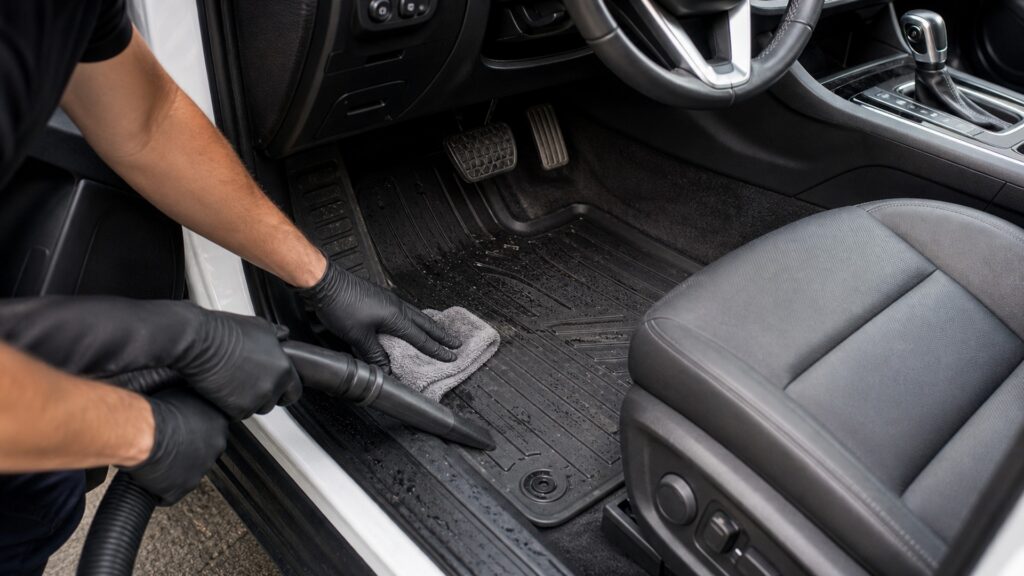
The operating contract covers clean service, accumulating solids, liquid capacity, saturation, displacement, removal, drying, and reinstall verification.
Tip: Name both contamination state and retention state before deciding to continue use, clean, reposition, or replace.
These definitions turn routine floor condition into a testable operating sequence.
The current combination of cleanliness, dryness, position, retention, integrity, and available containment capacity.
The amount and distribution of grit, soil, fibers, crumbs, leaves, or dried material held by the protector.
The remaining volume that channels and raised boundaries can hold under vehicle angle and motion before release.
The condition where absorbent material cannot retain additional liquid without transfer, seepage, prolonged drying, or overflow.
The confirmed engagement and condition of every anchor, backing surface, contour, and edge controlling movement.
A crack, curl, wear opening, failed anchor, permanent slip, odor, or deformation beyond which reliable service cannot be restored.
Tip: Observe load, remaining capacity, position, and clearance together.
Correct installation places one intended layer against the floor, engages anchors, leaves pedals and seats clear, and presents open channels or clean fibers ready to receive contamination.
The accepted clean state becomes the reference for later decisions.
Grooves and fibers separate particles from contact until compaction or volume erases that separation. Heel motion then grinds material into the wear layer or transports it beyond the protected boundary.
Debris state is defined by remaining separation, not surface color alone.
Vehicle slope, braking, flexible walls, absorbency, temperature, and mixed solids alter usable capacity. Standing liquid can slosh; saturated textile can transfer moisture; salt solution can remain after apparent drying.
Containment is temporary storage whose remaining margin changes during every trip.
Foot pressure, damaged anchors, stacked layers, stiff cold material, or awkward lifting can shift the protector or spill contents. Removal requires a level path around pedals, seats, console, and sill.
Position and load must remain controlled until contamination leaves the vehicle.
Material-compatible cleaning removes particles and residue; full drying prevents trapped moisture; inspection checks wear and anchors; exact reinstallation restores contour, retention, and control clearance.
The cycle resets only when the protector and vehicle floor return to the accepted dry state.
Dark material can conceal standing water, compacted grit, salt residue, a torn grommet, underside moisture, or an edge moving toward the pedals.
Load, reservoir margin, anchor engagement, edge position, and underlying carpet can all be inspected.
Cleaning and reinstallation end with dry surfaces and complete clearance tests.
Moisture, mold, corrosion, wear, and debris can develop beneath an apparently stable covering.
A retained corner does not prove the rest of the protector remains flat and intact.
These myths treat one visible feature as proof of every operating state.
Liquid can escape through cutouts, deform flexible edges, slosh during motion, or spill during removal before reaching nominal wall height. Effective capacity depends on vehicle angle, material stiffness, contamination, and handling.
Water may remain in textile backing, beneath a liner, inside carpet padding, or as dissolved salt residue. Remove the protector, inspect hidden surfaces, and dry both sides fully before returning it to service.
A covering can rotate around a single point, tear at the grommet, lift elsewhere, or slide when backing is contaminated. Verify every intended attachment, contour, edge, and dynamic pedal boundary after repeated foot motion.
Heat, chemicals, brushes, pressure, or improper drying can shrink, curl, harden, soften, delaminate, or leave slippery residue. Return to service requires inspection, correct orientation, full retention, and renewed clearance testing.
Tip: Inspect capacity, integrity, retention, and hidden surfaces separately.
These answers define action thresholds for solids, liquids, movement, cleaning, and replacement.
Clean before recesses fill enough for grit to return to shoe contact, spread around edges, abrade the wear layer, obstruct anchors, or hide damage. High-use heel areas and channels usually reveal the earliest capacity loss.
Remove it well before the level approaches the lowest wall, opening, or flexible edge, and before driving conditions can create slosh. Lift the protector level and inspect carpet for leakage or another water source.
Stop using the displaced covering until the vehicle is safely parked, remove it from control paths, inspect orientation, anchors, backing, contour, stacking, and damage, then reinstall only if full retention and pedal clearance are restored.
Both faces and the underlying floor must be dry and residue-free; channels, edges, and anchors must be intact; the protector must lie flat; seats and vents remain clear; and every pedal operates completely.
Replace when leaks, cracks, permanent curl, collapsed walls, torn attachments, unstable backing, dangerous wear openings, persistent contamination, unrecoverable odor, or vehicle mismatch prevents the covering from returning to its accepted retained and clear state.
Floor protection moves through load, capacity, retention, and service states.
Reliable operation means recognizing when solids need removal, liquid approaches its effective limit, movement invalidates use, or damage prevents reset. Cleaning is complete only after dry, retained, correctly oriented reinstallation and renewed pedal verification.
These explainers locate each state in the contamination pathway and preserve its baseline over time.
Map every operating state to wear, solid capture, liquid routing, retention, and cleanout.
Use recurring debris, moisture, anchor, material, carpet, and clearance checks to prevent drift.
Review pedal, slip, chemical, moisture, heat, and emergency boundaries before returning a covering to service.
Choose a retailer
Prices checked regularly. We may earn a commission at no cost to you.