
Pedal Envelope
The complete three-dimensional space used by pedals, linkages, and the driver's moving foot during normal and full operation.
- Locate the pedal envelope
- Observe pedal envelope changes
- Verify the pedal envelope
Floor protection becomes safety-relevant wherever it shares space with the driver's feet and vehicle controls. An unsecured mat can translate or rotate, a curled wall can catch footwear, and stacked layers can reduce clearance beneath pedals. Material toughness cannot compensate for incorrect geometry or missing retention.
Other hazards develop through use. Water, snow, cleaning residue, oil, or loose grit can change surface traction; retained moisture can damage carpet or support odor and biological growth; heat or harsh chemicals can deform edges. Safe ownership requires inspection before driving and after cleaning, seasonal swaps, seat movement, cargo use, or any event that changes position or material shape.
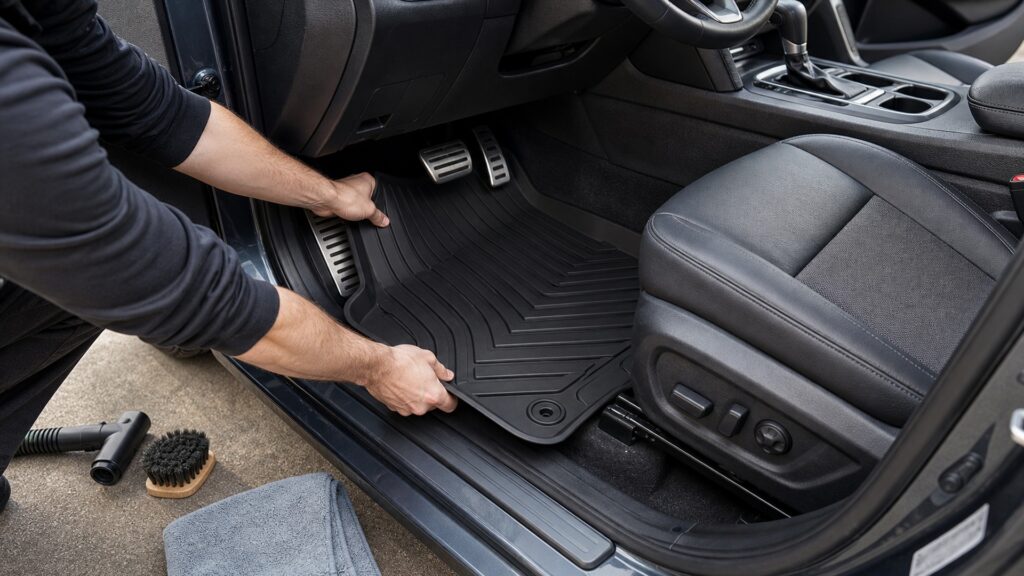
The safety review covers dynamic pedal space, attachment, shoe grip, edges, hidden moisture, cleaning chemistry, temperature, and inspection.
Tip: A protector is safe only while it stays secured, remains predictable underfoot, and occupies none of the control envelope.
These definitions identify the conditions that turn a cabin covering into a control-path hazard.
The complete three-dimensional space used by pedals, linkages, and the driver's moving foot during normal and full operation.
Mechanical engagement with intended hooks, posts, clips, locks, or grommets that resists translation and rotation.
Resistance between footwear and the exposed protector under dry, wet, dusty, oily, or chemically contaminated conditions.
Permanent or temporary upward deformation capable of catching footwear, contacting controls, releasing liquid, or obstructing seat movement.
Cleaner, dressing, salt, oil, or other material remaining after use and capable of changing friction, odor, compatibility, or exposure.
Liquid retained beneath or within a protector, carpet, or padding where visual inspection from above cannot confirm dryness.
Tip: Test them on the installed product, not from appearance alone.
Install one intended layer, operate every pedal through full travel, and move the foot among accelerator, brake, clutch, and rest areas. Repeat after real entry cycles that can push the covering forward.
Clearance is dynamic because feet and flexible edges move.
Correct grommet spacing, full engagement, intact hardware, stable backing, and matching floor geometry work together. A single loose corner can permit rotation even when another point remains attached.
Positive retention is verified by resisting likely forces, not by visual alignment.
A safe surface must remain predictable through expected contamination. Polished wear, soap residue, hard particles, collapsed ribs, or lifted edges can promote slip or snagging during rapid foot movement.
The top face is part of the driver's control interface.
Hot interiors, freezing weather, pressure washing, solvents, and incomplete drying can harden, soften, shrink, curl, crack, or delaminate materials. Moisture below the covering can persist after the visible face dries.
Material condition and hidden dryness matter as much as visible cleanliness.
Reinstall in the correct seating position and orientation, engage all anchors, flatten every boundary, move seats, inspect vents and wiring, test footwear transitions, and operate each pedal fully before driving.
Maintenance is complete only when the original safe geometry has been restored.
Cleaning may leave slippery residue, hidden water, thermal distortion, a missed anchor, reversed orientation, or an edge nearer the pedals.
The covering resists likely movement and remains outside every pedal and seat path.
Surfaces are dry, residue-free, intact, and predictable under representative footwear.
Uncertain fit, missing retention, stacking, curling, cracking, or control contact invalidates continued use.
Persistent wetness, odor, or carpet damage requires investigation beyond surface cleaning.
These myths mistake weight, cleanliness, or a single attachment for complete safety.
Repeated heel force, slick backing, incompatible contours, missing anchors, and rotation around one attachment can move substantial material. Weight may slow motion but cannot replace correct geometry and fully engaged positive retention.
Brake, clutch, linkages, lateral foot transitions, and rebound paths also need space. Test every pedal through complete travel using normal footwear, then repeat after entry cycles that can reposition a flexible covering.
Dressings, soaps, oils, and incomplete rinsing can leave a low-friction film, soften material, create odor, or harm backing. Use compatible methods, rinse as directed, dry fully, and reassess shoe traction.
Passenger and rear coverings can enter seat tracks, vents, wiring, restraint anchors, or another occupant's foot space, and cargo liners can interfere with latches. Each installed position needs its own clearance and retention check.
Tip: Verify every control boundary and material condition directly.
These answers establish practical safety checks before driving and after maintenance.
Use only the intended floor covering directly against the designed floor or carpet in the driver position. Stacking can defeat anchors, create a sliding interface, increase height, conceal moisture, and reduce pedal clearance.
With the vehicle safely stationary, secure the covering, inspect beneath all pedals, operate each through full travel, move the foot between controls, and repeat after several entries to expose translation, rotation, edge lift, or bunching.
Remove the covering from service if the curl can catch footwear, contact controls or seats, release liquid, or prevent stable fit. Follow supported correction guidance only; replace material that cannot reliably recover its shape.
Water can enter around edges, spill during removal, condense, or come from a vehicle leak, then remain trapped against carpet and padding. Periodic removal reveals moisture, salt residue, odor, staining, corrosion, and damaged backing.
Recheck after washing, seasonal swaps, another driver, seat adjustment, passenger or cargo movement, anchor replacement, interior service, high heat, freezing, a major spill, or any sensation that footwear or pedals contacted the covering.
Safe protection stays outside the control path.
Use one compatible layer, complete retention, predictable traction, intact edges, material-aware cleaning, and dry hidden surfaces. Repeat full pedal and cabin-clearance checks whenever removal, weather, wear, or service changes the installed condition.
These explainers show where control clearances are established and how load or displacement changes safe use.
Check contour, anchors, pedal travel, seats, vents, trim, and removal on the exact vehicle.
Recognize debris, liquid, saturation, displacement, cleaning, and return-to-service states.
Trace how wear, contamination, retention, and cleanout move through the protection mechanism.
Choose a retailer
Prices checked regularly. We may earn a commission at no cost to you.