
Secondary High Voltage
The elevated potential produced by the ignition coil to ionize the spark-plug gap and sustain discharge.
- Insulation contains the path
- Damaged boots redirect current
- Rated probes are required
Ignition service looks small because plugs and coils fit in one hand, yet the operating environment combines high secondary voltage, substantial primary current, flammable mixture, hot metal, moving machinery, and control systems that may crank or restart unexpectedly. Severe misfire can also send unburned fuel into a catalyst and overheat it.
Safety factors matter before, during, and after removal. Identify the propulsion and voltage architecture, disable operation by the exact procedure, allow safe cooling, control fuel and ignition sources, use rated instruments, protect plug threads and open wells, route harnesses away from heat and motion, and verify without open sparks. A disconnected battery cable is not a universal isolation procedure, especially on hybrids, start-stop vehicles, or capacitive circuits.
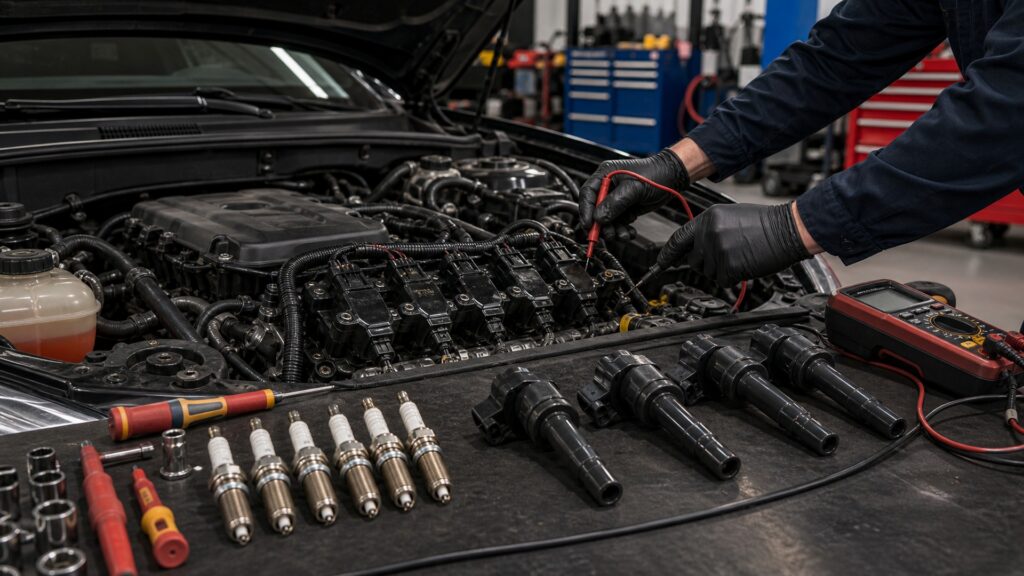
Safe ignition work begins with architecture identification and a no-start plan, then protects people, threads, clean openings, electronics, catalysts, and harness routing through final verification.
Tip: Never hold a plug wire, coil boot, or improvised test gap by hand while cranking; secondary voltage can find unexpected paths through damaged insulation, tools, and the body.
These terms identify the stored energy, heat, fire, and mechanical risks hidden inside routine ignition service.
The elevated potential produced by the ignition coil to ionize the spark-plug gap and sustain discharge.
Lower-voltage coil current that can create heat, arcing, driver damage, or wiring stress during charging.
Excess temperature caused when unburned fuel from sustained misfire reacts within the catalytic converter.
Starter or engine rotation triggered by remote start, start-stop, hybrid control, another person, or diagnostic command.
Loss or deformation of cylinder-head plug threads through cross-threading, contamination, wrong reach, over-torque, or unsuitable repair.
Measurement equipment designed for the circuit's voltage, transient energy, insulation, connection, and intended diagnostic method.
Tip: Plan emergency shutdown and fire control before energizing the repaired system; the first crank is an active test, not a harmless formality.
Possessing the key nearby, opening a door, charging a hybrid, or issuing a scan command can change vehicle state. Service information defines sleep, disable, and reactivation steps for the exact architecture.
The safe engine is one proven unable to crank while hands and tools are exposed.
Secondary pulses reach high voltage, while primary switching produces current and transients. Piercing insulation, disconnecting under load, shorting drivers, or using an unrated meter can create injury or expensive electronic damage.
Safe measurement preserves both insulation and the controller being diagnosed.
Dirt around a plug can fall into the cylinder; a tilted plug can cross-thread the head; excess force can distort or break components. Compressed air can spread debris or fluids unpredictably.
Ignition safety includes preventing foreign-object and thread damage inside the engine.
Repeated cranking can accumulate fuel, open sparks can ignite vapor, and continued loaded misfire can overheat the catalyst. Hot manifolds, turbochargers, heads, and plugs add burn hazards after shutdown.
More test time is not better evidence when heat and fuel are accumulating.
A repaired coil circuit needs locked connectors, fully seated boots, retained harnesses, restored covers, and clearance from belts, fans, exhaust, sharp edges, and moisture paths. Final checks use controlled engine states.
A smooth startup does not excuse a loose harness resting against the exhaust.
Ignition safety combines energy isolation, fire prevention, heat control, motion control, clean mechanical work, catalyst protection, and verified reassembly.
Exact architecture and disable instructions, controlled keys and remote features, cooled surfaces, rated tools, clean wells, correct fitment and torque, protected connectors, and a defined first-start procedure.
The technician knows the catalyst-risk warning, fuel-vapor controls, moving-component clearances, hybrid boundaries, measurement ratings, abort criteria, and post-heat-soak inspection points.
High-voltage isolation, severe arcing, fuel leakage, flashing misfire warnings, damaged head threads, broken plugs, uncertain timing, remote-start behavior, or required waveform tools exceed available training and equipment.
Prior success on another engine does not transfer its coil topology, hybrid state logic, torque, plug geometry, driver protection, hot-surface layout, or reactivation procedure.
Familiar plug and coil shapes make unsafe shortcuts feel routine, especially improvised spark tests and casual assumptions about battery disconnection.
Hybrids and EV-related systems can retain high voltage, capacitors may remain charged, and disconnecting can trigger procedures or data loss. Use the exact isolation and verification process for the architecture and task.
An improvised gap can expose people to high voltage, ignite fuel vapor, stress coils and drivers, or allow unexpected engine motion. Use manufacturer-approved enclosed or instrumented tests with proper connections and ventilation.
A severe active misfire can send unburned fuel into the catalyst, rapidly raising temperature and damage risk. Reduce load, stop according to vehicle guidance, and diagnose without prolonged driving or repeated high-load reproduction.
It reduces cross-threading risk but does not remove dirt, wrong reach or seat, damaged threads, incorrect torque, hot-head concerns, or tool misalignment. Follow the complete clean installation procedure and exact specification.
Tip: Treat vehicle state, electrical ratings, fuel, heat, motion, and catalyst temperature as explicit gates rather than background conditions.
These answers address battery disconnection, hot engines, stuck plugs, high-voltage hybrids, and safe first-start verification.
Follow exact manufacturer guidance. Aluminum heads, plug shells, deposits, and thermal expansion affect thread risk, while hot surfaces can burn. Allow appropriate cooling and use the specified removal method rather than a universal rule.
Stop before applying destructive force. Confirm engine temperature and direction, inspect well contamination, use approved penetrating or staged procedures where specified, and seek qualified thread or broken-plug service when resistance remains abnormal.
Ordinary meters and leads are not designed for secondary ignition pulses. Use rated ignition probes, current clamps, scopes, and manufacturer methods. Incorrect connection can injure, damage the meter, distort readings, or harm modules.
Clear tools, restore required systems, ventilate, keep people away from belts and fans, start with diagnostic monitoring, watch for arcing, fuel odor, warnings, abnormal noise, or misfire, then shut down and inspect routing.
Loose wiring can touch exhaust heat, rub sharp edges, enter belt or fan paths, admit water, pull connectors, or arc to ground. Restore every clip, loom, cover, seal, and designed clearance before release.
Ignition-component safety factors matter because high voltage, primary current, fuel, heat, motion, fragile threads, catalyst temperature, and vehicle state converge during seemingly routine service.
Identify and disable the exact architecture, use rated methods, protect clean openings and threads, set firm abort limits, and inspect harness routing and combustion behavior through a controlled first start and heat cycle.
Related explainers connect ignition energy flow, exact fitment, and operating margins to the hazards that must remain controlled during measurement and verification.
Understand where primary current, secondary voltage, plug discharge, and engine motion appear in the ignition sequence.
Match reach, seat, torque, gap, coil electronics, boot contact, and sealing before first start.
Interpret current, saturation, breakdown voltage, spark duration, chamber demand, and timing without unsafe improvised tests.
Choose a retailer
Prices checked regularly. We may earn a commission at no cost to you.