
Occupant Geometry
The body dimensions, joint ranges, posture, mass distribution, and clothing that meet the vehicle's support and control surfaces.
- Locate the occupant geometry
- Observe occupant geometry changes
- Verify the occupant geometry
Interior comfort fit is a relationship among one occupant, one seating position, the vehicle's safety systems, and the conditions of use. Body dimensions, mobility, clothing, trip duration, climate, and sensitivity change which pressure, reach, temperature, glare, or noise intervention feels useful. A universal label cannot establish that relationship.
The accessory must also fit the vehicle. Cushions and covers can alter belt contact, head-restraint position, occupant sensing, side-airbag paths, pedal reach, and seat travel. Shades can reduce glare while blocking visibility; powered heaters or fans add wiring and thermal limits. Fitment is complete only after the intended comfort improvement survives a representative trip with every safety boundary intact.
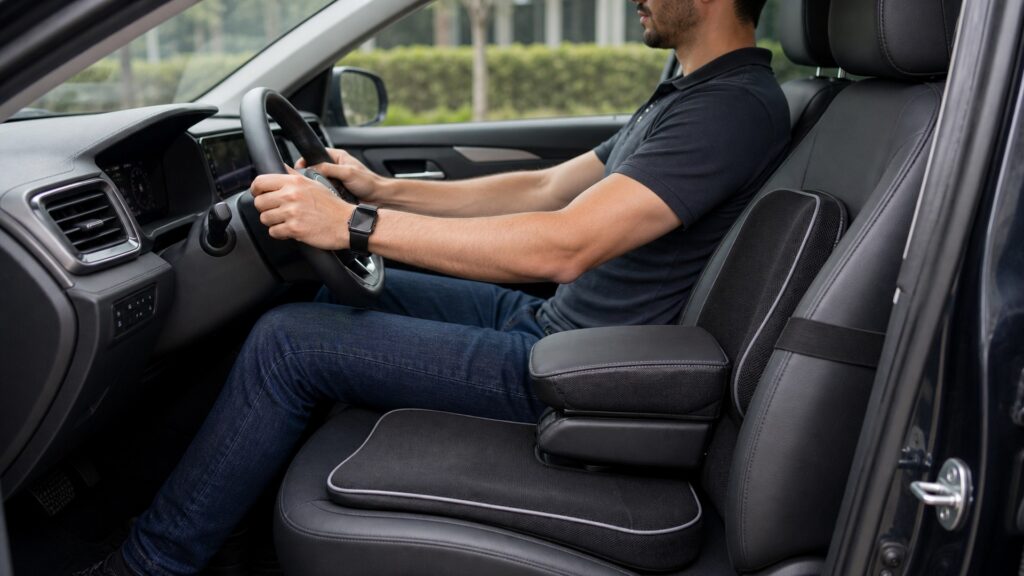
The evaluation covers body geometry, seat adjustment, restraints, airbags, controls, views, climate, attachment, electrical behavior, and time.
Tip: Comfort fit is proven by sustained improvement without compensatory posture or interference with vehicle safety functions.
These definitions identify the person-to-vehicle boundaries an accessory can change.
The body dimensions, joint ranges, posture, mass distribution, and clothing that meet the vehicle's support and control surfaces.
The vehicle-provided position, height, tilt, recline, lumbar, head-restraint, and memory settings that establish the baseline.
The intended relationship of lap and shoulder restraint portions to the occupant's pelvis, torso, neck, clothing, and seating posture.
The required unobstructed deployment and occupant space around steering wheel, dashboard, seat, roof, curtain, and side airbag zones.
The ability to operate steering, pedals, switches, displays, gear selection, and emergency controls while maintaining stable intended posture.
A realistic duration, road, climate, clothing, traffic, and task exposure long enough to reveal comfort benefits and tradeoffs.
Tip: Evaluate them in the occupant's actual driving position.
Set seat, backrest, lumbar, head restraint, steering wheel, mirrors, pedals where adjustable, and climate for the actual occupant. A poor baseline can make an accessory compensate for an easily correctable relationship.
Factory adjustment defines the reference against which any addition is judged.
Added thickness, straps, covers, or supports can shift the body and cross deployment seams or sensor zones. Product and vehicle compatibility must explicitly address those interfaces rather than relying on a visual fit.
Comfort cannot be accepted by borrowing space from crash protection.
The occupant must reach full pedal travel and steering range, view required displays and surroundings, and enter or exit without the accessory sliding, folding, snagging, or demanding excessive movement.
Fit includes movement because driving is not a static seating pose.
Heaters, fans, coolers, or illuminated accessories must suit the outlet, fuse, cable route, control placement, temperature distribution, startup, shutdown, and parked behavior while leaving vents and safety circuits unobstructed.
Thermal comfort is unsuitable when heat, wiring, or battery behavior becomes uncertain.
Use the actual occupant through realistic driving time and conditions. Note onset, location, severity, adjustments, stability, reach, distraction, and recovery, then compare with the baseline while changing one variable.
Representative use reveals whether the accessory solves the original problem or merely moves it.
Matching dimensions do not prove appropriate pressure, posture, belt contact, reach, temperature, stability, or symptom response for one person.
The occupant sustains stable posture and safe vehicle control during a representative trip.
Restraints, airbags, sensors, visibility, seats, vents, wiring, and exits remain unobstructed.
Persistent pain, numbness, weakness, restricted mobility, or medical heat sensitivity exceeds ordinary accessory selection.
Structural seat damage or safety-system faults require qualified diagnosis and repair.
These myths treat dimensions or immediate relief as proof of safe long-term fit.
Bodies, seats, belt anchors, side airbags, sensors, head restraints, pedals, and steering reach vary. A cushion can lift or move the occupant enough to change multiple safety relationships despite fitting within the seat outline.
Short-term softness or temperature can conceal later pressure concentration, heat buildup, instability, altered posture, reduced reach, or numbness. A representative trip must confirm sustained relief and absence of new vehicle-interface problems.
Some seats integrate side airbags, occupant classification, heaters, ventilation, controls, wiring, and deployment seams. An incompatible cover, strap, pad, or fastening method can obstruct or alter those functions even when the upholstery remains visible.
Connector fit does not prove outlet capacity, fuse protection, wire condition, cable routing, contact temperature, control accessibility, automatic shutdown, or parked-current behavior. Verify the complete electrical and thermal installation under realistic use.
Tip: Test the whole occupant-vehicle relationship across realistic time.
These answers establish a fit sequence for occupants, safety systems, powered products, and long trips.
Record body dimensions relevant to support and reach, mobility limits, normal clothing and footwear, typical trip duration, climate, seating role, discomfort location, onset time, preferred adjustments, and any professional recommendations already provided.
Follow vehicle and product guidance, keep lap and shoulder belt paths direct, preserve buckle access and head-restraint position, avoid airbag seams and sensor zones, and confirm the accessory cannot slide beneath or around the occupant.
From the accepted seated posture, operate every pedal fully, steer through required range, reach primary and emergency controls, view displays and mirrors, scan outside, enter and exit, and repeat without using the accessory as an unstable brace.
Inspect rating, outlet, fuse, cable route, connector heat, surface temperature, control placement, vent obstruction, noise, startup, shutdown, and parked state. Stop using it if heat, odor, discoloration, damage, or intermittent power appears.
Seek qualified guidance when pain, numbness, weakness, restricted motion, disability, pregnancy, medical heat sensitivity, prior injury, or required adaptive equipment affects driving fit, or when an accessory would alter structural seats or safety systems.
Comfort fit belongs to one occupant in one vehicle.
Begin with factory adjustment, preserve every restraint and airbag boundary, verify dynamic control and visibility, test powered products thermally and electrically, and use representative time to confirm the intervention improves the original sensation without creating another.
These explainers show why the comfort variables interact and how they differ from floor contamination control.
Understand how support, pressure, heat, airflow, sound, touch, glare, reach, and time combine.
Separate comfort fit from floor barrier coverage, containment, and retention.
Review how seat-surface protection can interact with upholstery, attachment, airbags, and occupant contact.
Choose a retailer
Prices checked regularly. We may earn a commission at no cost to you.