
Session State
The combination of connector, ignition, network, module, security, and tool conditions that determines whether a request can proceed.
- It can change quickly
- Sleep interrupts access
- State belongs in reports
An OBD tool is useful only when each function behaves predictably in the vehicle state where it is needed. Connection, identification, module scanning, code reading, live graphing, active tests, resets, report export, and recovery each have different prerequisites and consequences. A menu label does not define those boundaries.
Operating function matters because ambiguous results invite bad diagnosis. A blank list can mean no faults, wrong module, unsupported coverage, or a failed session. A commanded output can be rejected, delayed, or unsafe in the current state. Define every important feature as an observable contract: required input, permitted state, expected response, feedback, failure indication, and safe recovery.
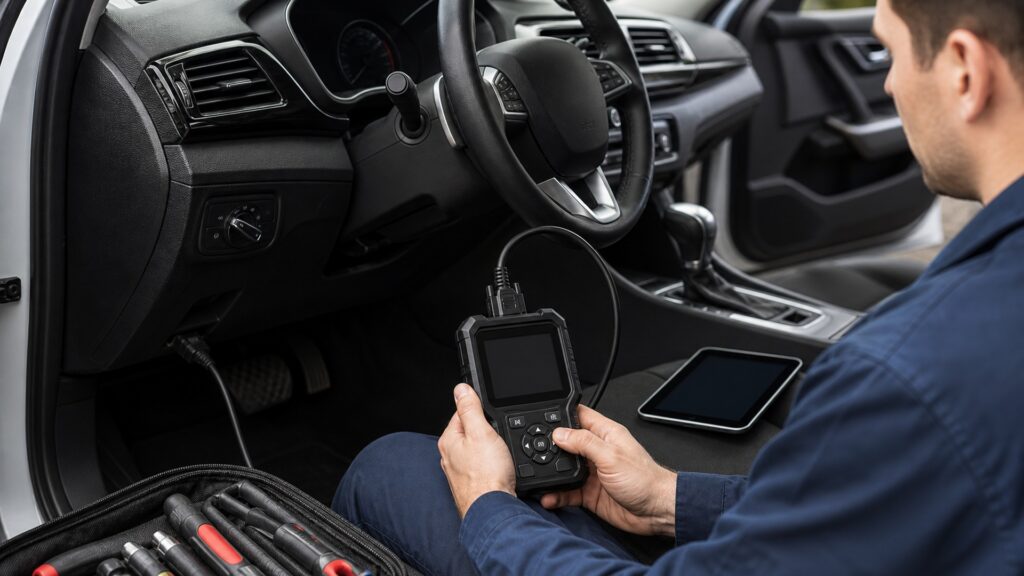
Reliable operation comes from knowing what starts a function, what the vehicle should return, how failure appears, and what state remains afterward.
Tip: Test one contract at a time and save its before-state; a successful tap is not the same as a successful diagnostic operation.
These terms identify the operating states a product demonstration often skips.
The combination of connector, ignition, network, module, security, and tool conditions that determines whether a request can proceed.
Metadata such as pending, confirmed, permanent, current, history, or test-failed state attached to a diagnostic trouble code.
The effective frequency and timing with which requested parameters are refreshed and displayed.
A supported diagnostic request that commands an output or routine so response can be observed under controlled conditions.
A defined procedure that clears or reinitializes a service-related state after required work, distinct from indiscriminate code clearing.
The known condition reached after communication loss, cancellation, tool removal, or an interrupted operation.
Tip: Write expected feedback and prohibited states beside every command-capable feature.
The tool should distinguish no power, no protocol, partial network discovery, wrong vehicle selection, and unsupported access. Automatic identification is convenient, but the displayed identity and installed-module list still require confirmation.
Good operation names the connected context before presenting data.
A scan should show which module answered, which status applies, whether freeze frame exists, and what could be lost by clearing. Reports should preserve units, timestamps, vehicle identity, and unsupported areas.
Readable data is operationally sound only when its provenance survives.
Parameter selection, bus traffic, tool processing, wireless delay, and screen rendering affect update rate. Compare related signals with compatible time axes and units; a smooth line can still be late or sparsely sampled.
Graph shape cannot outrun the measurements that produced it.
Before commanding a fan, valve, lamp, relay, motor, or routine, establish the permitted vehicle state and physical exclusion zone. The tool must show acceptance or rejection and release the command on cancel or fault.
A command feature is incomplete without a defined stop path.
Clearing, resetting, calibrating, or programming can alter readiness, learned values, warnings, or module availability. Record the baseline, meet power requirements, verify completion, rescan, and follow the specified relearn or recovery sequence.
Operational maturity is most visible after something does not go as planned.
A tool may show an active-test, reset, graph, or report menu while the exact vehicle rejects it, returns limited data, or requires additional access.
Inputs, preconditions, outputs, feedback, failure signals, and recovery can be tested directly.
Unsupported states become explicit instead of looking like an empty success.
Vehicle configuration, tool version, licensing, gateway access, and service procedure determine usable capability.
High-risk operations need controls beyond menu availability.
These myths confuse a displayed feature, a smooth graph, or an accepted button press with complete operation.
The tool may be viewing the wrong module, using incomplete coverage, missing a failed session, or filtering status. Confirm vehicle identity, discovered modules, communication health, supported records, and the difference between empty and unavailable.
Each additional request can reduce effective refresh rate and obscure short transitions. Select signals that test one hypothesis, confirm units and timestamps, create a controlled stimulus, and compare with an independent measurement when timing matters.
A visible control does not establish correct vehicle state, physical clearance, authorization, or consequences. Consult the exact procedure, restrain the vehicle, protect moving areas, monitor feedback, and know how the output will stop.
The requested message may be accepted while relearn, calibration, readiness, warning, or verification work remains. Rescan, observe the affected state, complete the specified drive or setup procedure, and document the final condition.
Tip: Require state, feedback, and recovery evidence.
These answers define practical proof for the most common OBD operating functions.
Verify stable tool power, correct vehicle identification, expected protocol, complete required-module discovery, responsive requests, and no new communication faults. A powered interface or one responding controller proves only part of the diagnostic path.
It should distinguish not installed, not responding, access denied, unsupported by the tool, and scan interrupted whenever possible. Those states lead to different next actions and should not be collapsed into a blank result.
The graph needs the correct module and parameter, visible units, suitable scale, useful refresh rate, known vehicle conditions, and a repeatable stimulus. Save the trace and compare decisive values with physical measurements or specifications.
Avoid it without an exact procedure, safe vehicle state, secure restraint, clear work area, adequate power, and knowledge of the stop condition. Do not command safety-related or moving hardware casually or while driving.
It should release temporary commands, report the interruption, preserve already captured evidence, reconnect only in an appropriate state, and allow a fresh module scan. Inspect the vehicle for warnings or faults before continuing.
OBD operating function matters because every read, graph, command, reset, and report depends on a particular vehicle and session state, with distinct feedback and consequences.
Define the contract before use, preserve evidence before change, make unsupported states explicit, and verify safe recovery. A feature is dependable only when its complete state transition can be observed and repeated.
These explainers connect each state to the underlying exchange, compatibility boundary, and risk controls.
Trace how requests, responses, decoding, and physical confirmation produce diagnostic evidence.
Verify protocol, module, function, gateway, power, and workflow coverage for the vehicle.
Control connector, electrical, motion, distraction, and security hazards during operation.
Choose a retailer
Prices checked regularly. We may earn a commission at no cost to you.