
Payload Distribution
Placement of occupants, accessories, fluids, and cargo across the vehicle's allowable carrying capacity.
- Total payload is not the only limit
- Axles respond differently
- Rear overhang adds leverage
Overlanding storage systems matter because remote travel places dense, essential, and sometimes hazardous items inside a moving vehicle. Water, tools, recovery hardware, batteries, fuel, food, cooking equipment, medicine, and shelter must remain secure through braking, side loads, vibration, and rough terrain while still being reachable when the vehicle is stuck or damaged.
Good storage is therefore a load-management system, not a collection of boxes. It controls total mass, axle balance, center of gravity, structural attachment, crash restraint, access order, contamination, heat, ventilation, water leaks, and inventory. A perfectly organized drawer can still make the vehicle less capable if it consumes payload, hides inspection points, blocks emergency equipment, or concentrates heavy cargo behind the rear axle.
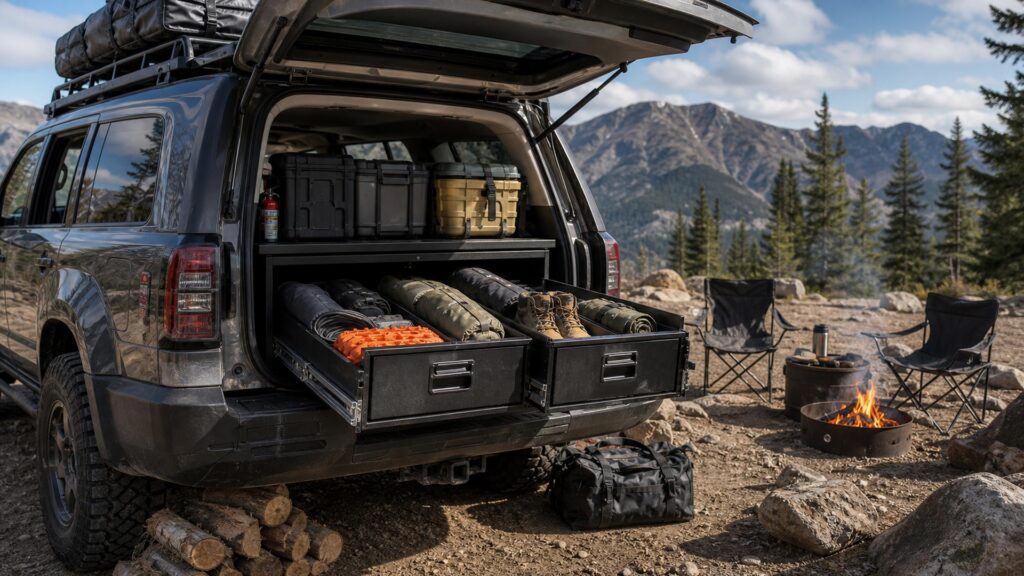
Weigh the complete travel load, place dense items low and near the vehicle's supported center, restrain every module and object, and arrange access by emergency sequence rather than visual neatness.
Tip: With the vehicle packed for departure, simulate a tire failure, first-aid event, fire response, recovery setup, rain arrival, and nighttime meal; record every item blocked by another item or unsafe door position.
These terms link organization to vehicle loading, crash behavior, and field access.
Placement of occupants, accessories, fluids, and cargo across the vehicle's allowable carrying capacity.
System preventing an item from moving under acceleration in multiple directions.
Sliding enclosed storage assembly mounted within the cargo area or bed.
Order in which items must be retrieved during routine or emergency tasks.
Physical separation of incompatible materials, fumes, heat sources, food, water, and occupants.
Repeatable record of item identity, location, quantity, condition, and replacement date.
Tip: Storage mounts can affect airbags, seats, child restraints, crumple zones, wiring, fuel systems, structure, and emergency exits; use vehicle-specific guidance and qualified fabrication where needed.
High roof boxes raise the center of gravity; dense rear drawers increase rear axle load and can reduce front-axle authority; water and fuel shift as consumed. Added structure itself consumes payload before cargo enters it.
Storage capability is bounded by the vehicle's ratings and handling, not by empty cubic volume.
A latch may keep a drawer shut while the entire cabinet tears from the floor. Forces travel through item dividers, drawer slides, enclosure, fasteners, brackets, and vehicle structure; each interface needs suitable direction and capacity.
The safe load path continues beyond the box into the vehicle.
Recovery gear buried below bedding forces unloading beside a stuck vehicle; first aid behind a blocked hatch may be unreachable; cooking gear mixed with shelter creates repeated repacking. Task-based zones and exterior-access options shorten hazardous exposure.
Organization matters most when darkness, traffic, weather, injury, or vehicle position removes normal access.
Sealed boxes exclude dust but can trap moisture; wet recovery gear corrodes or molds; batteries and electronics need temperature and ventilation control; food odors and fuels require separate containment and campsite practices.
A storage system must manage what enters the container and what the contents release.
Modules that can be lifted or unbolted allow cleaning, leak detection, wiring inspection, seasonal load reduction, and repair. Permanent panels may hide corrosion, loose mounts, pests, damaged cables, or water until failure grows.
Modularity is valuable because the safest packing plan changes with route, occupants, season, and equipment condition.
Useful organization must also preserve ratings, restraint, emergency reach, environmental separation, inspection, and changing trip needs.
Dense cargo stays low and structurally restrained, axle loads remain legal, emergency items are reachable, and incompatible materials occupy separate controlled zones.
Modular containers, documented inventory, drainable or ventilated wet-gear space, clear labels, and accessible service points make condition visible between trips.
Heavy drawers, roof boxes, elaborate kitchens, and duplicate equipment can consume payload, degrade handling, block exits, hide corrosion, and create dangerous projectiles.
No storage product makes interior fuel, damaged lithium batteries, loose recovery hardware, contaminated water, overloaded roofs, or inaccessible fire equipment safe by appearance alone.
These myths confuse tidy packaging with verified loading, restraint, and access.
Interior volume does not establish legal or safe mass. Occupants, fuel, water, permanent accessories, drawers, roof systems, tongue weight, and cargo count against payload and individual axle ratings, which require actual loaded weighing.
Drawer locks restrain the moving drawer, not necessarily every tool or the cabinet-to-vehicle attachment. Internal dividers, latches, slides, brackets, fasteners, and vehicle structure must form a continuous multidirectional load path.
Roof mass raises the center of gravity, increases roll and crosswind sensitivity, consumes dynamic roof capacity, and complicates lifting. Bulky light items are usually better candidates than water, batteries, tools, or recovery hardware.
Seals block dust and rain but can trap wet straps, condensation, battery heat, fuel vapors, or food odors. Contents must be dry and compatible, with ventilation or secondary containment where the specific hazard requires it.
Tip: Test the system under full mass and abnormal access conditions rather than judging empty drawers in a stationary vehicle.
These answers cover drawer weight, water, recovery access, roof boxes, and inventory practices.
Subtract the complete cabinet, slides, fasteners, deck, fridge mount, electrical hardware, and permanently carried contents from available payload. Then weigh the loaded vehicle and axles because placement can exceed one rating first.
Use food-safe secured containers low and protected from heat, freezing, puncture, and chemicals. Divide supply across independent containers, allow leak detection, keep dispensing sanitary, and account for water mass as it shifts or empties.
Keep first-use items reachable without unloading unsecured cargo or entering traffic, water, or the downhill side. Wet and muddy gear needs a drainable separated area, while heavy hardware requires low structural restraint.
They can hold bulky lighter weather-protected items when vehicle, rails, rack, box, mounts, height, and dynamic limits allow. Include crosswind, branch clearance, fuel use, key access, water intrusion, and emergency removal.
Use a location map and dated checklist covering quantity, weight, expiration, charge state, damage, missing adapters, cleaning, and seasonal need. Reconcile it after every trip so duplicated or obsolete items do not accumulate.
Overlanding storage systems matter because they control payload placement, crash restraint, emergency access, contamination, weather exposure, serviceability, and inventory across a vehicle operating far from normal infrastructure.
Weigh the complete system, protect axle and roof limits, create continuous structural load paths, place dense cargo low, separate hazards, keep first-use tools reachable, and remove modules for cleaning and inspection.
These explainers show how storage consumes payload and how critical equipment must remain reachable when normal doors, terrain, or vehicle position change.
Place storage mass, access, and segregation inside the full overlanding system of mobility, recovery, shelter, water, power, navigation, and repair.
Design access for tire, traction, pulling, communication, and inspection equipment when the vehicle is immobilized or a normal door is blocked.
Compare removable power stations with installed dual-battery hardware whose restraint, ventilation, cables, and service access must be integrated into storage.
Choose a retailer
Prices checked regularly. We may earn a commission at no cost to you.