Why Polishing & Paint Correction Maintenance Role Matters

Correction maintenance has two targets: the working system and the corrected paint. Pads accumulate spent abrasive, removed paint, residue, and heat; backing plates fatigue; machines, cords, bearings, vents, and attachments wear. If these conditions drift, the same nominal settings can produce different cut, temperature, haze, vibration, or safety.

The paint also carries a history after correction. Records of panels, defects, combinations, passes, residual marks, and protection help future work avoid repeating aggressive cut. Compatible washing and protection reduce new marring, preserve the remaining coating margin, and make later diagnosis more trustworthy.

By: Review Streets Research Lab
Updated: September 1, 2026
Explainer · 8-12 min read
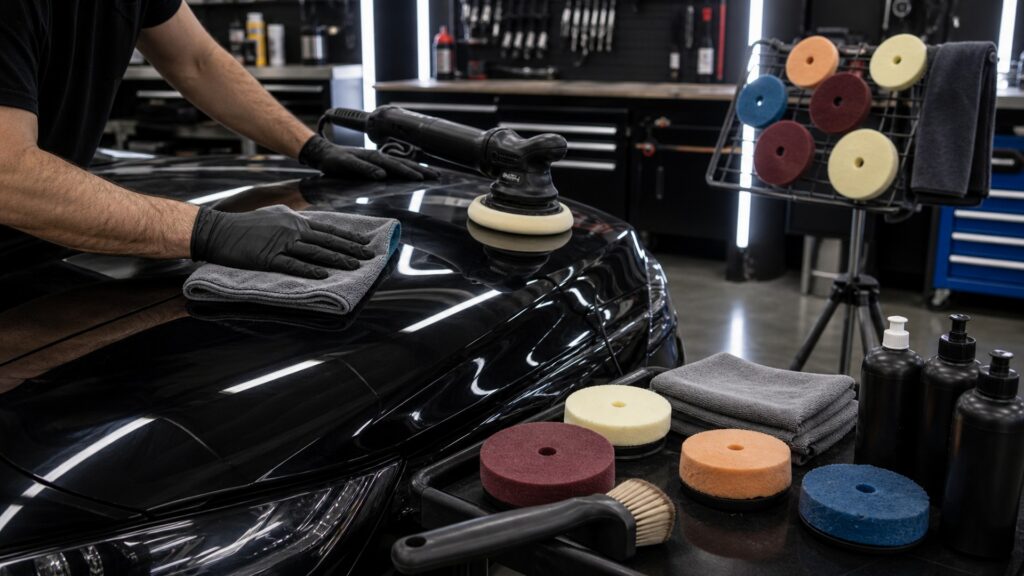
polishing & paint correction maintenance role explainer hero image for Review Streets
What You'll Learn

Resolve Polishing and Paint Correction Maintenance Role through Its Controlling Evidence

Maintenance keeps the abrasive interface repeatable and preserves the finite paint margin after correction.

  • Clean Faces Preserve Cut, Cooling, Balance, and Finish
  • Backing Plates, Vents, Bearings, Cords, Switches, and Attachments Need Inspection
  • Abrasives, Bottles, Towels, and Brushes Need Clean Storage and Traceable Use
  • Lighting, Test Records, and Repeatable Sections Preserve the Diagnostic Method
  • Protection and Low-Abrasion Washing Preserve the Reduced Coating Margin
  • How to verify the finished state

Tip: Treat pad condition, machine integrity, stored chemistry, inspection evidence, service records, and later wash technique as one continuity system.

Definitions

Key Concepts That Define Polishing and Paint Correction Maintenance Role

The required terms mark the observable interfaces in this article: pad-face contamination load, foam and fiber fatigue, backing-plate integrity, machine bearing vibration, power-cord condition, abrasive suspension stability, towel and residue control, inspection-light consistency, test-spot process record, corrected-area history, low-abrasion wash method, future correction reserve.

Pad-Face Contamination Load

Pad-Face Contamination Load locates the interface where polishing and paint correction maintenance role under the named surface and operating conditions.

  • Measure pad-face contamination load before work
  • Observe how pad-face contamination load changes
  • Record pad-face contamination load after verification

Foam And Fiber Fatigue

Foam And Fiber Fatigue sets the usable boundary for polishing and paint correction maintenance role under the named surface and operating conditions.

  • Measure foam and fiber fatigue before work
  • Observe how foam and fiber fatigue changes
  • Record foam and fiber fatigue after verification

Backing-Plate Integrity

Backing-Plate Integrity explains the material response during polishing and paint correction maintenance role under the named surface and operating conditions.

  • Measure backing-plate integrity before work
  • Observe how backing-plate integrity changes
  • Record backing-plate integrity after verification

Machine Bearing Vibration

Machine Bearing Vibration measures the transfer created by polishing and paint correction maintenance role under the named surface and operating conditions.

  • Measure machine bearing vibration before work
  • Observe how machine bearing vibration changes
  • Record machine bearing vibration after verification

Power-Cord Condition

Power-Cord Condition reveals the failure condition within polishing and paint correction maintenance role under the named surface and operating conditions.

  • Measure power-cord condition before work
  • Observe how power-cord condition changes
  • Record power-cord condition after verification

Abrasive Suspension Stability

Abrasive Suspension Stability records the verified outcome after polishing and paint correction maintenance role under the named surface and operating conditions.

  • Measure abrasive suspension stability before work
  • Observe how abrasive suspension stability changes
  • Record abrasive suspension stability after verification

Tip: Use each term at its measured material, electrical, acoustic, or process boundary; record the related input and output before changing the system.

Pad Maintenance

Clean Faces Preserve Cut, Cooling, Balance, and Finish

Loaded foam, microfiber, or wool changes particle contact and heat. Pads are cleaned with supported methods, dried, inspected for collapse or separation, and retired when their structure no longer recovers. Evidence checkpoint 1 pairs pad-face contamination load with machine bearing vibration; towel and residue control is the limiting observation. Record test-spot process record before changing low-abrasion wash method, then repeat the pad-face contamination load reading after the system reaches a stable cooled, cleaned, powered, or tuned state. For row 225, foam and fiber fatigue establishes the input condition and abrasive suspension stability identifies the expected transformation. If corrected-area history moves outside its limit first, hold machine bearing vibration constant and diagnose that interface instead of adding unrelated passes, pressure, gain, chemistry, or equalization. Service interval 1 logs pad-face contamination load before machine bearing vibration is returned to use. If towel and residue control changes during the same test conditions, test-spot process record is inspected before another pad, product, machine setting, or paint section is authorized, preserving low-abrasion wash method as a traceable baseline. The maintenance ledger connects foam and fiber fatigue with the prior correction history, then verifies abrasive suspension stability after storage or washing. A drift in corrected-area history triggers cleaning, retirement, repair, or process review instead of automatic escalation on the vehicle.

  • Clean during work
  • Rotate pads
  • Dry completely
  • Retire damaged material

A dirty pad is an undocumented abrasive combination.

Machine Maintenance

Backing Plates, Vents, Bearings, Cords, Switches, and Attachments Need Inspection

Cracks, hook-and-loop loss, eccentric wear, blocked cooling, vibration, damaged insulation, or loose hardware can harm paint, vehicle, or operator and must be corrected before reuse. Evidence checkpoint 2 pairs foam and fiber fatigue with power-cord condition; inspection-light consistency is the limiting observation. Record corrected-area history before changing future correction reserve, then repeat the foam and fiber fatigue reading after the system reaches a stable cooled, cleaned, powered, or tuned state. For row 225, backing-plate integrity establishes the input condition and towel and residue control identifies the expected transformation. If low-abrasion wash method moves outside its limit first, hold power-cord condition constant and diagnose that interface instead of adding unrelated passes, pressure, gain, chemistry, or equalization. Service interval 2 logs foam and fiber fatigue before power-cord condition is returned to use. If inspection-light consistency changes during the same test conditions, corrected-area history is inspected before another pad, product, machine setting, or paint section is authorized, preserving future correction reserve as a traceable baseline. The maintenance ledger connects backing-plate integrity with the prior correction history, then verifies towel and residue control after storage or washing. A drift in low-abrasion wash method triggers cleaning, retirement, repair, or process review instead of automatic escalation on the vehicle.

  • Inspect before setup
  • Clean cooling paths
  • Check plate adhesion
  • Remove faulty tools

Machine condition is part of process control.

Product and Media Maintenance

Abrasives, Bottles, Towels, and Brushes Need Clean Storage and Traceable Use

Contamination, separation, freezing, heat, wrong labels, grit, and mixed residue change performance. Products are stored per instructions; media is segregated by task and condition. Evidence checkpoint 3 pairs backing-plate integrity with abrasive suspension stability; test-spot process record is the limiting observation. Record low-abrasion wash method before changing pad-face contamination load, then repeat the backing-plate integrity reading after the system reaches a stable cooled, cleaned, powered, or tuned state. For row 225, machine bearing vibration establishes the input condition and inspection-light consistency identifies the expected transformation. If future correction reserve moves outside its limit first, hold abrasive suspension stability constant and diagnose that interface instead of adding unrelated passes, pressure, gain, chemistry, or equalization. Service interval 3 logs backing-plate integrity before abrasive suspension stability is returned to use. If test-spot process record changes during the same test conditions, low-abrasion wash method is inspected before another pad, product, machine setting, or paint section is authorized, preserving pad-face contamination load as a traceable baseline. The maintenance ledger connects machine bearing vibration with the prior correction history, then verifies inspection-light consistency after storage or washing. A drift in future correction reserve triggers cleaning, retirement, repair, or process review instead of automatic escalation on the vehicle.

  • Label products
  • Protect from extremes
  • Separate clean towels
  • Discard contaminated media

Clean inputs prevent unplanned scratching and false inspection.

Process Maintenance

Lighting, Test Records, and Repeatable Sections Preserve the Diagnostic Method

Stable inspection light, recorded pad-liquid-tool combinations, section size, passes, temperature, and results let the operator reproduce a successful test without relying on memory. Evidence checkpoint 4 pairs machine bearing vibration with towel and residue control; corrected-area history is the limiting observation. Record future correction reserve before changing foam and fiber fatigue, then repeat the machine bearing vibration reading after the system reaches a stable cooled, cleaned, powered, or tuned state. For row 225, power-cord condition establishes the input condition and test-spot process record identifies the expected transformation. If pad-face contamination load moves outside its limit first, hold towel and residue control constant and diagnose that interface instead of adding unrelated passes, pressure, gain, chemistry, or equalization. Service interval 4 logs machine bearing vibration before towel and residue control is returned to use. If corrected-area history changes during the same test conditions, future correction reserve is inspected before another pad, product, machine setting, or paint section is authorized, preserving foam and fiber fatigue as a traceable baseline. The maintenance ledger connects power-cord condition with the prior correction history, then verifies test-spot process record after storage or washing. A drift in pad-face contamination load triggers cleaning, retirement, repair, or process review instead of automatic escalation on the vehicle.

  • Standardize inspection
  • Log the test spot
  • Note panel differences
  • Review before escalation

Repeatability is maintained evidence, not a favorite product.

Paint Maintenance

Protection and Low-Abrasion Washing Preserve the Reduced Coating Margin

Corrected paint is washed with clean media and compatible chemistry, dried safely, inspected, and protected so avoidable marring does not trigger repeated correction. Evidence checkpoint 5 pairs power-cord condition with inspection-light consistency; low-abrasion wash method is the limiting observation. Record pad-face contamination load before changing backing-plate integrity, then repeat the power-cord condition reading after the system reaches a stable cooled, cleaned, powered, or tuned state. For row 225, abrasive suspension stability establishes the input condition and corrected-area history identifies the expected transformation. If foam and fiber fatigue moves outside its limit first, hold inspection-light consistency constant and diagnose that interface instead of adding unrelated passes, pressure, gain, chemistry, or equalization. Service interval 5 logs power-cord condition before inspection-light consistency is returned to use. If low-abrasion wash method changes during the same test conditions, pad-face contamination load is inspected before another pad, product, machine setting, or paint section is authorized, preserving backing-plate integrity as a traceable baseline. The maintenance ledger connects abrasive suspension stability with the prior correction history, then verifies corrected-area history after storage or washing. A drift in foam and fiber fatigue triggers cleaning, retirement, repair, or process review instead of automatic escalation on the vehicle.

  • Pre-rinse grit
  • Use clean contact media
  • Maintain protection
  • Record future work

Aftercare protects material that cannot be restored once removed.

Quick Reality Check

Where Polishing and Paint Correction Maintenance Role Helps—and Where It Stops

The method is defensible only while its named input, transformation, material or electrical limit, and verification evidence remain aligned.

Evidence Supporting Use

pad-face contamination load and foam and fiber fatigue remain controlled while backing-plate integrity produces the expected material response.

machine bearing vibration, power-cord condition, and abrasive suspension stability can be observed independently without masking residue or an unstable finish.

Evidence Requiring a Stop

Stop when towel and residue control, inspection-light consistency, or test-spot process record cannot be verified within the supported process window.

Unknown material, uncontrolled corrected-area history, incompatible low-abrasion wash method, or failed future correction reserve requires another method, location, repair, or qualified service.

Common Myths

Misconceptions About Polishing and Paint Correction Maintenance Role

Shortcuts about polishing and paint correction maintenance role often confuse pad-face contamination load with machine bearing vibration or ignore the limit imposed by towel and residue control.

Pads only need cleaning after the vehicle is finished

Loading changes cut, finish, heat, and balance during the job; cleaning or rotating pads by section evidence keeps the tested combination closer to its validated state. Verify polishing and paint correction maintenance role on the named material after complete drying.

A worn backing plate only affects comfort

Hook failure, tears, imbalance, plate exposure, or loss of support can release a pad, strike paint, create uneven contact, increase vibration, and make correction unsafe. Check polishing and paint correction maintenance role against vehicle guidance and the observed residue.

Compound lasts indefinitely if the bottle is closed

Shelf life, temperature, contamination, separation, labeling, and manufacturer storage guidance still apply; unknown or changed abrasive suspension should not be trusted on paint. Confirm polishing and paint correction maintenance role with a controlled test before broader application.

Corrected paint can be polished whenever swirls return

Repeated leveling consumes finite coating. Diagnose wash technique, contamination, fillers, lighting, protection, and defect depth before authorizing another irreversible correction cycle. Reinspect polishing and paint correction maintenance role under stable light, temperature, and moisture conditions.

Tip: Challenge the claim by holding backing-plate integrity stable, observing inspection-light consistency, and verifying low-abrasion wash method before changing the system.

FAQ

Frequently Asked Questions About Polishing and Paint Correction Maintenance Role

The answers below close the unresolved questions around foam and fiber fatigue, power-cord condition, test-spot process record, and the final evidence for future correction reserve.

How often should pads be cleaned?

Use loading, temperature, cut, residue, balance, finish, product guidance, and section size—not a fixed count alone—to decide when to clean, rotate, or replace a pad. Document polishing and paint correction maintenance role, the affected surface, and the final

What makes a pad unserviceable?

Retire it for separation, tears, collapsed structure, persistent contamination, distorted face, failed attachment, imbalance, chemical damage, or any condition that prevents predictable contact and cooling. Keep polishing and paint correction maintenance role within the product label and recovery capacity.

What machine faults require stopping?

Stop for damaged cords, plugs, guards, switches, backing plates, fasteners, excessive vibration, unusual sound, odor, heat, stalled movement, intermittent power, or blocked ventilation. Judge polishing and paint correction maintenance role by transferred soil rather than immediate appearance.

Why record correction history?

Panel, paint, tool, pad, abrasive, passes, residual defects, temperature, and protection records prevent guesswork and help preserve coating during later service or ownership changes. Stop polishing and paint correction maintenance role when color, texture, grip, or adhesion changes.

How is corrected paint maintained?

Use compatible protection, frequent low-abrasion washing, clean media, safe drying, prompt contaminant removal, and inspection before choosing decontamination or any new abrasive intervention. Compare polishing and paint correction maintenance role with the untreated area after all residue leaves.

Bottom Line

Why Polishing & Paint Correction Maintenance Role Matters depends first on pad-face contamination load, foam and fiber fatigue, and backing-plate integrity; machine bearing vibration, power-cord condition, and abrasive suspension stability define the next controlled interface.

Close the decision only after towel and residue control, inspection-light consistency, and test-spot process record remain compatible with corrected-area history, low-abrasion wash method, and future correction reserve under the final operating test.

Next Steps

Continue the Polishing and Paint Correction Maintenance Role Decision

Each destination extends a direct mechanism, fitment, or category boundary needed for the decision above; none is a taxonomy ancestor.

Quick Summary

Polishing and Paint Correction Maintenance Role Explained

  • Clean Faces Preserve Cut, Cooling, Balance, and Finish
  • Backing Plates, Vents, Bearings, Cords, Switches, and Attachments Need Inspection
  • Abrasives, Bottles, Towels, and Brushes Need Clean Storage and Traceable Use
  • Lighting, Test Records, and Repeatable Sections Preserve the Diagnostic Method
  • Protection and Low-Abrasion Washing Preserve the Reduced Coating Margin