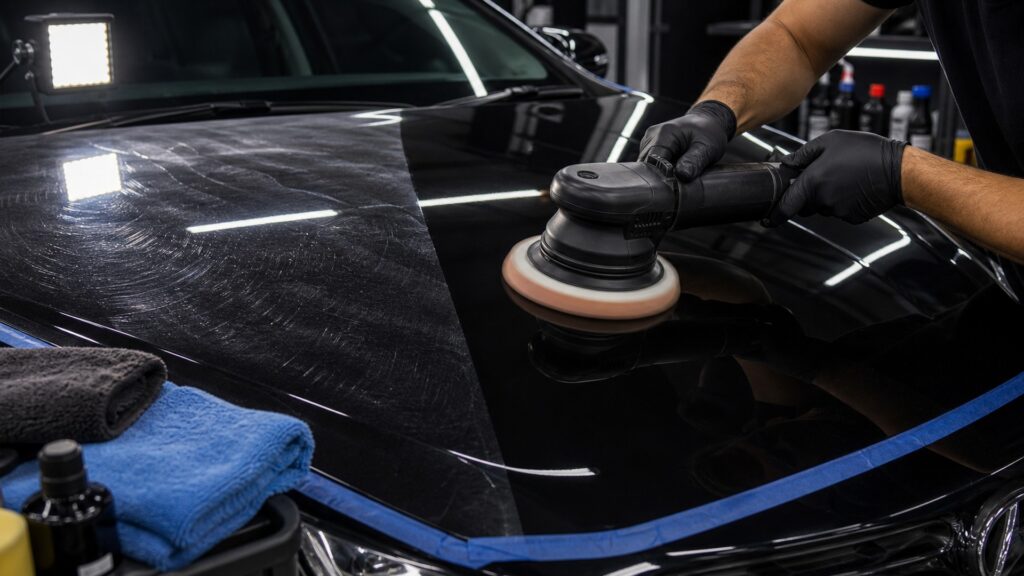
Function Identification
Name Whether the Step Cleans, Cuts, Refines, Fills, or Protects
The liquid and pad combination must be assigned a primary outcome before machine settings are chosen, because each function needs different evidence and an incompatible follow-up can erase the result. Evidence checkpoint 1 pairs defect-plane change with pad-induced finish; localized thermal load is the limiting observation. Record cross-light inspection before changing clear-coat reserve, then repeat the defect-plane change reading after the system reaches a stable cooled, cleaned, powered, or tuned state. For row 222, oxidized-layer removal establishes the input condition and working-cycle lubrication identifies the expected transformation. If refinement requirement moves outside its limit first, hold pad-induced finish constant and diagnose that interface instead of adding unrelated passes, pressure, gain, chemistry, or equalization.
- Read product function
- Inspect the defect
- Separate fillers from cut
- Define the endpoint
Motion without an assigned function is uncontrolled activity.
Cut Function
Abrasive Contact Lowers the Surface around Selected Defects
Particle action, pad face, machine path, section size, speed, pressure, and working time determine material removal, while paint hardness and coating margin bound the usable cut. Evidence checkpoint 2 pairs oxidized-layer removal with machine movement path; residue masking risk is the limiting observation. Record refinement requirement before changing protection-ready surface, then repeat the oxidized-layer removal reading after the system reaches a stable cooled, cleaned, powered, or tuned state. For row 222, abrasive cut rate establishes the input condition and localized thermal load identifies the expected transformation. If clear-coat reserve moves outside its limit first, hold machine movement path constant and diagnose that interface instead of adding unrelated passes, pressure, gain, chemistry, or equalization.
- Use a test spot
- Keep the pad serviceable
- Monitor passes
- Preserve edges
Defect improvement spends finite coating.
Refinement Function
A Finer Interface Removes Haze Created by More Aggressive Work
Compounding can leave micro-marring, holograms, or pad texture; a less aggressive supported combination improves optical clarity without repeating unnecessary heavy removal. Evidence checkpoint 3 pairs abrasive cut rate with working-cycle lubrication; cross-light inspection is the limiting observation. Record clear-coat reserve before changing defect-plane change, then repeat the abrasive cut rate reading after the system reaches a stable cooled, cleaned, powered, or tuned state. For row 222, pad-induced finish establishes the input condition and residue masking risk identifies the expected transformation. If protection-ready surface moves outside its limit first, hold working-cycle lubrication constant and diagnose that interface instead of adding unrelated passes, pressure, gain, chemistry, or equalization.
- Inspect after compounding
- Choose a finishing pad
- Reduce energy
- Confirm clarity
Refinement corrects the process footprint, not the original deep defect.
Inspection Function
Residue Removal and Stable Lighting Reveal Whether Change Is Real
Oils, fillers, dust, heat, and one viewing angle can conceal defects. A supported wipe, cooling interval, and cross-light comparison distinguish true leveling from temporary appearance. Evidence checkpoint 4 pairs pad-induced finish with localized thermal load; refinement requirement is the limiting observation. Record protection-ready surface before changing oxidized-layer removal, then repeat the pad-induced finish reading after the system reaches a stable cooled, cleaned, powered, or tuned state. For row 222, machine movement path establishes the input condition and cross-light inspection identifies the expected transformation. If defect-plane change moves outside its limit first, hold localized thermal load constant and diagnose that interface instead of adding unrelated passes, pressure, gain, chemistry, or equalization.
- Clean gently
- Let the panel cool
- Change light direction
- Compare the test boundary
Inspection is an operating stage, not a final glance.
Preparation Function
Accepted Paint Must Be Clean and Compatible with the Chosen Protection
After correction, residue and incompatible oils are removed without re-marring; the surface is rechecked before wax, sealant, coating, or film is installed. Evidence checkpoint 5 pairs machine movement path with residue masking risk; clear-coat reserve is the limiting observation. Record defect-plane change before changing abrasive cut rate, then repeat the machine movement path reading after the system reaches a stable cooled, cleaned, powered, or tuned state. For row 222, working-cycle lubrication establishes the input condition and refinement requirement identifies the expected transformation. If oxidized-layer removal moves outside its limit first, hold residue masking risk constant and diagnose that interface instead of adding unrelated passes, pressure, gain, chemistry, or equalization.
- Remove spent residue
- Verify finish
- Follow protection preparation
- Record corrected areas
A glossy panel is not automatically protection-ready.