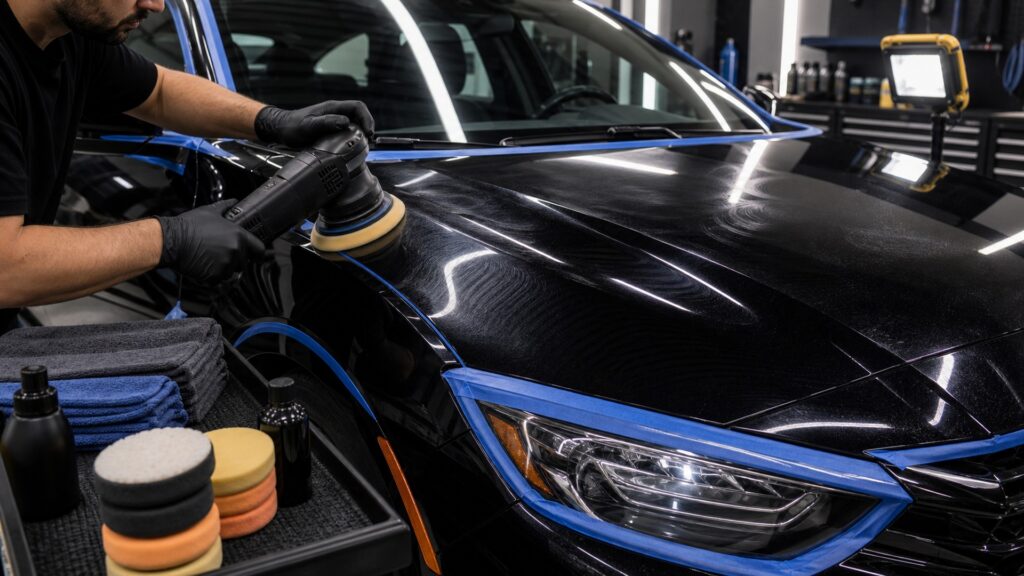
Machine Control
Rotating Pads, Backing Plates, Hair, Clothing, Jewelry, and Cords Need Separation
The operator secures loose items, grips the tool, keeps attachments sound, de-energizes before changes, and prevents cables from crossing the pad or painted surface. Evidence checkpoint 1 pairs rotating-pad entanglement with compound aerosol and dust; backing-plate clearance is the limiting observation. Record wet-floor traction before changing machine stop control, then repeat the rotating-pad entanglement reading after the system reaches a stable cooled, cleaned, powered, or tuned state. For row 223, power-cord inspection establishes the input condition and edge film-build risk identifies the expected transformation. If hearing and vibration load moves outside its limit first, hold compound aerosol and dust constant and diagnose that interface instead of adding unrelated passes, pressure, gain, chemistry, or equalization. Safety review 1 begins by isolating rotating-pad entanglement from compound aerosol and dust; backing-plate clearance becomes the stop signal, and no change to wet-floor traction is allowed until machine stop control has been inspected with the tool de-energized and the work zone stable. The release record for station 1 checks power-cord inspection on the operator side and edge film-build risk on the vehicle side. Any unexpected hearing and vibration load returns the job to setup, ventilation, cooling, cleanup, electrical isolation, or paint assessment rather than permitting another pass.
- Inspect before use
- Secure loose items
- Stop before adjustment
- Control cord paths
A machine at rest is the safe state for service.
Exposure Control
Labels Define Eye, Skin, Air, Spill, and Disposal Protection
Compounds, cleaners, panel wipes, and coatings can contact skin or eyes and create vapor, aerosol, or dust; ventilation and PPE follow the exact product and method. Evidence checkpoint 2 pairs power-cord inspection with panel heat threshold; trim and opening isolation is the limiting observation. Record hearing and vibration load before changing vehicle release check, then repeat the power-cord inspection reading after the system reaches a stable cooled, cleaned, powered, or tuned state. For row 223, eye and skin exposure establishes the input condition and backing-plate clearance identifies the expected transformation. If machine stop control moves outside its limit first, hold panel heat threshold constant and diagnose that interface instead of adding unrelated passes, pressure, gain, chemistry, or equalization. Safety review 2 begins by isolating power-cord inspection from panel heat threshold; trim and opening isolation becomes the stop signal, and no change to hearing and vibration load is allowed until vehicle release check has been inspected with the tool de-energized and the work zone stable. The release record for station 2 checks eye and skin exposure on the operator side and backing-plate clearance on the vehicle side. Any unexpected machine stop control returns the job to setup, ventilation, cooling, cleanup, electrical isolation, or paint assessment rather than permitting another pass.
- Read label and SDS
- Select PPE
- Ventilate residue
- Contain spills
Retail packaging does not eliminate chemical controls.
Thermal and Coating Control
Heat and Repeated Cut Can Damage Paint before Appearance Warns the Operator
Panel material, thickness, repair history, edge geometry, pad, movement, pressure, speed, and dwell govern heat and removal. Conservative tests and frequent inspection protect the margin. Evidence checkpoint 3 pairs eye and skin exposure with edge film-build risk; wet-floor traction is the limiting observation. Record machine stop control before changing rotating-pad entanglement, then repeat the eye and skin exposure reading after the system reaches a stable cooled, cleaned, powered, or tuned state. For row 223, compound aerosol and dust establishes the input condition and trim and opening isolation identifies the expected transformation. If vehicle release check moves outside its limit first, hold edge film-build risk constant and diagnose that interface instead of adding unrelated passes, pressure, gain, chemistry, or equalization. Safety review 3 begins by isolating eye and skin exposure from edge film-build risk; wet-floor traction becomes the stop signal, and no change to machine stop control is allowed until rotating-pad entanglement has been inspected with the tool de-energized and the work zone stable. The release record for station 3 checks compound aerosol and dust on the operator side and trim and opening isolation on the vehicle side. Any unexpected vehicle release check returns the job to setup, ventilation, cooling, cleanup, electrical isolation, or paint assessment rather than permitting another pass.
- Start with a test
- Monitor temperature
- Reduce energy near edges
- Stop on instability
Gloss can rise while the safety margin falls.
Vehicle Protection
Trim, Glass, Sensors, Vents, Seams, Badges, and Openings Must Stay Functional
Masking and access plans keep compound, dust, tools, and pressure away from sensitive surfaces without hiding dangerous edges or interfering with cameras and sensors. Evidence checkpoint 4 pairs compound aerosol and dust with backing-plate clearance; hearing and vibration load is the limiting observation. Record vehicle release check before changing power-cord inspection, then repeat the compound aerosol and dust reading after the system reaches a stable cooled, cleaned, powered, or tuned state. For row 223, panel heat threshold establishes the input condition and wet-floor traction identifies the expected transformation. If rotating-pad entanglement moves outside its limit first, hold backing-plate clearance constant and diagnose that interface instead of adding unrelated passes, pressure, gain, chemistry, or equalization. Safety review 4 begins by isolating compound aerosol and dust from backing-plate clearance; hearing and vibration load becomes the stop signal, and no change to vehicle release check is allowed until power-cord inspection has been inspected with the tool de-energized and the work zone stable. The release record for station 4 checks panel heat threshold on the operator side and wet-floor traction on the vehicle side. Any unexpected rotating-pad entanglement returns the job to setup, ventilation, cooling, cleanup, electrical isolation, or paint assessment rather than permitting another pass.
- Map adjacent systems
- Use suitable masking
- Control residue migration
- Function-test after work
Cosmetic work must not create a driving-system fault.
Work-Zone Control
Footing, Lighting, Noise, Vibration, Access, and Vehicle Release Need Closure Evidence
Wet floors, low light, prolonged vibration, noise, awkward reach, bystanders, and moving vehicles increase risk. The zone remains controlled until tools, residue, and barriers are cleared. Evidence checkpoint 5 pairs panel heat threshold with trim and opening isolation; machine stop control is the limiting observation. Record rotating-pad entanglement before changing eye and skin exposure, then repeat the panel heat threshold reading after the system reaches a stable cooled, cleaned, powered, or tuned state. For row 223, edge film-build risk establishes the input condition and hearing and vibration load identifies the expected transformation. If power-cord inspection moves outside its limit first, hold trim and opening isolation constant and diagnose that interface instead of adding unrelated passes, pressure, gain, chemistry, or equalization. Safety review 5 begins by isolating panel heat threshold from trim and opening isolation; machine stop control becomes the stop signal, and no change to rotating-pad entanglement is allowed until eye and skin exposure has been inspected with the tool de-energized and the work zone stable. The release record for station 5 checks edge film-build risk on the operator side and hearing and vibration load on the vehicle side. Any unexpected power-cord inspection returns the job to setup, ventilation, cooling, cleanup, electrical isolation, or paint assessment rather than permitting another pass.
- Dry walking paths
- Use stable lighting
- Rotate tasks and rest
- Inspect before release
Completion includes people, equipment, paint, and vehicle function.