
Legal Boundary
The current jurisdiction- and vehicle-specific rules governing possession, sale, installation, mounting, operation, and interference devices.
- Rules can change
- Routes cross boundaries
- Commercial vehicles may differ
Radar-detector safety begins before the device is powered. The owner must confirm current law for the jurisdiction and vehicle class, choose a permitted location, keep the road view and airbags clear, restrain cables, and use supported power hardware. A prohibited or obstructive installation is unsafe regardless of receiver performance.
Operation adds human risk. Sudden tones can trigger abrupt braking, frequent nuisance alerts can drain attention, and a quiet detector can create false confidence. Settings, lockouts, and phone connections should be handled while parked. On the road, an alert should prompt a calm check of speed, signs, traffic, and conditions—not device interaction or an evasive maneuver.
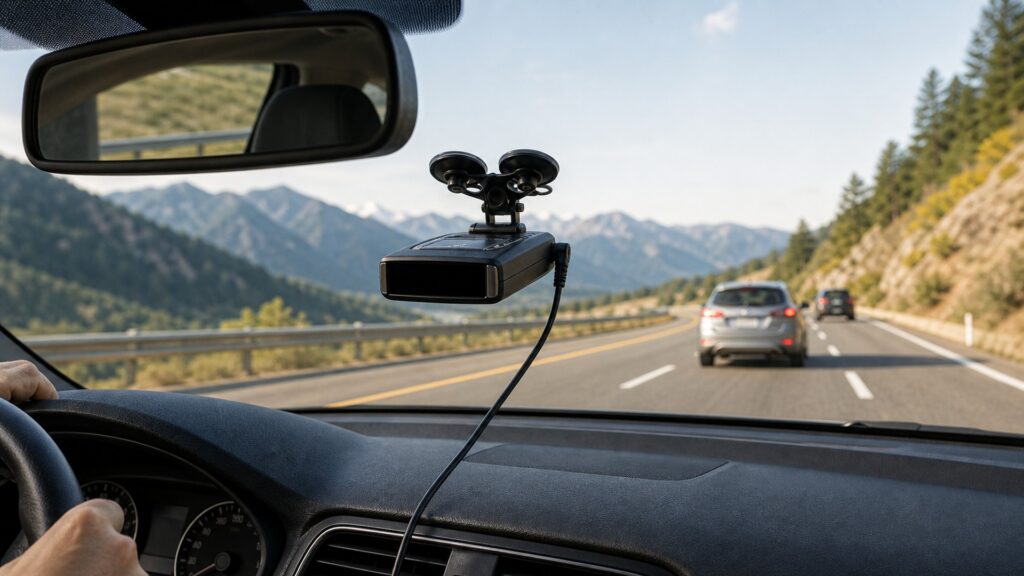
Safe use depends on permission, secure placement, stable power, limited interaction, responsible response, protected data, and realistic expectations.
Tip: Configure and learn the device while stationary; the driver should never need to inspect menus or diagnose an alert in moving traffic.
These terms turn general caution into specific installation and response controls.
The current jurisdiction- and vehicle-specific rules governing possession, sale, installation, mounting, operation, and interference devices.
Any detector, bracket, cable, or display position that hides relevant road, mirror, instrument, or signal information.
The volume through which a restraint deploys and the surrounding surfaces that must remain free of attached equipment or loose hardware.
A sudden sound, light, or voice capable of provoking an abrupt control input or attentional shift.
Risky behavior encouraged by believing the detector will always provide early or accurate warning.
Exposure created when GPS history, lockouts, routes, accounts, or connected apps reveal travel patterns.
Tip: Document the chosen legal source, mounting position, and response rule before regular use.
Current rules may distinguish private and commercial vehicles, detection and jamming, possession and use, or permitted mounting. Consult official sources for every route and change plans when the legal boundary changes.
Legal uncertainty is a reason to stop, not improvise.
A detector should remain secure during braking and bumps without blocking the road, mirrors, instruments, sensors, or airbag deployment. Route power leads away from pedals, steering, knees, sharp trim, and heat.
Receiver performance never justifies a projectile or obstruction hazard.
Menu interaction is visual, manual, and cognitive work. Configure profiles, study tones, pair phones, update databases, and review alert history while parked or assign a passenger during necessary observation.
The detector should shrink driver workload rather than become another screen task.
The safe response is to maintain control, verify speed and posted limits, observe surrounding traffic, and adjust smoothly if needed. Hard braking can create rear-end risk and may be unnecessary for a nuisance alert.
Responsible response remains the driver's job even when classification is correct.
Phone apps, cloud databases, updates, GPS history, and wireless adapters expand the data and trust boundary. Use supported software, protected accounts, limited permissions, and retention settings while remembering that no configuration guarantees detection.
Technology reduces neither legal duty nor uncertainty about unseen signals.
Its alert does not change the speed limit, visibility, stopping distance, traffic law, or the driver's obligation to control the vehicle attentively.
A calm, familiar alert can cue the driver to verify speed and surroundings.
Secure, lawful, preconfigured installation can minimize added workload.
Startle, distraction, obstruction, abrupt braking, battery drain, location exposure, and false confidence can outweigh any informational value.
No alert can guarantee measurement was not made.
These myths mistake detection capability for permission, certainty, or harmless installation.
Speed affects stopping distance, crash energy, sight distance, and legal responsibility regardless of warning technology. A detector neither changes roadway physics nor ensures advance notice, so posted limits and conditions remain the controlling boundaries.
A compact object close to the driver's eyes can hide a distant pedestrian, sign, motorcycle, or signal. The bracket and cable can also enter airbag, control, or occupant space during hard braking or impact.
Abrupt braking can surprise following traffic and destabilize the vehicle, especially on curves or low-grip surfaces. Maintain control, check actual speed and surroundings, and make smooth lawful adjustments instead of reacting to tone alone.
A detector may face no transmission, instant-on use, narrow laser targeting, blocked geometry, disabled bands, filtering, lockouts, interference, power loss, or receiver failure. Silence cannot justify exceeding limits or reducing ordinary observation.
Tip: Judge safety by behavior and environment, not alert count.
These answers address law, placement, attention, response, travel, and connected features.
Consult current official sources for the origin, destination, and every jurisdiction crossed, including rules for vehicle class, possession, use, mounting, and interference devices. Recheck when laws, routes, vehicles, or fleet policies change.
Confirm lawful location, manufacturer orientation, clear road and mirror sightlines, airbag separation, secure bracket retention, restrained cable routing, reachable controls while parked, stable power, manageable heat, and no interference with vehicle sensors.
Learn tones while parked, set moderate volume and brightness, use clear priority rules, suppress verified nuisances carefully, keep following distance, and rehearse a response that begins with vehicle control and a smooth speed check.
No. Select the mode and volume before departure, use a passenger for observation where appropriate, and pull over safely for lockouts, pairing, updates, troubleshooting, or detailed review. Driving attention must remain primary.
Inspect app permissions, location history, account security, cloud synchronization, stored lockouts, diagnostic logs, export metadata, paired phones, and deletion behavior. Keep only the access and retention needed for the chosen feature.
Radar-detector safety factors include current law, vehicle class, sightlines, airbags, mount retention, cables, electrical behavior, distraction, alert startle, response, false confidence, wireless security, and location privacy.
Configure while parked and respond calmly by checking speed and surroundings. The detector never authorizes speeding, guarantees notice, or replaces attentive control of the vehicle.
These explainers connect lawful placement and calm response to the installation and state checks that support them.
Audit legal fit, sightlines, airbag clearance, power, cable routing, heat, and interference.
Define alert, mute, lockout, fault, audio, and recovery states before driving.
Understand receiver uncertainty, signal geometry, and why detection cannot guarantee warning.
Choose a retailer
Prices checked regularly. We may earn a commission at no cost to you.