
Scheduled Charging
A rule that permits or targets charging during selected times.
- It can follow utility rates
- Departure time needs margin
- Clock errors can block energy
Smart EV chargers matter because parked vehicles usually offer more connection time than active charging requires. Connected controls can place energy delivery inside lower-cost hours, cap demand, share a limited circuit, record consumption, notify an owner, and restrict access without asking the driver to reconnect the cable later.
Connectivity does not increase the electrical ceiling or guarantee savings. The vehicle, charger, utility program, home load, clock, network, cloud service, and user settings must agree. A smart feature is valuable when it solves a defined timing or capacity problem and retains safe local charging when internet service, an app, or a vendor platform becomes unavailable.
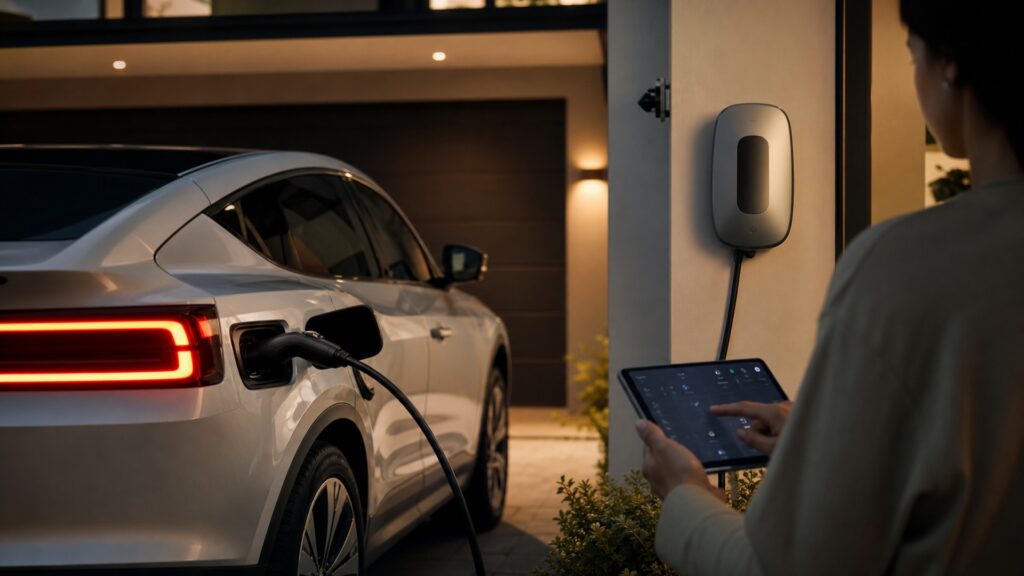
Smart behavior should produce a verifiable charging outcome while preserving local safety and owner control.
Tip: Before enabling multiple schedules, choose one authoritative controller; overlapping vehicle, charger, utility, and home-automation rules can create missed departures that look like hardware faults.
These terms distinguish useful energy management from a remote on-off switch.
A rule that permits or targets charging during selected times.
Control that adjusts charging to remain within site or circuit capacity.
Voluntary or contracted adjustment in response to a grid or utility signal.
Measurement of electricity associated with a vehicle or charging port.
Permission rules that restrict who may initiate or use charging.
Defined charger behavior when connectivity or remote services fail.
Tip: Document which functions run locally and which depend on the internet, vendor cloud, utility enrollment, subscription, or account permission.
A vehicle connected at 6 p.m. may need only several hours of energy before morning. Scheduling can delay start until a lower rate or cleaner grid period, then finish before departure with reserve for cold weather or an unexpected trip.
The benefit comes from moving energy without reducing readiness, so completion matters more than strict adherence to the cheapest minute.
Dynamic control can reduce EV current when household demand rises and restore it later, or divide capacity among several vehicles. Proper design keeps fixed electrical protections independent while sensors and software optimize beneath the safe ceiling.
Smart control can use existing capacity more effectively; it cannot correct undersized conductors or an unsafe installation.
Charger records can reveal energy, duration, interruptions, users, and schedule performance. Those data help allocate shared costs and diagnose trends, but utility billing, charger input, and vehicle-stored energy are different measurements with losses and accuracy limits.
A useful dashboard explains what it measured rather than converting every kilowatt-hour into an unsupported battery or range claim.
Eligible connected equipment may receive price or load signals and alter charging under program rules. Savings depend on enrollment, tariff, event frequency, override policy, baseline, and whether the vehicle still reaches its departure target.
Utility control is a negotiated service, not an automatic advantage attached to the word smart.
Cloud dependence can strand schedules, accounts, logs, or access controls when service ends. Secure credentials, supported updates, minimal data collection, local manual control, and a documented reset path determine whether the charger remains useful throughout its electrical life.
A long-lived electrical appliance should not lose its essential charging function merely because a short-lived app disappears.
Scheduling, load management, records, and utility coordination can improve charging, but connectivity adds dependencies that must be designed and tested.
A defined schedule can meet departure needs inside a favorable rate window, while dynamic control can share limited electrical capacity among home loads or vehicles.
Session records, alerts, and access rules can improve accountability and make intermittent problems easier to reproduce.
Smart software cannot increase circuit capacity, repair unsafe wiring, override vehicle acceptance, or guarantee savings under every tariff.
Internet outages, cloud shutdowns, account loss, conflicting schedules, poor security, or unsupported updates can make convenience less reliable than simple local control.
These myths confuse connectivity with electrical capability and guaranteed economics.
Connectivity may schedule or modulate power, but the circuit, EVSE rating, connector, vehicle onboard charger, battery controls, and thermal conditions set speed. Smart management may intentionally reduce current to protect capacity or follow a program.
Savings require a tariff with meaningful time differences, correct clock and schedule settings, sufficient off-peak hours, and no penalty that outweighs the shift. Compare actual bills and departure readiness rather than assuming.
Two independent controllers can each wait for permission from the other, producing little or no energy. Use one primary schedule unless the manufacturers document a coordinated configuration and verify it repeatedly.
Applications, subscriptions, servers, and vendors can change long before electrical hardware wears out. Evaluate local fallback, data export, standards-based integration, update policy, account transfer, and continued basic charging without the service.
Tip: Define the exact control problem, then test both normal and failure behavior.
These answers focus on configuration, resilience, and evidence rather than app feature lists.
For many homes, reliable scheduling or load management has the clearest purpose. The better choice depends on the utility tariff, service capacity, other large loads, number of vehicles, departure times, and available local fallback.
A properly engineered load-management system can keep EV demand below a defined capacity, but breakers, conductors, grounding, and installation remain the independent safety foundation. Software alone must never substitute for correctly sized protective hardware.
Behavior varies. Some units continue local charging and stored schedules; others lose remote commands, logs, authentication, or utility coordination. Test the documented offline mode before depending on the charger for a time-critical departure.
Not exactly. A charger generally measures input at its boundary, while conversion, cable, conditioning, and battery losses separate that value from energy stored. Use readings consistently for trends and confirm accuracy before billing other users.
Review collected data, retention, location and vehicle identifiers, third-party sharing, account security, remote-control permissions, deletion, export, and transfer procedures. Grant only necessary access and remove former household members or installers promptly.
Smart EV chargers matter when control over time, capacity, access, and information solves a real constraint while the vehicle remains ready by departure.
Choose functions with measurable value, establish one scheduling authority, preserve hard electrical protections, and verify offline charging, account security, data ownership, updates, and long-term support.
These explainers show where connected management sits within the physical charging system and daily parking routine.
Build a home-charging routine around parking, circuit capacity, utility rates, weather, and departure needs.
Translate scheduled or managed power into energy delivered before the next trip.
Understand the interfaces and communication rules that enable connected charging and interoperability.
Choose a retailer
Prices checked regularly. We may earn a commission at no cost to you.