Why Vehicle Batteries Maintenance Role Matters

Battery maintenance protects reserve by controlling conditions around the cells, not by reversing chemical aging. Clean, tight connections reduce voltage loss; correct charging prevents chronic undercharge or damaging overcharge; a secure case, open vent route, and sound tray prevent damage. Infrequently driven vehicles may need an approved maintainer and a key-off draw investigation rather than repeated jump starts.

The plan changes by architecture. Serviceable low-voltage batteries may allow checks that sealed designs do not; monitored vehicles can require battery-sensor care and a replacement reset; electrified vehicles depend on low-voltage health plus intact traction-pack cooling and software supervision. Owners should follow charging and storage guidance, watch warnings and range trends, and leave internal traction-battery inspection to qualified high-voltage technicians.

By: Review Streets Research Lab
Updated: September 1, 2026
Explainer · 8-12 min read
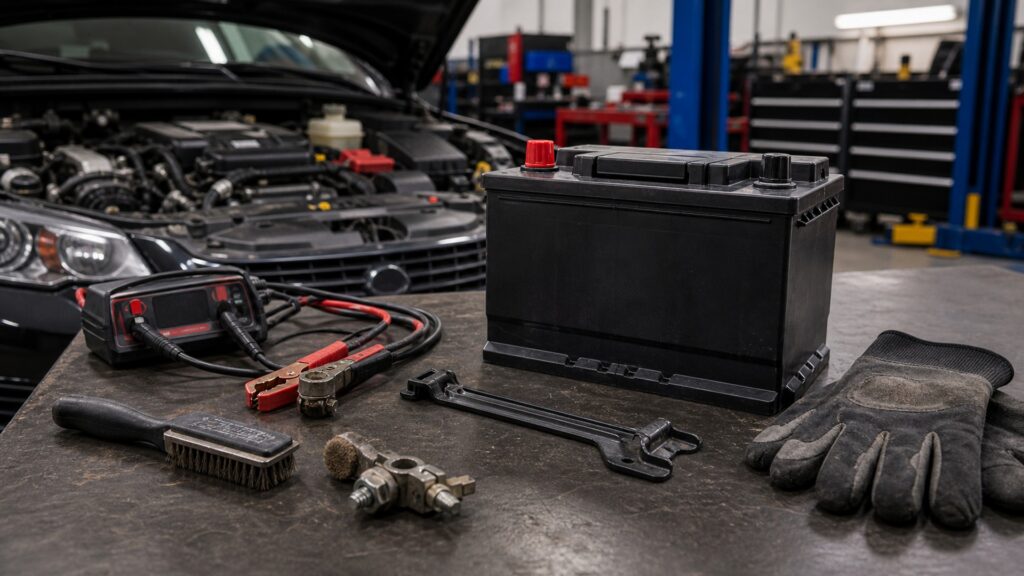
vehicle batteries maintenance role explainer hero image for Review Streets
What You'll Learn

Maintain the Conditions That Preserve Reserve

Useful maintenance joins visual inspection, voltage-loss control, charging and sleep-current checks, trend records, exact storage guidance, and architecture-specific safety limits.

  • Inspect case, tray, and hold-down
  • Clean and protect terminals correctly
  • Test charging under relevant states
  • Measure key-off draw after sleep
  • Record load or conductance trends
  • Keep approved thermal paths functional

Tip: Test before cleaning a corroded connection when safe; the pre-service voltage drop and photographs can show whether appearance was actually affecting current delivery.

Definitions

Key Concepts That Define Vehicle Battery Maintenance

These terms connect routine observations to charge preservation, connection quality, storage, and long-term battery trend analysis.

Terminal Corrosion

Reaction products accumulated around battery posts, clamps, or nearby conductors that may raise resistance, damage materials, or signal leakage.

  • Appearance does not quantify loss
  • Neutralization must match guidance
  • Hidden cable damage can remain

Voltage Drop

Electrical potential lost across a connection, cable, switch, or ground while current flows through unwanted resistance.

  • Load makes the loss visible
  • Measure both circuit sides
  • Location guides the repair

Parasitic Draw

Current consumed after the vehicle should have completed normal shutdown and entered its specified sleep state.

  • Testing can wake modules
  • Some loads are timed
  • Circuit isolation requires care

Conductance Trend

A series of comparable low-voltage battery test results used to observe changing ability to pass current under a defined instrument method.

  • Methods are not interchangeable
  • Temperature affects comparisons
  • Trend supports but does not prove

Battery Maintainer

A compatible regulated charger designed to preserve charge during storage according to the battery chemistry and vehicle instructions.

  • Wrong mode can damage cells
  • Connection points may be remote
  • Ventilation remains important

Thermal Management

Hardware and control strategies that heat or cool a traction battery to support performance, charging, longevity, and safety.

  • Energy may power conditioning
  • Blocked passages reduce capability
  • Service remains architecture specific

Tip: Record the test method and conditions, not just pass or fail. Different instruments and temperatures can make isolated scores look more comparable than they are.

Connections Need Electrical Proof

Clean Appearance Is Less Important than Low Resistance under Load

Loose clamps, corrosion between mating surfaces, damaged grounds, and wicking inside cables can consume voltage during cranking. Maintenance should measure loss before and after safe cleaning and correct tightening.

  • Inspect terminals and cable ends
  • Measure cranking voltage drop
  • Protect surfaces as specified
  • Restore covers and strain relief

Do not file or reshape terminals to conceal a fitment or clamp problem.

Charge History Explains Repeated Weakness

Short Trips and Long Storage Can Prevent Full Recovery

Starting removes energy quickly; brief operation may not replace it, especially with accessories, cold conditions, or smart charging. Repeated low state of charge accelerates some degradation and confuses one-time tests.

  • Review driving and charging patterns
  • Stabilize before final testing
  • Use an approved maintainer
  • Investigate recurring discharge

A recharge restores state of charge, not necessarily state of health or the cause of depletion.

Key-Off Loads Must Be Measured after Sleep

Normal Network Activity Can Resemble an Abnormal Drain

Modern modules remain awake after shutdown and may wake when a door, key, test lead, or network tool changes state. A valid draw test preserves circuit continuity and waits for the documented sleep process.

  • Control keys and remote devices
  • Avoid waking the network
  • Use a suitable measurement method
  • Isolate circuits systematically

Pulling fuses immediately can erase the state that produced the complaint.

Physical Condition Protects the Cells

Tray, Hold-Down, Vent, and Case Prevent Movement and Exposure

Routine inspection should find swelling, cracks, leakage, loose retention, debris beneath the case, blocked vent routing, cable strain, and missing insulation before vibration or a collision magnifies the damage.

  • Inspect without leaning on posts
  • Clean the tray safely
  • Torque the designed restraint
  • Escalate a damaged case

A heavy battery must be restrained even when it has never shifted visibly.

Electrified-Vehicle Care Includes Thermal Support

Cooling Paths and Software Warnings Preserve Traction-Pack Boundaries

Owners generally maintain a traction battery by following charging, parking, update, and storage guidance while keeping external cooling inlets clear where applicable. Internal service belongs to qualified technicians.

  • Follow manufacturer charge guidance
  • Heed temperature and isolation warnings
  • Keep specified inlets unobstructed
  • Document range and charge trends

Maintenance does not authorize opening a high-voltage pack or improvising its cooling system.

Quick Reality Check

Maintenance Protects Reserve around the Cells

Connections, charging support, key-off behavior, storage, physical retention, venting, thermal systems, and repeatable records can preserve reliable operation and expose developing faults early.

A Practical Maintenance Record Contains

Date, mileage, battery identifiers, architecture and chemistry, state and temperature, terminal condition, loaded voltage, cable drops, charging behavior, sleep-current method, physical inspection, and comparable trend results.

For stored vehicles, record maintainer type and connection; for electrified vehicles, record relevant warnings, charge behavior, range context, cooling observations, software or service actions, and qualified diagnostic findings.

Maintenance Cannot Reverse or Excuse

Lost active material, internal shorts, severe sulfation, damaged separators, leaking or swollen cases, failing cell groups, isolation faults, crash damage, thermal events, or capacity loss beyond accepted limits require diagnosis, replacement, or specialist response.

Do not add fluid to sealed batteries, mix chemicals, bypass sensors, force charge a frozen or damaged battery, open traction enclosures, clear persistent warnings, or use a maintainer mode not approved for the chemistry.

Common Myths

Misconceptions About Vehicle Battery Maintenance

Battery care is often reduced to terminal cleaning or a periodic replacement date, leaving the causes of chronic low charge and connection loss unexplored.

Driving around the block fully recharges any battery

A short trip may consume more energy than the charging system replaces, especially after a difficult start, in cold weather, or with heavy accessory demand. Confirm charging and use an approved maintainer when appropriate.

Visible corrosion proves the battery itself has failed

Corrosion may result from leakage, venting, moisture, dissimilar metals, damaged terminals, or prior service. Measure loaded voltage and connection drop, inspect the case and cable, then correct the source before judging internal battery condition.

Disconnecting the battery is the best storage method

Disconnection can affect alarms, locks, memories, emissions readiness, windows, and other procedures, while some vehicles specify remote charging points or a maintainer. Follow exact storage guidance instead of applying one universal method.

Traction batteries require no maintenance because packs are sealed

Owners usually do not service cells, but charging habits, cooling inlets, temperature exposure, software, warnings, damage, and storage guidance still matter. Qualified technicians maintain related thermal, electrical, and diagnostic systems when specified.

Tip: Treat maintenance as condition control plus trend evidence, with different owner and technician boundaries for low-voltage and high-voltage systems.

FAQ

Frequently Asked Questions About Vehicle Battery Maintenance

These answers address testing frequency, terminal cleaning, short-trip use, maintainers, parasitic draw, sealed batteries, and traction-pack care.

How often should a 12-volt battery be tested?

Follow vehicle and battery guidance, climate, age, use, and symptoms. Testing before temperature extremes or long travel can establish a trend, but comparable method, charge state, temperature, and load context matter more than frequency alone.

Should corrosion be cleaned with the battery connected?

Follow the service procedure. Prevent sparks, protect eyes and skin, control vehicle state, and use chemistry-appropriate cleanup. Connection order and memory support vary; damaged, leaking, or high-voltage-adjacent installations require qualified handling.

When is a maintainer useful?

It can preserve charge during seasonal storage, infrequent use, or extended service when its voltage profile, chemistry mode, connection points, ventilation, and monitoring match manufacturer guidance. It cannot repair capacity loss or abnormal key-off draw.

How is parasitic draw tested without waking the vehicle?

Use a method that preserves power continuity, controls keys and access points, allows the specified sleep time, and measures the correct current range safely. Then isolate circuits without repeatedly resetting network state.

What maintenance can an EV owner perform safely?

Follow charging and storage guidance, keep designated external cooling inlets clear, observe warnings and unusual heat or odor, maintain the 12-volt system, and arrange qualified service. Do not open or probe high-voltage components.

Bottom Line

Vehicle-battery maintenance matters because connection loss, chronic undercharge, abnormal key-off loads, poor storage practice, damaged retention, blocked venting, and thermal-management faults can consume reliable reserve before cell replacement is justified.

Inspect and measure the conditions around the battery, preserve comparable trend records, and follow chemistry- and vehicle-specific charging guidance. Treat damage, persistent faults, and every internal traction-battery task as qualified diagnostic or high-voltage service work.

Next Steps

Build a Battery History, Not a Replacement Habit

Related explainers connect the battery mechanism, operating measurements, and fitment interfaces needed to turn routine care into evidence-based decisions.

How Vehicle Batteries Work

Trace chemical energy, external current, charging, and the separate roles of auxiliary and traction batteries.