
Front-Wheel Drive
A layout in which the front tires receive propulsion torque, commonly through a compact transaxle.
- Powertrain packaging can be space-efficient
- Front tires also steer
- Acceleration shifts load away from them
A drivetrain carries propulsion torque from an engine or motor to the tires that push against the road. Choosing front-, rear-, all-, or four-wheel drive changes the mechanical route, the tires asked to accelerate the vehicle, and the hardware carried beneath the body.
Those differences matter during launches, climbs, towing, corner exits, snow, loose terrain, packaging, maintenance, and energy use. They do not define safety or capability alone. Tire compound, load, suspension, stability controls, power delivery, center coupling, differential behavior, clearance, cooling, and driver inputs decide whether the chosen layout helps. Exact implementation is more informative than the badge.
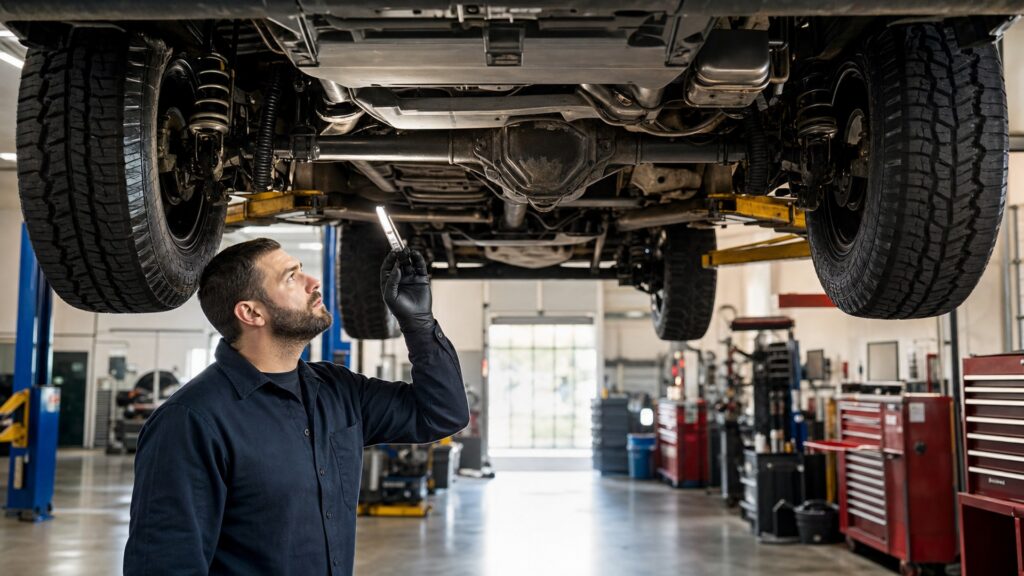
The useful question is not how many wheels are nominally driven, but how torque reaches them, what grip each tire retains under load transfer, and which hardware or controls limit the result.
Tip: During acceleration, load shifts rearward. That can reduce the traction reserve available to heavily powered front tires and increase it at rear tires, although suspension, geometry, road grade, tires, and controls alter the magnitude.
These terms connect drivetrain architecture with torque routing, tire grip, and ownership consequences.
A layout in which the front tires receive propulsion torque, commonly through a compact transaxle.
A layout sending propulsion torque to the rear tires through a longitudinal gearbox, driveshaft, or rear motor arrangement.
A road-oriented system capable of powering both axles through gearing, clutches, or separate motors.
A selectable or heavy-duty architecture commonly offering direct axle coupling and sometimes low-range reduction.
A gear or controlled device allowing driven wheels or axles to rotate at different speeds while receiving torque.
The maximum longitudinal and lateral force a tire can produce under its current load, surface, temperature, and slip state.
Tip: A drivetrain can deliver torque to a tire, but only the tire-road contact can convert that torque into force without excessive slip.
Combining engine or motor, gearbox, final drive, and differential near the front can reduce driveline length and preserve cabin space. The front tires must divide grip among propulsion, steering, and much of braking.
Compact packaging is useful even when maximum launch traction is not the priority.
A rear-driven layout often supports strong acceleration, towing architecture, and balanced steering effort because load shifts toward the powered axle. Wet or icy throttle use can still provoke rear slip and yaw.
Rearward load transfer helps propulsion only within the rear tires' available friction.
An AWD center differential, clutch, or motor strategy can use traction available at both axles and respond to changing surfaces. Clutches, gears, shafts, and extra rotating parts add heat, mass, service needs, and energy loss.
Distribution strategy matters most when grip differs across tires or changes rapidly.
A transfer case can directly couple axles and provide reduction for crawling, steep grades, recovery, or heavy low-speed movement. On high-grip pavement, locked operation can bind because axles need different average speeds in turns.
Terrain capability emerges from the whole vehicle, not the transfer case alone.
More driveline hardware can add service points and make tire mismatch more consequential. CV joints, driveshafts, seals, differential fluids, transfer cases, clutches, and motors have vehicle-specific intervals and repair costs.
The best layout is the one whose real benefits are used often enough to justify its continuing costs.
Layout changes packaging and available propulsion strategies, while tires, controls, loading, terrain hardware, ratings, and driver behavior determine the outcome.
Its driven-axle behavior repeatedly solves the owner's launch, packaging, towing, weather, performance, or terrain constraint under the actual tires, loads, routes, and control strategy.
The buyer understands tire-matching, fluid, maintenance, efficiency, overheat, mode-selection, and failure implications and confirms that the exact trim contains the expected hardware.
AWD cannot guarantee short stopping, RWD cannot guarantee balanced handling, FWD cannot guarantee efficiency, and 4WD cannot guarantee off-road passage. Exact engineering and conditions control each claim.
No drivetrain compensates for poor tires, excess speed, overload, weak brakes, insufficient clearance, unstable towing, unsafe water, missed maintenance, or a driver unfamiliar with the installed modes.
Drivetrain myths turn common tendencies into universal rankings and ignore the tire contact patches that ultimately create road force.
AWD can route propulsion torque to more tires, but grip comes from the tires and surface. It does not increase the basic friction available for braking or cornering, and unsuitable tires remain unsuitable.
Compact packaging and fewer driveline components can help, yet body, powertrain, gearing, tires, mass, aerodynamics, hybrid strategy, axle disconnects, and test cycle can make a particular AWD or RWD vehicle more efficient.
Rear propulsion changes slip and yaw behavior, but suitable tires, stability control, progressive inputs, load, speed, and chassis tuning govern safety. Any layout can lose control when demand exceeds available friction.
A transfer case does not supply clearance, articulation, underbody protection, water sealing, recovery points, tire grip, cooling, visibility, or driver judgment. Actual route difficulty and manufacturer operating limits remain decisive.
Tip: Ask which axle receives torque under the exact condition, which tires retain friction reserve, and what complexity supports that decision.
These answers cover acceleration, braking, snow, tire replacement, towing, and what to verify before paying for a more complex system.
The answer depends on available tire grip, driven-axle load, power, gearing, differential control, launch calibration, temperature, surface, and speed. AWD often helps high-power launches, while mass and losses can matter later.
Service brakes act at all wheels, so drive layout does not directly grant shorter stops. Regenerative braking, engine braking, ABS calibration, tires, load transfer, temperature, road friction, and speed shape the measured result.
Different rolling circumference creates persistent wheel-speed differences that some center couplings interpret or absorb as slip, producing heat and wear. Follow the vehicle's tire-size, tread-depth, inflation, rotation, and temporary-spare instructions.
It can improve starts and climbing when tires have uneven grip, but winter tires, speed, braking margin, visibility, ground clearance, plowing depth, and route maintenance often matter more. Evaluate the complete winter task.
No layout wins universally. Tow rating, payload, axle loads, wheelbase, cooling, gearing, hitch structure, trailer brakes, stability, launch surface, and grade decide. Verify the exact configuration and measured loaded combination.
Vehicle drivetrain choices matter because they determine the mechanical path from propulsion source to driven tires, changing packaging, acceleration under load transfer, mixed-surface response, terrain modes, energy losses, service, and failure behavior.
Choose the exact implementation that repeatedly solves the route or duty, then support it with suitable matched tires, correct modes, ratings, fluids, and maintenance. Driven-wheel count alone cannot establish stopping, handling, towing, or off-road capability.
Related explainers connect drivetrain architecture to AWD's specific effects, AWD-versus-4WD mode selection, and the whole vehicle systems that convert tire force into controlled motion.
Examine AWD torque distribution, traction opportunities, energy losses, tire sensitivity, and ownership consequences in depth.
Decide when road-friendly variable coupling fits better than locked or low-range terrain hardware.
See how drivetrain torque interacts with tires, steering, suspension, braking, energy conversion, heat, and controllers.
Choose a retailer
Prices checked regularly. We may earn a commission at no cost to you.