
Vehicle Telemetry
Time-associated data describing vehicle condition, operation, position, or events.
- It can come from many modules
- Sampling rate limits detail
- Transmission is separate from sensing
Vehicle monitoring technology matters because a condition that is invisible between inspections can become actionable when it is sampled, time-stamped, compared, and delivered to the right person. Battery voltage trends, tire pressure, location, impact events, mileage, charging state, and operating history can support maintenance, recovery, fleet coordination, or household awareness.
The same pipeline can also mislead or intrude. A sensor can be wrong, a stale value can look current, network loss can delay an alert, and a service can retain sensitive location or driving behavior. Useful monitoring begins with a defined decision, then limits collection, validates the source, establishes alert ownership, protects access, and provides a deletion or transfer plan.
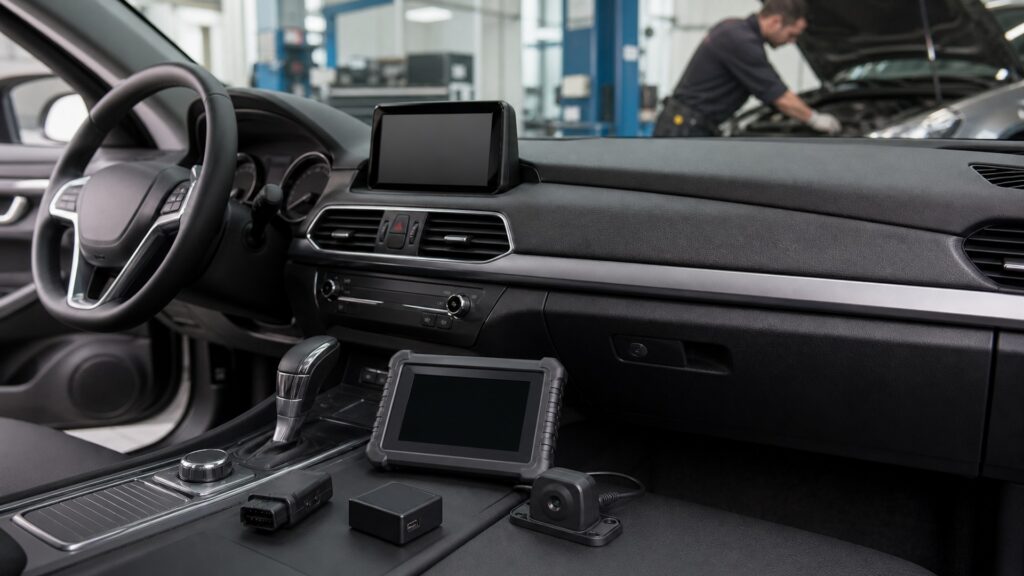
Monitoring becomes valuable only when the chain from sensor to timestamp, transport, rule, notification, interpretation, and response remains intact.
Tip: For every enabled alert, name the person who receives it, the time window that matters, and the physical check or service action that should follow.
These terms describe the monitoring pipeline from a sampled condition to a retained, shareable record.
Time-associated data describing vehicle condition, operation, position, or events.
An onboard module that can combine vehicle data, location, wireless communication, and service logic.
A virtual geographic boundary used to trigger an event when location enters or leaves it.
A notification created when a selected value or condition crosses a configured rule.
The period and conditions under which monitoring records remain stored and accessible.
A vehicle state reported through a network rather than observed directly at the car.
Tip: Inspect the timestamp, unit, source, and connection state before treating a dashboard value as the vehicle's present condition.
Factory modules already calculate many states from voltage, pressure, temperature, switches, and network messages. An aftermarket monitor may read the diagnostic connector, attach directly to a battery, or use its own motion and location sensors, each with different authority and risk.
A polished dashboard cannot make an indirect estimate equivalent to the underlying physical quantity.
A battery reading after rest means something different from one during cranking or charging. Tire pressure changes with temperature. Location can lag. Monitoring becomes explanatory when samples are placed against operating state, environment, and prior history.
Context turns a value into evidence; without it, more samples can merely repeat ambiguity.
A telematics module or paired device transmits selected records to a service, where rules decide whether to notify an app, text destination, or fleet portal. Coverage, sleep behavior, subscriptions, server status, and phone settings can interrupt that path.
The alert is only as timely as the slowest unverified link between vehicle and responder.
Trips, acceleration, biometrics, contacts, and precise location can reveal routines and relationships. FTC actions show that connected-vehicle data practices can affect privacy and financial welfare, so collection and sharing deserve explicit scrutiny.
Monitoring value should be purchased with deliberate consent, minimal collection, and a planned end to access.
A good rule detects a meaningful condition early enough for a named response, while accounting for normal variability and sensor uncertainty. Excessive alerts train users to ignore the channel; vague messages send them toward parts replacement without diagnosis.
Monitoring succeeds when it improves a real response, not when it maximizes the number of notifications.
Monitoring can expose change between inspections while adding uncertainty, account dependence, and sensitive records.
Condition trends can support timely maintenance, while location and event reporting can improve recovery, coordination, or emergency response.
A tested alert chain can shorten the interval between an important vehicle change and a responsible human decision.
Remote data can be delayed, stale, calculated, incomplete, or wrong and therefore cannot replace direct safety inspection or diagnosis.
Collecting more detail does not automatically create value and can increase privacy, security, subscription, battery, and data-retention costs.
These myths confuse data availability with accuracy, diagnosis, ownership, or harmless collection.
The displayed value may be cached from the last successful vehicle wake and upload. Coverage, sleep modes, service outages, subscriptions, and phone notification settings can make a recent-looking interface represent older data.
Repeated low-value warnings can create alarm fatigue and obscure consequential events. Safety improves when a validated condition triggers a clear response soon enough, while normal variation and known sensor limitations are controlled.
Access and use depend on service terms, accounts, consent, vehicle roles, employer policies, and applicable law. Location or driving behavior may involve multiple people, so ownership alone does not settle every privacy question.
Any attached device draws power and connects physically near vehicle networks. Poor design, incompatible communication, insecure software, connector damage, or continuous wake behavior can create battery, reliability, security, or service-access problems.
Tip: Treat every monitoring claim as a complete chain with a source, timestamp, transport path, access policy, and defined response.
These answers address stale data, battery draw, family use, selling a vehicle, and when monitoring should lead to service.
Look for its timestamp, last-contact indicator, vehicle awake state, and refresh result. If the decision affects safety or continued operation, verify at the vehicle with an appropriate physical inspection or instrument.
Yes, if its sleep current, communication retries, or vehicle wake behavior exceeds what the parked system can sustain. Measure current and follow vehicle-specific accessory guidance, especially during storage or on low-capacity batteries.
Yes. Location, trip, audio, video, and behavior data can affect drivers and passengers. Explain what is collected, why, who can view it, how long it remains, and how access can be withdrawn.
Remove paired phones, saved addresses, garage access, apps, user profiles, subscriptions, and invited drivers according to the manuals. Confirm account transfer or deletion rather than assuming a factory reset clears every cloud record.
Seek appropriate service when the alert concerns braking, steering, overheating, charging, battery failure, repeated faults, or another consequential condition you cannot verify safely. Preserve timestamps and trend data for diagnosis.
Vehicle monitoring matters when a trustworthy, time-stamped data path reveals a meaningful change early enough for a defined response.
Choose the minimum data needed, validate freshness and units, test notifications, protect access, and confirm consequential alerts at the vehicle before acting.
These explainers distinguish ongoing observation from standardized diagnostic evidence and the electronics that create both.
See how fast diagnostic streams, sampling, graphing, triggers, and saved events support fault investigation.
Understand how standardized trouble codes, freeze-frame, readiness, and monitor status preserve regulated diagnostic evidence.
Trace the power, sensor, network, module, wireless, and display layers that make remote status possible.
Choose a retailer
Prices checked regularly. We may earn a commission at no cost to you.