
Rated Recovery Point
Vehicle attachment engineered and documented for specified recovery loads and directions.
- Its mounting structure carries the force
- Tow or tie-down loops may serve another purpose
- Angle limits can be as important as capacity
Vehicle recovery equipment matters because traction loss and immobilization are different mechanical problems. Buried tires, a high-centered chassis, a failed wheel, a ditch angle, or a disabled powertrain each requires a different way to reduce resistance or apply force. The wrong tool can multiply load without freeing the vehicle.
A recovery system is not a strap or winch in isolation. Force travels through anchors, points, shackles, rope, hardware, frames, tires, and ground. Every part must be rated, compatible, inspected, and arranged so failure does not launch hardware toward people. Good equipment makes that load path controllable; good judgment knows when the path cannot be made safe and professional recovery is required.
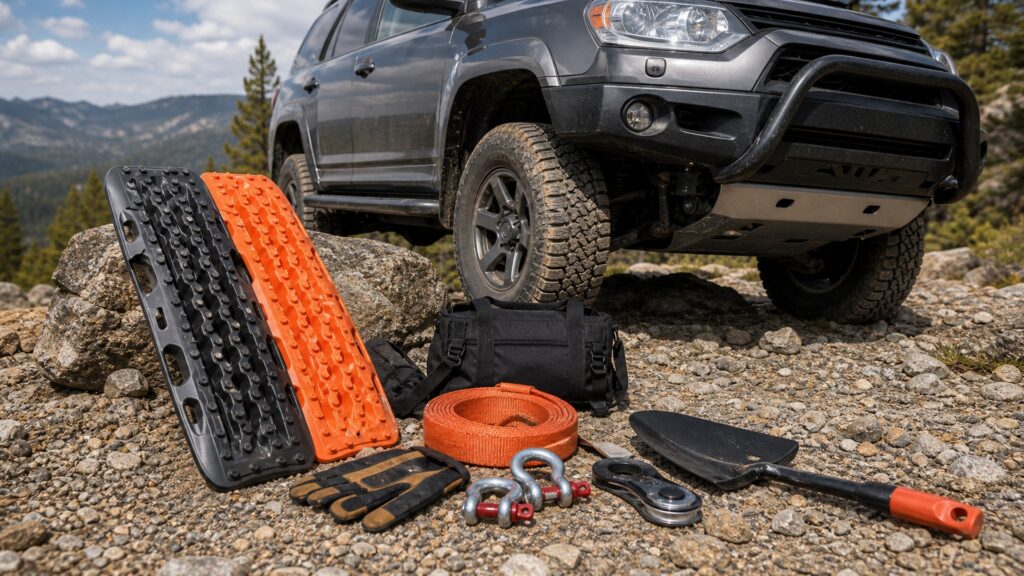
Start at the stuck vehicle and trace resistance, attachment, connectors, rope or strap, power source, anchor, and bystander positions. If any link is unknown, the pull is unknown.
Tip: Lay every component on the ground in load-path order before connecting it. This exposes mismatched ratings, missing connectors, sharp edges, unknown points, and a pull direction that cannot be controlled.
These recovery terms explain why hardware that looks strong can still be unsuitable in a dynamic vehicle pull.
Vehicle attachment engineered and documented for specified recovery loads and directions.
Maximum load a component is authorized to carry in defined service with an applied safety basis.
Lowest force at which a new component is specified to fail under its test conditions.
Force opposing movement from slope, mud suction, embedded tires, obstacles, brakes, or high-centering.
Pull using a purpose-designed elastic strap or rope and controlled vehicle momentum to store and release energy.
Area cleared of people because tensioned lines, hardware, vehicles, or anchors could move during failure.
Tip: Product manuals, vehicle instructions, and qualified training govern exact rigging. Ratings of dissimilar items are not interchangeable, and towing eyes are not automatically recovery points.
Traction boards address tire-ground shear; a shovel removes material; a jack can relieve high-centering; a winch applies controlled static force; kinetic equipment uses stored elastic energy. Selecting by product availability instead of failure mode can increase resistance or instability.
The least dramatic recovery often begins by reducing the load rather than increasing the pull.
A powerful winch cannot upgrade an unrated attachment point, damaged rope, mismatched shackle, weak anchor, or compromised frame. Connector shape, pin diameter, bend radius, edge contact, and pull angle determine how published capacity applies.
Strength is a property of the assembled load path, not the largest number printed on one component.
A winch builds force progressively and allows pauses; a kinetic system converts vehicle momentum into strap stretch and a dynamic pull. Kinetic recovery can overcome resistance but also magnifies consequences when points, drivers, distances, or gear are wrong.
The energy method changes both extraction behavior and the failure zone.
Side pulls can shift a vehicle toward hazards, load a point outside its design direction, pile winch rope on a drum, or overload redirect hardware. Multiple-line rigging may change capacity and anchor loads rather than simply making the pull safer.
A rig that was acceptable at the start can become unacceptable halfway through the recovery.
Tensioned rope and elastic rigging store energy; failed points can add heavy projectiles. Spectators belong outside the recovery envelope, operators need one communication protocol, and vehicles need a stable post-recovery stopping area.
A recovery is not controlled unless a credible component failure leaves people protected.
The equipment converts an uncertain stuck condition into a planned resistance reduction, rated pull, controlled path, and protected failure envelope.
Every point and component has a known purpose, legible rating, compatible geometry, current inspection, and capacity for the specific vehicle and method.
The team can state what is holding the vehicle, how resistance will be reduced, where it will move, who controls the operation, and where nobody may stand.
Unknown attachment structure, rollover potential, live traffic, water, damaged steering or brakes, hazardous cargo, injured occupants, overhead lines, unstable anchors, or inadequate ratings exceed a consumer recovery kit.
Repeated pulls without progress indicate a wrong resistance model; increasing speed or stacking more components can raise stored energy faster than it improves the extraction.
These myths treat recovery force as if more capacity always creates more safety.
Tow balls are designed for trailer coupling loads, not arbitrary recovery shock in exposed directions. Failure can launch heavy hardware toward occupants, so only documented rated recovery points and compatible connections belong in the load path.
An overly stiff or mismatched kinetic strap may not stretch as intended and can transfer sharper loads into points and vehicles. Selection must follow the manufacturer, vehicle mass, method, and complete rigging—not the largest label.
Slope, suction, high-centering, damaged wheels, snatch-block geometry, rope layers, electrical condition, anchor strength, and side load can push actual demand beyond a simple mass comparison. Recovery planning must calculate the specific resistance.
A damper may influence some rope behavior but cannot contain a failed anchor, shackle, hook, point, vehicle, or redirect. People still need an exclusion zone based on every possible line and hardware trajectory.
Tip: The safer system reduces resistance, verifies every link, controls geometry, and limits stored energy before the pull begins.
These answers address ratings, inspection, straps, traction aids, anchors, and the threshold for calling a trained recovery operator.
Use manufacturer-documented ratings applicable to the exact component, load direction, connector, and method. Do not equate working load, breaking strength, winch line pull, or vehicle mass; the complete system needs deliberate margin.
Retire it according to its manual and after cuts, melted or glazed fibers, chemical exposure, damaged stitching, severe abrasion, illegible labels, overloaded use, or unknown history. Cleaning and storage practices also affect serviceability.
They usually introduce less stored line energy because they rebuild the tire-ground interface, but spinning tires can eject boards and unstable digging remains possible. Clear people, control wheel speed, and secure boards only after use.
It must resist the planned load and direction without shifting, uprooting, damaging protected resources, or creating a dangerous angle. Use approved vehicle points or anchor methods and rated tree protection where permitted; never assume appearance equals strength.
Escalate for uncertain points or ratings, rollover, traffic, deep water, injury, hazardous materials, structural damage, failed steering or brakes, complex multi-line rigging, unstable terrain, or any pull beyond the team's training and equipment.
Vehicle recovery equipment matters because it lets trained users reduce resistance and route force through rated, compatible, inspectable components while keeping people outside the failure envelope.
Select equipment by the immobilization mechanism, not by catalog category; verify every link and angle, agree on control signals, and stop when the system cannot be made predictable.
These related explainers distinguish the load-path audit from broader gear selection, recovery planning, and incident-scene control.
Study resistance reduction, recovery force methods, rigging geometry, energy zones, and escalation in the dedicated off-road recovery-equipment treatment.
Build overall recovery readiness around cause assessment, communication, inspection, access, and professional thresholds.
Stabilize traffic, injuries, fire, communications, and occupant exposure before attempting to move a disabled vehicle.
Choose a retailer
Prices checked regularly. We may earn a commission at no cost to you.