
Maintenance Baseline
The recorded known-good configuration, credential set, current draw, zone behavior, response timing, and recovery result used for later comparison.
- Conditions are dated
- Measurements need units
- Changes require explanation
Vehicle security can lose effectiveness gradually. Adhesive releases, a door switch corrodes, a shock sensor shifts, a backup battery ages, or a wireless account remains assigned to a former user. The system may still chirp at arming while one protected zone, notification route, or recovery method has already failed.
Maintenance preserves a reference state across physical hardware, parked electrical behavior, credentials, software, communications, and records. The useful question is not whether the alarm sounds today, but whether every intended boundary and legitimate recovery path still behaves like the accepted installation. Scheduled inspection and controlled event tests reveal drift before a real incident or no-start condition exposes it.
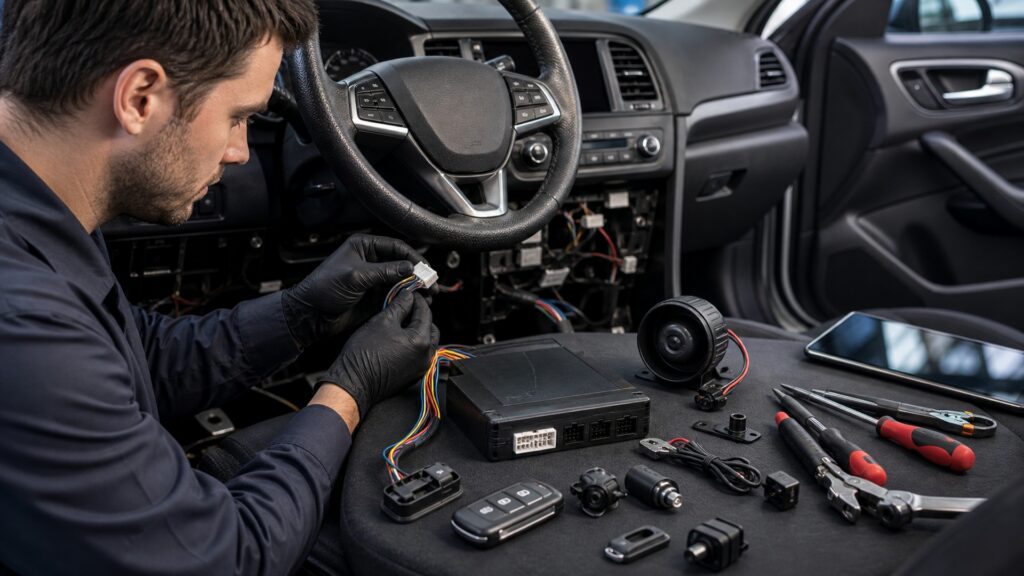
The program covers baseline records, sensors and wiring, parked power, credentials, software, communications, history, and recovery.
Tip: Compare every maintenance result with a named baseline so quiet degradation cannot hide behind a successful arm command.
These definitions organize recurring checks around evidence rather than cosmetic condition.
The recorded known-good configuration, credential set, current draw, zone behavior, response timing, and recovery result used for later comparison.
The authoritative list of keys, fobs, phones, accounts, codes, cards, services, and permissions allowed to control the system.
The retained position, orientation, attachment, sensitivity, and environmental exposure required for a detector to observe its intended event.
Electrical current consumed while the vehicle is parked after expected modules have entered their stable low-power state.
The documented source, version, applicability, authenticity, and installation result for controller or interface software.
A protected account of authorized entry, credential restoration, fault clearing, service exit, and return-to-operation checks.
Tip: Keep dates, versions, users, measurements, and test events together.
Doors cycle, panels flex, connectors vibrate, moisture enters, adhesives age, and cargo contacts hidden equipment. Inspect attachment, abrasion, corrosion, pin condition, fuse protection, and sensor orientation without disturbing safety circuits.
Physical continuity supports every later controller decision.
Test battery reserve, charging performance, stabilized sleep current, repeated wakeups, backup batteries, and low-voltage behavior. Weak cellular coverage or failing modules may lengthen active time and create intermittent no-start complaints.
Maintenance distinguishes normal monitoring load from an electrical fault that grows over time.
Revoke lost fobs, former phones, installer access, expired household users, and sold-vehicle accounts. Protect account recovery, review command history, update contact details, and ensure emergency records remain available to legitimate owners.
An unneeded credential is a maintenance defect even when hardware works perfectly.
Supported updates can fix faults or alter settings; subscriptions can expire; apps lose permission; and wireless coverage varies. Document versions, source, configuration, delivery timing, offline fallback, and post-update recovery.
A cloud feature is maintained only when local protection and remote delivery remain distinguishable.
Create controlled zone events, review timestamps and initiating inputs, confirm each output, export useful history, then exercise service mode, battery interruption, valid credential access, and documented recovery.
Maintenance ends when the vehicle returns to a verified normal condition, not when a warning disappears.
The arm sound may prove one output command while revealing nothing about a failed door zone, moved sensor, revoked account, delayed notification, depleted backup battery, or recovery path.
Current records connect each credential, sensor, output, version, and measurement to a successful controlled test.
Trend comparisons reveal changing sleep current, response delay, nuisance frequency, or communication reliability.
Controlled events cannot reproduce every theft method, radio outage, environmental extreme, or future software failure.
Clean wiring and current software do not guarantee intervention or vehicle recovery after an incident.
These myths allow visible hardware or automatic updates to substitute for recurring proof.
Switches, connectors, mounts, backup cells, batteries, wireless accounts, software, and permissions all age or change. Even solid-state controllers depend on physical inputs, stable voltage, current credentials, and external services that require periodic verification.
The tone may confirm only that a command reached one output. A closure can be bypassed, a sensor can drift, or a fault can remain stored. Test every protected boundary and review zone status.
An update can fail, become unsupported, reset preferences, alter credential behavior, change notification permissions, or require a new app. Record provenance and version, then retest local protection, remote delivery, sleep, and recovery.
The server account, shared credential, digital key, service integration, or vehicle ownership record may remain active after local deletion. Revoke access at the authoritative system and confirm the removed user can no longer issue commands.
Tip: Track the specific layer that changed and retest its dependents.
These answers define intervals, measurements, event tests, software checks, and ownership-transfer controls.
Use manufacturer and vehicle guidance, then add checks after battery service, collision repair, glass or trim work, software updates, credential loss, ownership changes, repeated alarms, long storage, wiring modifications, or unexplained starting and notification problems.
Record date, vehicle state, battery result, stabilized current, every zone and credential tested, response timing, notification delivery, firmware and app versions, permissions, faults, changes made, service mode, and completed authorized recovery.
Compare controlled event thresholds and zone history with the baseline, inspect mounting and environment, reproduce normal vibration, adjust only supported settings, and verify that nuisance events decrease without losing response to the intended condition.
Confirm all credentials, clock and history, armed profiles, zones, siren and lights, immobilizer authorization, notification links, backup supply, low-voltage messages, network sleep, service mode, and a complete authorized recovery sequence.
Remove personal accounts, phones, codes, digital keys, location history, and service access through supported procedures; transfer required ownership records; preserve new-owner instructions; and verify that retained factory security and emergency entry still operate correctly.
Vehicle-security maintenance matters because protection can degrade at sensors, wiring, parked power, credentials, software, communications, records, or recovery. A loud output cannot reveal all of those paths.
Maintain a dated baseline, reconcile access, measure sleep behavior, verify updates, test every zone and response, and practice authorized recovery. The result is a system whose changes are visible before they become incident surprises.
These explainers show what to test and why degraded behavior can affect both protection and legitimate mobility.
Use explicit arm, trigger, response, fault, service, and recovery states as recurring test points.
Review wiring, access, nuisance, battery, data, and incident controls as the system ages.
Trace each observed failure back through credentials, sensing, controller logic, outputs, and recovery.
Choose a retailer
Prices checked regularly. We may earn a commission at no cost to you.