
Glass Pitting
Small impact craters and abrasion marks that scatter light, collect residue, and can reduce contrast across heavily traveled viewing zones.
- Low sun reveals scatter
- Depth varies by impact
- Polishing has strict limits
Windshield maintenance preserves visibility margin by finding small problems while they remain measurable and localized. Approved cleaning removes films that scatter light; chip and crack inspection tracks damage before temperature or body flex extends it; fresh, correctly fitted blades maintain contact without abrading dry glass; washer fluid and aimed nozzles carry contamination away.
Maintenance also covers the surroundings. Cowls and specified drains must pass water, moldings and bond edges should be observed for change, cabin moisture sources affect fogging, and camera or rain-sensor windows need careful cleaning. Records should distinguish normal wear from sudden damage. Maintenance cannot restore a compromised bond, correct unsupported glass, or service inside a high-precision camera; those findings move the vehicle into qualified diagnosis or replacement.
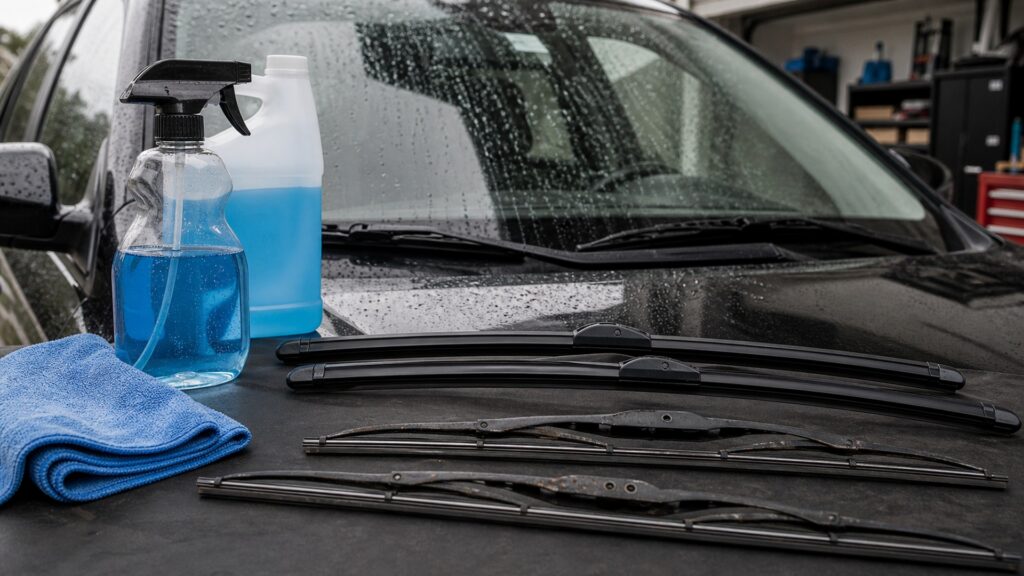
Routine care combines optics, damage tracking, blade contact, fluid delivery, drainage, moisture control, and sensor cleanliness instead of relying on one replacement interval.
Tip: Photograph damage with a ruler and driver-position reference before cleaning or repair; trend evidence helps distinguish stable residue from spreading fracture.
These terms connect routine observations to the mechanisms that consume optical, wiping, fluid, and moisture-control margin.
Small impact craters and abrasion marks that scatter light, collect residue, and can reduce contrast across heavily traveled viewing zones.
The flexible rubber or elastomer lip that reverses direction and meters water as it travels across the glass.
Spring-generated force transmitted through the wiper arm and blade structure to maintain contact across curved glazing.
The placement and spread of washer fluid onto the windshield before or during wiping.
Designed passages carrying water away from the windshield base, air inlet, electronics, and body cavities.
Residue on cabin-side glass from materials, smoke, cleaners, touch, or airborne contamination that increases haze and glare.
Tip: Use the exact vehicle and product guidance for cleaners, coatings, washer fluid, blade service position, drains, and camera zones; aggressive care can create defects.
Use approved cleaner, clean cloths, controlled application, and separate passes on both surfaces. Compare glare before and after; persistent haze may be pitting, delamination, film damage, or interlayer deterioration. Persistent interior film can resemble glass pitting until approved cleaning separates residue from permanent impact scatter.
More abrasive cleaning can turn removable residue into permanent scatter.
Small impacts can grow with temperature change, body flex, moisture, vibration, or edge stress. Early qualified assessment may preserve options, while delayed observation can allow damage into critical or nonrepairable areas. A documented chip inspection makes crack growth visible before the damage crosses a repair or sightline boundary.
A stable-looking chip still needs location-specific evaluation.
Inspect roughness, splits, permanent set, contamination, correct lock, arm angle, and sweep. Never let a bare spring arm strike the pane, and avoid prolonged dry wiping that drags debris across the surface.
Replacing rubber without checking the arm can leave the same missed band.
Maintain climate-appropriate washer fluid, look for leaks, observe nozzle coverage, and avoid running the pump dry. Remove debris only from designated drainage areas without pushing it into hidden passages.
Water management includes delivery onto the glass and removal around the body opening.
Clean the interior, verify outlet airflow and temperature, reduce moisture sources, and keep camera or rain-sensor areas free of residue, stickers, unsupported coatings, ice, and trapped condensation.
Maintenance preserves the sightline but does not substitute for calibration after specified work.
Cleaning, damage tracking, blade contact, washer delivery, drainage, moisture control, and sensor-zone care protect different parts of the forward view.
Date, mileage, weather, glass markings, chip and crack map, photographs, pitting and glare observations, blade and arm condition, sweep, spray pattern, washer fluid, cowl debris, leaks, interior film, and defog timing.
Feature records include rain-sensor behavior, camera obstruction messages, heater operation, prior glass work, calibration documentation, cleaners or coatings used, and before-and-after driver-position observations.
Damage spreads, enters restricted areas, reaches edges, causes meaningful distortion, compromises layers or bonding, leaks persist, arm or linkage geometry is wrong, electrical features fail, or sensor warnings remain after careful cleaning.
Do not polish away certification markings, drill cracks, add perimeter sealant blindly, bend arms by guess, probe heater grids, move camera brackets, open sensor modules, or clear calibration faults without the supported procedure.
Windshield care is often reduced to buying blades after they streak, leaving optical films, chip trends, drainage, washer chemistry, and electronic sightlines unmanaged.
Hardening, chatter, permanent set, nicks, uneven contact, noise, and persistent streaks can reduce visibility before a visible tear appears. Inspect the edge and wet pattern using vehicle guidance and actual operating conditions.
Ammonia, abrasives, solvents, or additives can affect tint films, coatings, optical pads, plastics, displays, cameras, adhesives, or rubber. Use products approved for the installed glass and attached features, applied without flooding electronics.
Location, depth, contamination, layer involvement, edge distance, temperature, and stress determine risk and repairability. Document it and seek qualified assessment early; appearance alone cannot predict whether a crack will propagate.
Moldings may not be the structural or water barrier, and leaks can start at adhesive voids, roof drains, seams, cowls, doors, or HVAC inlets. Controlled tracing should locate the path before products are added.
Tip: Use small, repeatable observations before and after service so maintenance improves the view without hiding damage or disturbing precise hardware.
These answers address cleaning, blade timing, chips, washer fluid, drains, interior fog, sensor zones, and when maintenance becomes repair.
Follow vehicle and blade guidance, climate, exposure, and performance. Inspect before severe weather and whenever streaking, chatter, noise, skipping, or poor contact appears. The wet cleared pattern matters more than calendar age alone.
Qualified repair may be possible depending on size, type, location, contamination, layer involvement, edge distance, driver view, sensor field, and local rules. Maintenance inspection should preserve the damage and obtain a supported assessment.
Use fluid compatible with the vehicle, materials, sensors, and expected temperature. Maintain freeze protection where required, never mix unknown products casually, and avoid plain water or household detergents when manufacturer guidance calls for formulated fluid.
High cabin humidity, wet carpets, leaks, recirculation, weak HVAC airflow, low surface temperature, dirty films, or drainage problems can contribute. Clean the glass, test defog output, and locate the moisture source instead of repeatedly wiping.
Confirm the correct surface and approved method, remove streaks without moving hardware, inspect for condensation or damage, read feature messages, and follow manufacturer diagnostics if availability does not return. Cleaning cannot replace required calibration.
Windshield-component maintenance matters because optical films, minor damage, worn wiping edges, poor spray, blocked drainage, cabin moisture, and dirty sensor zones can consume safe visibility gradually.
Maintain each path with approved methods, document damage and performance trends, and move persistent optical, bond, leak, electrical, or calibration findings into qualified repair. Routine care should reveal defects, not cover them.
Related explainers connect the full windshield mechanism, operating outputs, and safety thresholds that determine whether care, diagnosis, repair, or replacement is appropriate.
Evaluate transmission, distortion, fracture behavior, bond continuity, wiping, spray, condensation, and sensor geometry under representative conditions.
Trace how glass, adhesive, wipers, washers, airflow, and sensors create the usable forward view.
Recognize when glass, spring force, bonding, electrical, visibility, or calibration risk moves the work beyond maintenance.
Choose a retailer
Prices checked regularly. We may earn a commission at no cost to you.