
Task sequence
The task sequence is the order of actions needed to complete an assignment.
- Example: park, retrieve tools, deploy equipment, work, and stow
- Check: the transitions between steps
- Limit: a feature demonstration may omit those transitions
A work truck's operating function is its ability to carry a crew and equipment through the complete job: load, travel, set up, perform the task, pack away, and leave. Useful capacity on paper can be undermined by an inaccessible compartment, a liftgate that blocks the required loading route, or an equipment power supply that does not suit the duty.
Judge the truck as a coordinated working system. The cab, body, storage, controls, power sources, and attachments must serve the same assignment. A realistic demonstration follows the order of work with representative tools and material, because problems often appear between individual functions rather than within a single component.
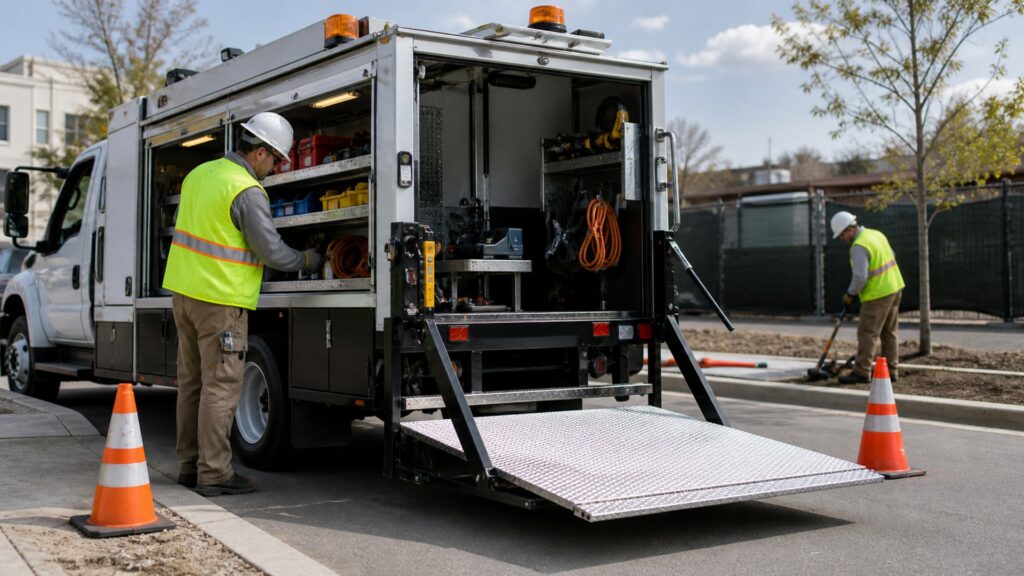
Find out whether transport, access, equipment, and pack-away work together.
Tip: Ask operators to demonstrate the full task instead of viewing each feature separately.
These concepts explain how a collection of equipment becomes a usable working vehicle.
The task sequence is the order of actions needed to complete an assignment.
An access path is the route a person or item uses to reach a working location.
Travel mode is the configuration required for the vehicle to move on the road.
Work mode is the configured state used to perform the stationary task.
Auxiliary power supplies equipment beyond the vehicle's propulsion needs.
An interlock permits or prevents an action according to specified conditions.
Tip: Distinguish what the vehicle can carry from what the crew can actually operate efficiently.
Place crew, tools, consumables, and regular material in the configuration used for a real trip. A body may hold each item individually yet fail when everything is aboard together. Check that required seats remain usable, frequently needed equipment stays accessible, and the finished load respects the truck's limits. Include the supplies that accumulate during a working week, not only the major equipment.
A successful demonstration begins with the truck ready to leave the depot, rather than with half its contents staged conveniently on the floor.
Compartment size is only one part of useful storage. Door orientation, shelf height, reach, and the order of retrieval determine how much handling the crew performs. A tool used at every stop should not require moving a rarely used item first. Test access at a realistic parking position, including the space needed for doors and safe movement around the truck.
The operational gain comes from a layout that supports the work, not simply from adding more drawers or compartments.
After arrival, the truck may need a particular parking position and equipment setup before the task begins. A liftgate needs its working area; other attachments may have their own ground, clearance, or stabilization requirements. Follow the exact manufacturer and site procedures. Evaluate whether the intended location accommodates the complete setup, including people and material moving around it.
A truck can fit through a site entrance yet lack enough usable space to perform its job once parked.
An accessory may need a particular electrical supply, hydraulic arrangement, or other power source. Check required output, operating duration, and simultaneous loads with the equipment supplier and upfitter. Controls should identify the selected function clearly and preserve required interlocks. A plug that physically connects does not establish that the system can sustain the intended work.
Manufacturer body-builder information provides vehicle-specific integration details; the completed arrangement needs confirmation for its actual equipment. GM body-builder integration resources.
Test the return sequence after equipment has been used and material has changed. Tools may be dirty, packaging may remain, and returned parts may need space. Confirm that equipment can be stowed, compartments secured, and the required departure checks completed without improvised storage. The next stop should begin with the same dependable organization as the first.
A body that works only when freshly organized may create avoidable delays and risks by the end of a busy day.
The transitions reveal whether the systems support one another.
How many compartments or attachments are fitted and their stated specifications.
Which controls and power options the completed truck includes.
Whether tools are reachable with the complete load and realistic parking constraints.
Whether setup, equipment use, and pack-away can be completed in the intended order.
More equipment does not automatically produce a more useful vehicle.
Poor placement can add reach, searching, and repeated handling.
Continuous demand, simultaneous use, and operating conditions must also be checked.
Deployed equipment, opened compartments, and people may need much more room.
Tip: Include loading and pack-away in the demonstration, not only the main task.
Answers for evaluating everyday usability.
The intended operators and the people responsible for equipment integration should help test a representative assignment.
Yes. Inadequate power, blocked access, unsuitable controls, or poor setup space can prevent the full task from working.
No. Learn and follow the intended operating sequence; unresolved interference needs assessment by the responsible supplier or installer.
A complete representative assignment from loaded departure through equipment use to secured, road-ready pack-away.
A work truck operates well when loading, access, setup, equipment use, and departure form a practical sequence for the crew.
Evaluate the complete task with the actual body and equipment; isolated specifications cannot show every conflict.
Use these Review Streets paths to compare related categories and practical next decisions.
Match the chassis, body, and equipment.
Review loading, site movement, and equipment hazards.
Keep the chassis and installed equipment ready.
Choose a retailer
Prices checked regularly. We may earn a commission at no cost to you.